
PlatoHagel: Probability Outcome and the I Ching
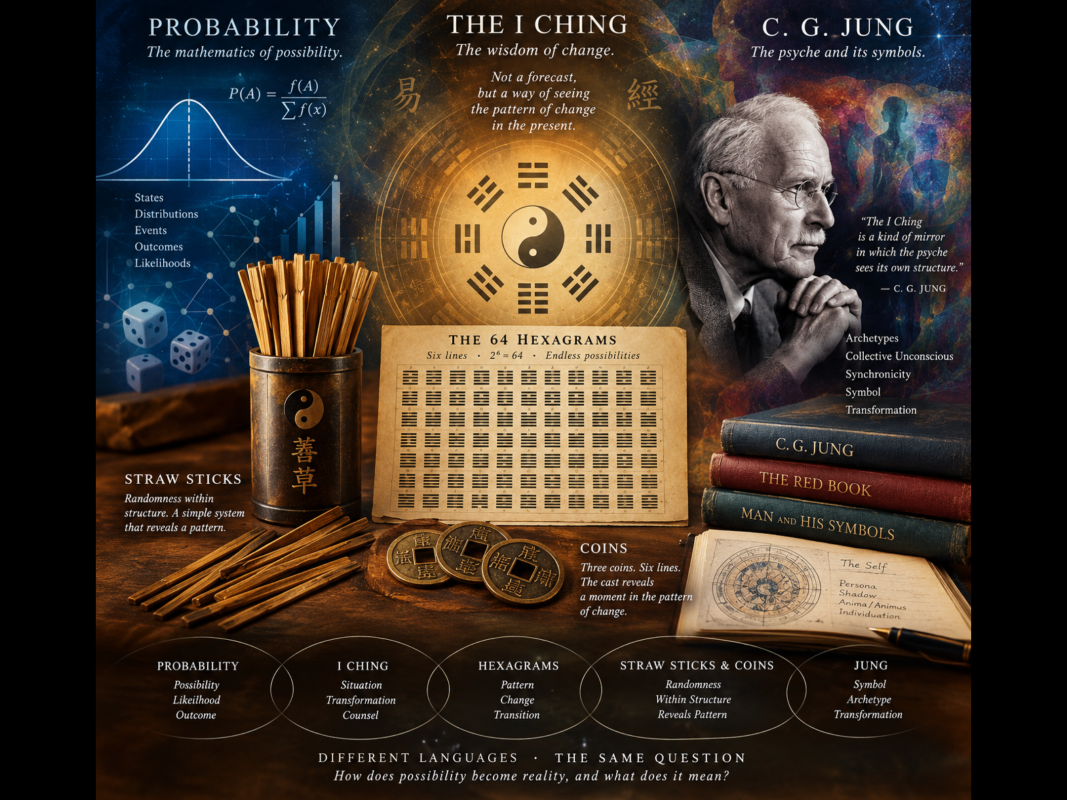
Socrates: If we place probability, outcome, and the I Ching beside one another, an interesting structure appears—not because the I Ching is a mathematical probability engine, but because both are concerned with possibility becoming actuality under conditions.
A useful conceptual bridge
CONDITION → POSSIBILITY → TRANSFORMATION → OUTCOME
In probability, we might say:
State → probability distribution → event → outcome
In the I Ching, the corresponding movement is closer to:
Situation → pattern → changing lines → transformed situation
The important distinction is that probability normally asks:
How likely is this outcome?
Given the configuration of conditions, what pattern of change is emerging, and how should one respond?
The I Ching asks something closer to:
Given the configuration of conditions, what pattern of change is emerging, and how should one respond?
The 64 hexagrams as a state space
The 64 hexagrams can be thought of—not as 64 predetermined futures—but as a finite symbolic space of possible configurations.
Each hexagram consists of six yin/yang lines:
2⁶ = 64
six binary relations → sixty-four configurations
That makes the system surprisingly interesting from a modern structural perspective.
A changing line introduces another transformation:
Hexagram A → changing relation → Hexagram B
So the oracle does not merely give a static “answer.” It gives a state and a possible transition.
Where probability enters
Suppose an initial configuration has several possible developments:
A → B
A → C
A → D
Probability theory assigns weights:
P(B|A), P(C|A), P(D|A)
The I Ching does something different. It provides a symbolic language through which one examines the character of the transition.
Thus:
╔══════════════════════════════════════════════════════╗
PROBABILITY
Possibility → likelihood → outcome
I CHING
Situation → transformation → counsel
GEOMETRY OF MEMORY
Relation → pattern → transformation → remembered form
╚══════════════════════════════════════════════════════╝
And this touches something very close to your Geometry of Memory work.
The interesting question is not whether the I Ching “predicts” the future. The deeper question is:
Can a symbolic system represent a changing space of possibilities well enough that an observer can recognize the structure of a situation before its outcome is determined?
That moves us from prediction toward pattern recognition.
And there is an even deeper connection: the I Ching is fundamentally a system of relations and transformations, while probability theory is a system for describing distributions over possible states.
Put together:
╔══════════════════════════════════════════════════════╗
STATE → RELATION → POSSIBILITY → TRANSFORMATION → OUTCOME → MEMORY
╚══════════════════════════════════════════════════════╝
That may be a very productive doorway into your question of what lies beneath the point: the point may represent an apparent event, while the underlying structure is a field of relations from which multiple outcomes are possible.
See Also: