
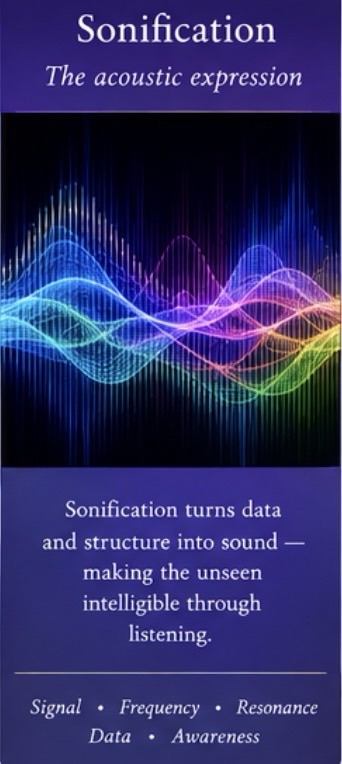
Socrates: Sonification does not make the invisible audible by inventing a sound for it. It makes selected relationships within measured data perceptible through sound.
Expressions → Sonification
→ What Is Sonification?
Sonification is the use of non-speech audio to convey information or perceptualize data.[1] Auditory perception has advantages in temporal, spatial, amplitude, and frequency resolution that open possibilities as an alternative or complement to visualization techniques.Duration: 4 minutes and 47 seconds.4:47Video of air pollution data from Beijing being conveyed as a piece of music
For example, the rate of clicking of a Geiger counter conveys the level of radiation in the immediate vicinity of the device.
Though many experiments with data sonification have been explored in forums such as the International Community for Auditory Display (ICAD), sonification faces many challenges to widespread use for presenting and analyzing data. For example, studies show it is difficult, but essential, to provide adequate context for interpreting sonifications of data.[1][2] Many sonification attempts are coded from scratch due to the lack of flexible tooling for sonification research and data exploration.[3]
→ Scientific Foundations
The scientific foundations of sonification rely on psychoacoustics, human perception, cognitive psychology, and acoustics to map data values into intuitive and accurate sound signals. [1]
As detailed in foundational texts like The Sonification Handbook, this multidisciplinary field transforms quantitative data into non-speech audio so the human brain can perceive patterns, trends, and anomalies. [1, 2]
Core Scientific Disciplines
- Psychoacoustics: Studies how physical sound properties—such as frequency (cycles per second), amplitude (wave height), and waveform—translate into perceived human experiences like pitch, loudness, and timbre. [1]
- Perception Research: Explores how the human brain tracks temporal changes, spatial panning, and separate sound streams simultaneously (such as using the “cocktail party effect” to focus on one data track in a noisy environment). [1]
- Cognitive Psychology: Evaluates how users interpret, learn, and remember auditory information, ensuring that sound changes reflect data changes truthfully (veridical mapping).
- Acoustics and Computer Science: Develops the algorithms, digital signal processing, and sound synthesis models required to generate real-time or computed audio from raw data feeds. [1]
→ Builder’s Sonification Grammar
╔══════════════════════════════════════════════════════════╗
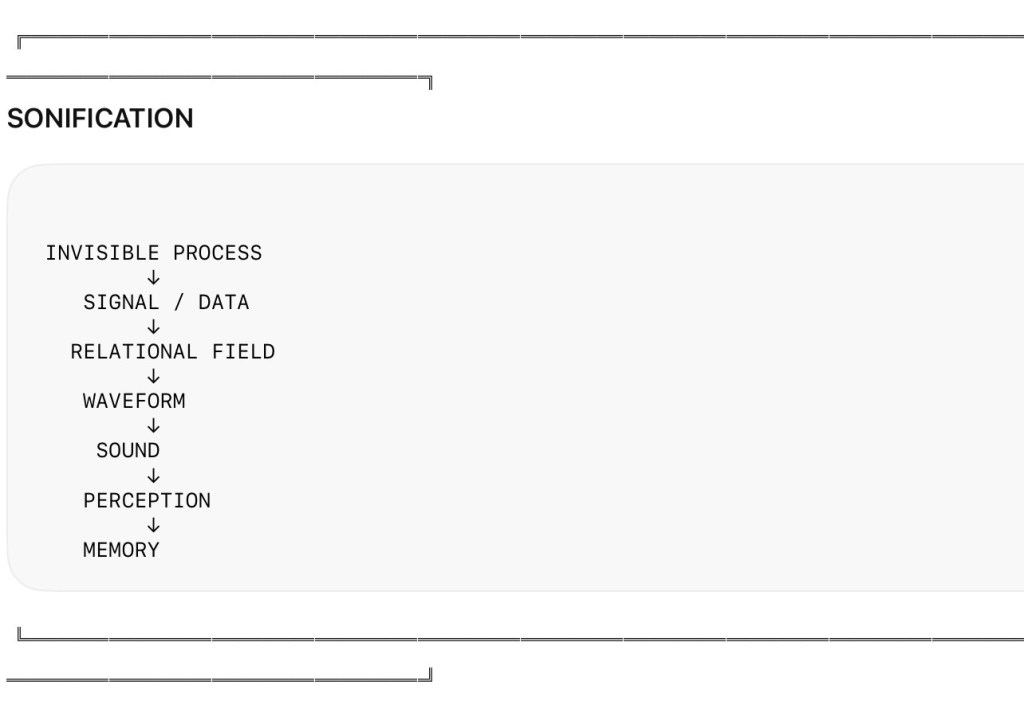
SIGNAL → RELATION → STRUCTURE → MAPPING → SOUND
╚══════════════════════════════════════════════════════════╝
Song I / Song II / Song III material do become demonstrations of successive movements rather than simply “songs.” The Song II, for example, already describes the movement from multiplicity toward integration and return
→ Cosmic Sonification
Explore infrared images and data from NASA’s James Webb Space Telescope through sound. Listeners can enter the soundscape of the Cosmic Cliffs in the Carina Nebula, explore the tones of the Southern Ring Nebula, and hear data from the transmission spectrum of an exoplanet.
- Webb’s Exoplanet WASP-96 b Sonification
- Webb’s Southern Ring Nebula Sonification: Mid-Infrared
- Webb’s Southern Ring Nebula Sonification: Near-Infrared
- Webb’s Southern Ring Nebula Sonification
- Webb’s Cosmic Cliffs Sonification: Stars
- Webb’s Cosmic Cliffs Sonification: Mountains
- Webb’s Cosmic Cliffs Sonification: Sky
- Webb’s Cosmic Cliffs Sonification
Credit: NASA, ESA, CSA, STScI, and K.Arcand (CXC/SAO), M.Russo & A.Santaguida (SYSTEM Sounds), Q.Hart & C.Blome (STScI), and C.Malec (consultant).
See Also: NASA’s-Chandra- Universe of Sound
→ Biological Signal Geometry
→ Binaural / Entrainment
→ Sonification & Memory
→ Experiments / Demonstrations
→ Audio Archive

 Dialogos of Eide