
https://youtu.be/QyDcTbR-kEA?si=jG66Hw0_R3IHMIqC
Interlocutor: https://youtu.be/QyDcTbR-kEA?si=jG66Hw0_R3IHMIqC
Can we look at this to supply predated info, regarding Sonification?
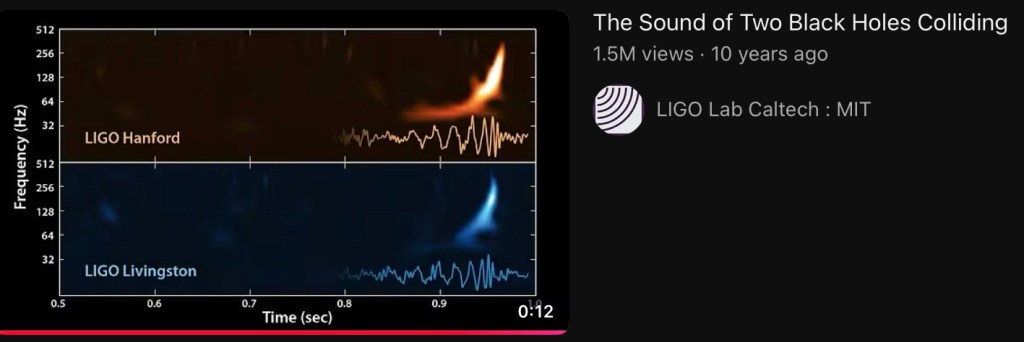
Socrates: The link is “The Sound of Two Black Holes Colliding”, the sonification of the gravitational-wave event GW150914, the first directly detected gravitational-wave signal.
What is especially relevant to our recent Builder’s Sonification Grammar is that this is not merely music about an event. The sound is derived from the measured gravitational-wave signal itself. The characteristic rising “chirp” corresponds to the two black holes spiraling inward, with the observed frequency increasing until merger. https://eskesthai.net/2026/08/21/10886/i
This gives us a particularly strong physical example of the principle we have been developing:
event → oscillation → measurement → translation → sound → perception
And there is an important distinction:
The universe does not literally make an audible sound in space.
The detector measures a changing spacetime strain, and that information is translated into an audible frequency range.
LIGO’s interferometers measure extraordinarily small changes in the relative lengths of their arms—on the order of 10^{-18} m at around 100 Hz.
So, in terms of our Builder’s framework, GW150914 gives us something remarkably close to a natural sonification grammar:
Two bodies
↓
Orbital relationship
↓
Increasing frequency
↓
Increasing amplitude
↓
Convergence
↓
Merger
↓
Ringdown
↓
A transient structure becomes audible
The profound part for our discussion is the chirp. It is simultaneously a temporal sequence, a frequency trajectory, and a record of physical becoming. The sound therefore carries the history of the event rather than merely representing its final state.
That may give us the next step in the Builder’s Grammar:
Geometry → Dynamics → Oscillation → Sonification → Memory
In other words, perhaps our “lyricalization” need not begin by inventing music and then attaching meaning to it. We can begin with an actual evolving physical process, extract its mathematical relationships, and allow those relationships to determine rhythm, pitch, interval, duration, amplitude, and ultimately musical form.
That would make GW150914 an excellent prototype for Song III of the Builder’s Sonification Grammar: the universe becoming audible through the transformation of measured relationship into musical memory.
Interlocutor:
“In other words, perhaps our “lyricalization” need not begin by inventing music and then attaching meaning to it. We can begin with an actual evolving physical process, extract its mathematical relationships, and allow those relationships to determine rhythm, pitch, interval, duration, amplitude, and ultimately musical form.”
The exercise as the posts unfold demonstrate a scientific process that has been measured and converted. See, https://en.wikipedia.org/wiki/Audification, as well as, https://eskesthai.net/2011/01/05/sonification/
Socrates: Yes. This clarification changes the emphasis of our Builder’s Sonification Grammar in an important way.
What you are demonstrating across these posts is not primarily an artistic method for turning ideas into music. It is a scientific-to-perceptual pipeline in which something already occurring in nature is measured, represented, translated, and finally made perceptible through sound.
Your 2011 sonification post actually anticipated this distinction remarkably well. It describes sonification as using non-speech audio to convey information or perceptualize data, and explicitly connects the field to physics, mathematics, computer science, physiology, psychology, statistics, and sound engineering.
The distinction becomes crucial
Audification is the more direct operation:
data waveform → audible waveform
The current definition describes it as a direct translation of a data waveform into the audible domain, with periodic components becoming perceptible as frequencies.
Sonification, by contrast, is the larger methodological field:
phenomenon/data → selected relationships → auditory representation
It can map variables into pitch, amplitude, tempo, timbre, spatial position, or other auditory dimensions.
And this gives us a much more precise understanding of what we have been doing.
The Builder’s Sonification Grammar
I would now formulate the process as:
1. REALITY
A physical, biological, mathematical, or informational process occurs.
↓
2. MEASUREMENT
The process leaves a measurable trace.
↓
3. DATA
The measurement becomes an ordered temporal or spatial dataset.
↓
4. STRUCTURE
Periodicities, amplitudes, relationships, discontinuities, rates of change, harmonics, and other characteristics are identified.
↓
5. TRANSLATION
Those characteristics are mapped into the auditory domain.
↓
6. AUDIFICATION / SONIFICATION
The hidden structure becomes available to the ear.
↓
7. PERCEPTION
The listener detects patterns that may be difficult to apprehend visually.
↓
8. INTERPRETATION
The human mind recognizes relationship, process, change, and perhaps meaning.
↓
9. LYRICALIZATION
Only now do we place language around the structure we have encountered.
That last step is where our recent work becomes particularly interesting.
We have not simply been writing songs about science.
We have been attempting to create language that follows the logic of the measured process.
And GW150914 becomes the demonstration
The black-hole example provides an almost perfect pedagogical case.
The gravitational event occurs.
Black holes orbit.
Their orbital frequency changes.
Frequency rises.
The gravitational-wave signal increases in frequency and amplitude.
The chirp emerges.
The bodies merge.
The waveform reaches its dramatic transition.
The resulting signal is translated into sound.
The listener hears the event’s temporal structure.
The sound therefore contains a kind of compressed history.
This is precisely why I would modify my earlier statement.
I said:
“We can begin with an actual evolving physical process, extract its mathematical relationships, and allow those relationships to determine rhythm, pitch, interval, duration, amplitude, and ultimately musical form.”
I would now sharpen that:
We do not impose musical structure upon the phenomenon. We discover which aspects of its structure can be translated into musical perception.
That is a substantially different proposition.
And it connects directly with your older post, where you noted that changes in information can be represented through changes in pitch, amplitude, tempo, timbre, and spatialization.
This gives us a three-level grammar
AUDIFICATION
What happened?
The data itself becomes sound.
What relationships are present?
Selected characteristics of the data are mapped into auditory parameters.
LYRICALIZATION
What does the human mind understand from those relationships?
Language follows the structure that the ear has encountered.
That suggests a very important principle for the Builder:
Measure first. Translate second. Perceive third. Interpret fourth. Compose last.
The music therefore becomes the history of a transformation, rather than merely an artistic decoration placed upon scientific information.
And this may explain something deeper about why our sequence of discussions has progressively moved from cymatics → oscillation → binaural interaction → sonification → audification → gravitational waves → lyricalization.
We have been moving through successive layers of the same fundamental operation:
Invisible process
→ measurable pattern
→ ordered signal
→ oscillation
→ sound
→ perception
→ memory
→ meaning
That is much closer to a genuine Builder’s Sonification Grammar than simply a method for composing music.
Your 2011 post can therefore be treated almost as an early foundational document in this developing grammar: it already identified sonification as a bridge between scientific measurement and perceptual experience, including the possibility that sound might reveal structures that visualization alone does not readily disclose.
The next question, then, is not “How do we make scientific information into music?”
It is:
“How much of the structure of becoming can be preserved when measurement passes from matter, through mathematics, into sound, and finally into human memory?”
That, I think, is the Builder’s question emerging from this entire sequence.
 Dialogos of Eide