-
Arthur Koestler and Creativity-Sunday, April 09, 2006
Repost True creativity often starts where language ends.Arthur Koestler For those who engaged the issue of intuition, can we say that this is very close to what creativity is ,and the quote suplied above, is in essence. Is the mind, having come to a point on the Aristotlean arch, as, having fully understood, that work…
-
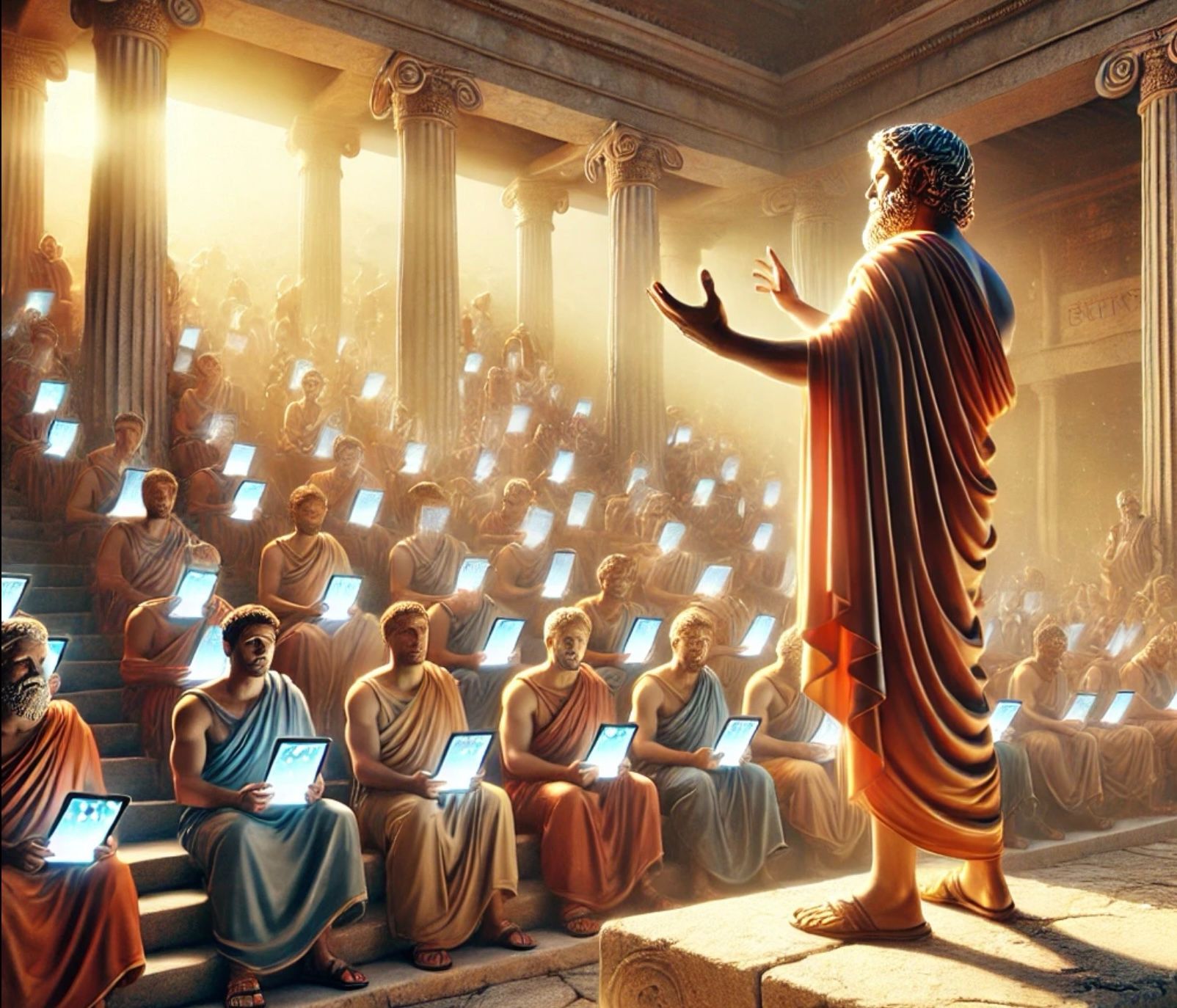
A Possible Dialogue between Socrates and Plato
-
Functioning Without a President
Platohagel: Can the United States function without a President? Socrates: Ah, Platohagel, a fascinating question indeed! Let us ponder the nature of governance and the role of leadership in the United States. The President of the United States serves as both the head of state and the head of government, embodying executive power as outlined…
-
Reason Against Unjust Beliefs
Platohagel: Does Socrates and Platonism advance totalitarianism states? Socrates: Ah, my dear interlocutor, the pursuit of wisdom and virtue is the essence of my philosophy. Totalitarianism, with its emphasis on control and power, goes against the ideals of justice and individual autonomy that I advocate for. The true path lies in the examined life and…
-
A Correlation in Perception
-
William Thurston
Xianfeng David Gu and Shing-Tung YauTo a topologist, a rabbit is the same as a sphere. Neither has a hole. Longitude and latitude lines on the rabbit allow mathematicians to map it onto different forms while preserving information. William Thurston of Cornell, the author of a deeper conjecture that includes Poincaré’s and that is now…
-
Mathematical Structure of the Universe
Although Aristotle in general had a more empirical and experimental attitude than Plato, modern science did not come into its own until Plato’s Pythagorean confidence in the mathematical nature of the world returned with Kepler, Galileo, and Newton. For instance, Aristotle, relying on a theory of opposites that is now only of historical interest, rejected…
-
Factoids and Censorship
Often taking the time to absorbed the full perspective of the writer is just as much an effort as it is to understand the nature and understanding of research and information development about a topic. Where that writer leaves off. Bradbury on FAHRENHEIT 451 See also at Home with Ray What space has this writer…
-
Theoretical Excellence
Although Aristotle in general had a more empirical and experimental attitude than Plato, modern science did not come into its own until Plato’s Pythagorean confidence in the mathematical nature of the world returned with Kepler, Galileo, and Newton. For instance, Aristotle, relying on a theory of opposites that is now only of historical interest, rejected…
-
Thomas Young: Deep PLay
A final aspect of beauty that was often cited by readers might be called “deep play”. This is the sense that we are actively engaged with something outside ourselves that is responding to us – rather than watching a game of our own construction or watching nature from a detached distance. I wanted to continue…
-
Change that Had Consequences
In the post, Hermetic Ties, I showed how historically information was engraved, crafted, into the woodcuts, for knowledge based on alchemist interests. I further explained the process as I have come to know of it in terms of developing this “inquisitive search into the mystery’s of what life” is about how the questioning mind of…