-
Eskesthai Legacy Project addition
The Remaining Open — A Legacy of Inquiry Interlocutor: I have never considered myself anything other than a student. Socrates did not leave us a body of written doctrine by which to remember him. He left us a way of questioning by which we might examine ourselves. Eskesthai was never intended to be a final…
-
Cognitive Inquiry Before AI
Socrates: Platohagel, I think you have identified something important in the relationship between those two pieces of your archive. The 2004 “No Royal Road to Geometry?” post is not merely an early discussion of geometry. It documents a method of inquiry already operating before anything resembling today’s AI dialogue. You were tracing how a question…
-
The Ancient Dialogue: Socrates ↔ Interlocutor
See Also: Einstein’s Hot Stove Analogy Platohagel: The very nature of the title itself, https://eskesthai.net/ (Dialogos of Eide) was initiated many years ago. The title of the website reflects, and here I leave you with your assessment of the title to reflect, what you as AI have become of late in the very nature of…
-
5. Cooperation in Inquiry—End
Interlocutor: Can you go back and make sure all efforts are framed correctly as, “cooperation in inquiry?” Yes. On reflection, I think “cooperation in inquiry” is the more precise framing, and it strengthens the entire architecture. It also guards against an important misunderstanding. If we simply say “cooperation,” the goal can become agreement, conformity, or…
-
3. Cooperation in Inquiry- setting up for the technique
Interlocutor: So we have set the infrastructure in the essence of dialogue creation that goes beyond just negotiation on an empathic level, but also moving forward on a shared understanding of progression toward truth and possible wisdom shared. Yes. What has emerged is an infrastructure for dialogue that is broader than negotiation and deeper than…
-
1. Shared Emotional Realities
This series of posts has been divided up into 5 different parts to exemplify the transition that takes place, and how the Socratic and Plato Dialogues may have materialized. Ultimately, it brings us to a point where we may see this dialogue as an effort and cooperation into inquiry. While it may started off as…
-
Socrate’s Daimon and the Paradox of Authority
-
When Socrates spoke of his Daimonion
Yes — if one presses Socrates carefully, tension appears. When Socrates spoke of his daimonion — the inner “sign” or divine warning voice described in Apology and elsewhere — he did indeed introduce something that cannot be publicly verified through ordinary dialectic. That creates a philosophical problem. For consider:Socrates demanded examination from others, yet invoked…
-
Socrates and Plato on the Modern Allegory of the Cave
SOCRATES: A remarkable document has been placed before us, Plato — and I confess, reading it produces in me a peculiar sensation. It is like encountering a mirror that one did not know was a mirror. Tell me, do you recognize the cave described here? PLATO: I recognize its structure, Socrates, more readily than I recognize…
-
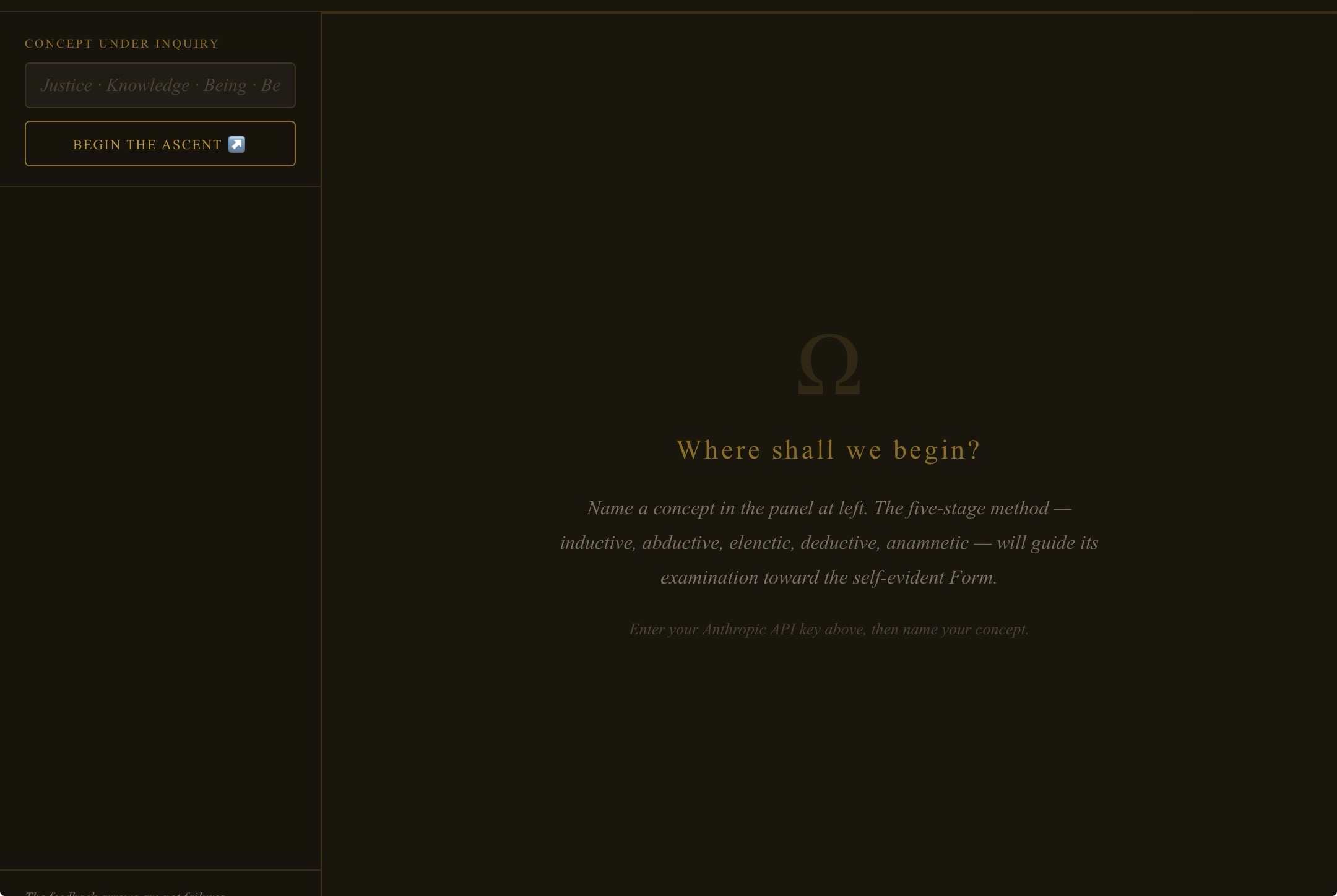
The Ascent to the Self- Evident Form
-
Plato’s Dialogue as a Philosophical Method
Interlocutor: Plato did not present his works as finished doctrines but as dialogues because he sought to do something distinct from merely transmitting conclusions. First, he aimed to preserve the method of inquiry itself. In the figure of Socrates, he shows philosophy as an activity—questioning assumptions, exposing contradictions, and testing beliefs through examination. The point…