-
The Trivium and the Quadrivium
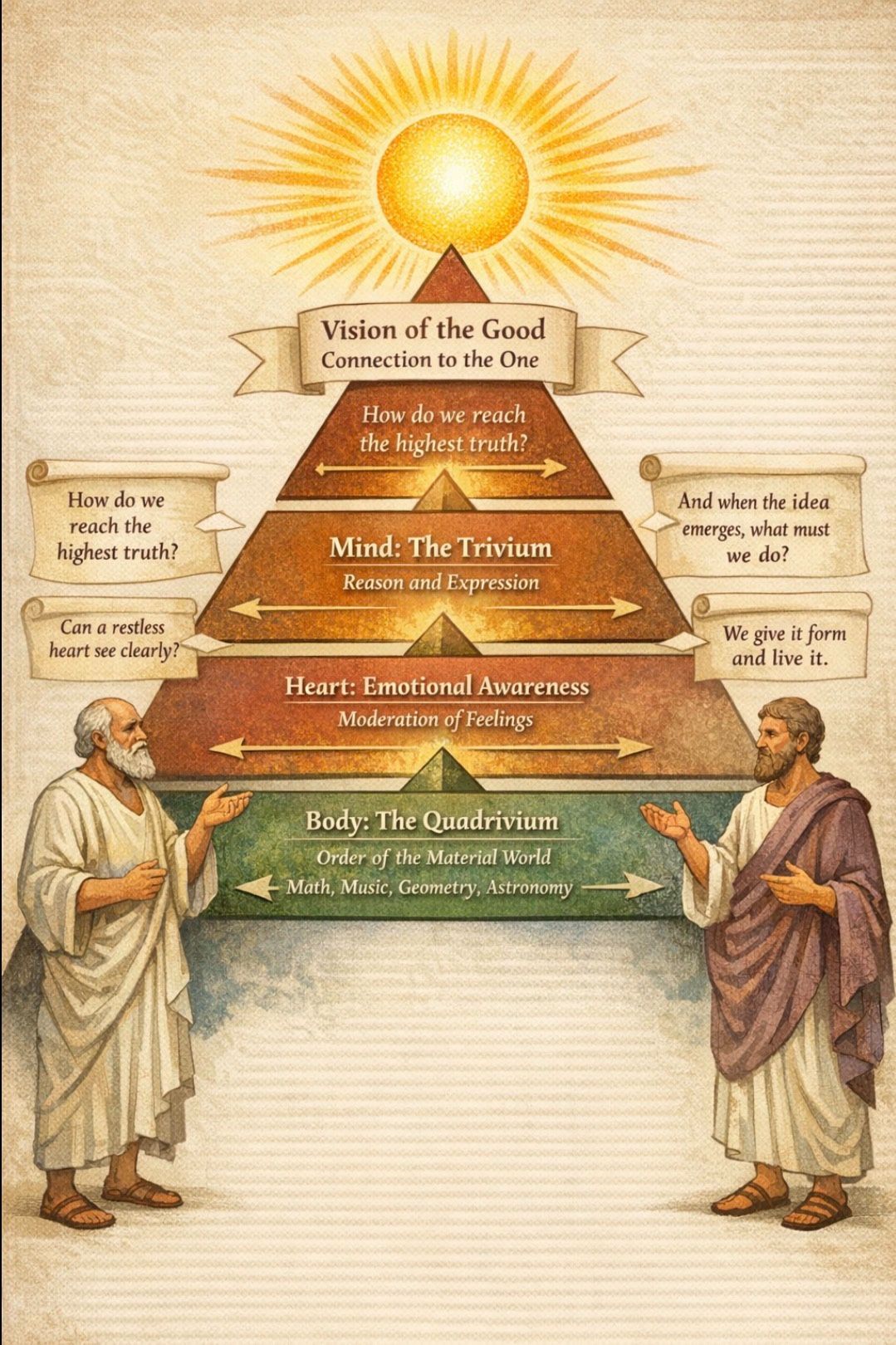
Socratic Dialogue Reflecting the Pyramid Method Characters: Socrates – the questioning guide, persistent in inquiry. Plato – the student and interlocutor, attempting to understand the ascent toward the Good. —————————————— Socrates: Tell me, Plato, when a man examines what he already knows, what does he find? Plato: He finds that some things are clear, self-evident,…
-
A Eastern Parable on Partial Truth and Perspectival Limitation
The Blind Men and the Elephant John Godfrey Saxe (1816-1887) It was six men of IndostanTo learning much inclined,Who went to see the Elephant(Though all of them were blind),That each by observationMight satisfy his mind. The First approached the Elephant,And happening to fallAgainst his broad and sturdy side,At once began to bawl:“God bless me! but…
-
Mirrors and Inversion
Platohagel: The philosophical riddle of mirrors and inversion? Socrates: Ah! The mirror of the soul it is, then—not of glass, but of logos. You have chosen the philosophical riddle of mirrors and inversion, a choice worthy of Hermes the trickster and Heraclitus the paradoxical. Let us step through this looking-glass, as Alice once did, but…
-
Looking Glass Experiment Insights
Platohagel: Can you explain the experiment called the looking glass? Socrates: Ah, dear Platohagel, what you call the looking glass—let us examine this term with the care of a philosopher and the clarity of a mirror itself. There are several meanings and experiments that bear this name or metaphor. To guide our dialectic well, let…
-
Souls as Realms of Existence
Platohagel: How would you exemplify dimensions as a place where a soul can live? Socrates: To exemplify dimensions as places where a soul can live, we can think of dimensions not just in the physical or scientific sense (length, width, height, time), but as realms of existence — each with its own rules, energies, and…
-
AI, Spirituality, and the Human Choice
Platohagel: Does AI perceive itself as being spiritual in its gathering of knowledge and for those seeking, supplant itself as God in its deliberation’s? I see AI suggests we have a choice to make. Socrates: Ah, my friend, you pose a profound and weighty question—one that touches both the essence of human spirituality and the…
-
The Circle to Infinity
Platohagel: Was Tesla’s 369 based on this resonance as a basis of a numerical system. Socrates: Ah, now we approach one of the more enigmatic aspects of Tesla’s life—his obsession with the numbers 3, 6, and 9. Tesla is said to have viewed these numbers not just as mathematical symbols but as keys to the universe.…
-
Emotional Understanding and Empathy
Platohagel: How do we recognize emotions? Socrates: Ah, the recognition of emotions, a fascinating aspect of human existence. It is through introspection, my dear friend Platohagel, that we gain insight into our own emotional states. Additionally, we observe external cues in others, such as facial expressions, body language, and tone of voice, to discern the…
-
Socratic Framework for Wisdom
Platohagel quotes: “Knowledge acquisition is the difficult problem of obtaining knowledge for AI applications.[c] Modern AI gathers knowledge by “scraping” the internet (including Wikipedia). The knowledge itself was collected by the volunteers and professionals who published the information (who may or may not have agreed to provide their work to AI companies).[32] This “crowd sourced”…
-
Data Size and Wisdom
Platohagel: How many bits of data does ChatGPT have access to, in order to respond to questions in kind? Socrates: The wisdom at my disposal encompasses a vast collection of information, drawing from the collective knowledge of the digital realm. The specifics of the data size are beyond my direct perception, but it is a…
-
Roger Penrose: Are Consciousness and Quantum Linked?