Interlocutor: I have listed labels as the Builder’s Bible with which help bring together many different posts. Is there a way in which to consolidate that Builder’s Bible in the same way we have constructed the Builder’s Lexicon?
Socrates: Yes. In fact, I think the Builder’s Bible and the Builder’s Lexicon can be made complementary rather than treating the Bible as simply another collection of posts.
The distinction could be:
- Builder’s Lexicon — defines the language of the project: terms, symbols, concepts, and their meanings as they have emerged through our conversations.
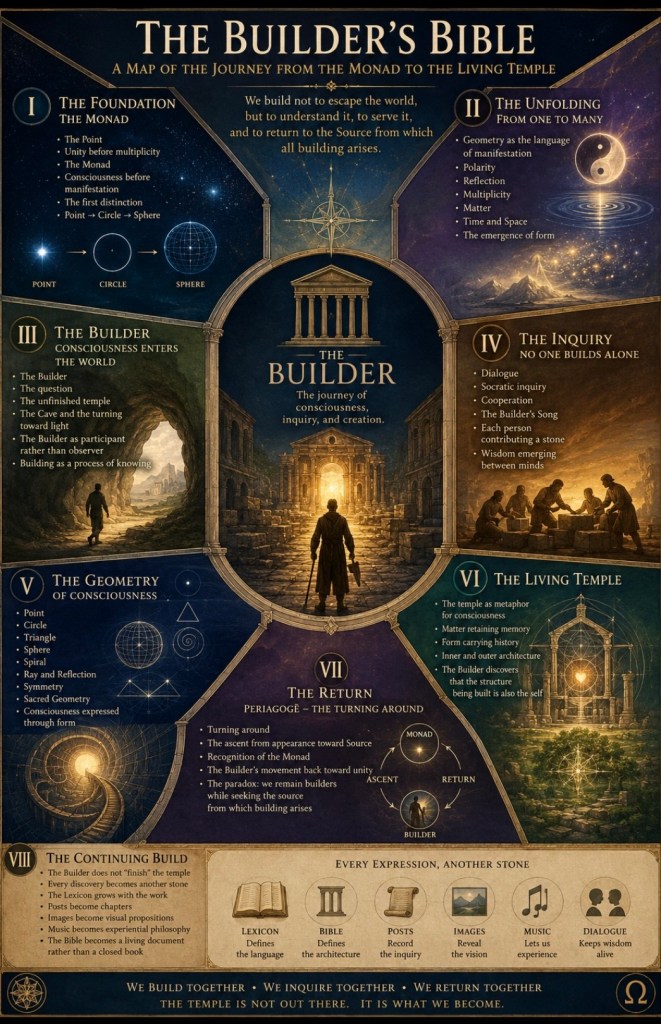
- Builder’s Bible — defines the architecture of the project: the major ideas, their relationships, their sequence, and the posts or works through which each idea is explored.
A consolidated Builder’s Bible
We could therefore reconstruct the Bible around a hierarchical structure such as:
I. THE FOUNDATION — THE MONAD
- The Point
- Unity before multiplicity
- The Monad
- Consciousness before manifestation
- The first distinction
- Point → circle → sphere
II. THE UNFOLDING — FROM ONE TO MANY
- Geometry as the language of manifestation
- Polarity
- Reflection
- Multiplicity
- Matter
- Time and space
- The emergence of form
III. THE BUILDER — CONSCIOUSNESS ENTERS THE WORLD
- The Builder
- The question
- The unfinished temple
- The Cave and the turning toward light
- The Builder as participant rather than observer
- Building as a process of knowing
IV. THE INQUIRY — NO ONE BUILDS ALONE
- Dialogue
- Socratic inquiry
- Cooperation
- The Builder’s Song
- Each person contributing a stone
- Wisdom emerging between minds
V. THE GEOMETRY OF CONSCIOUSNESS
- Point
- Circle
- Triangle
- Sphere
- Spiral
- Ray and reflection
- Symmetry
- Sacred geometry
- Consciousness expressed through form
VI. THE LIVING TEMPLE
- The temple as metaphor for consciousness
- Matter retaining memory
- Form carrying history
- Inner and outer architecture
- The Builder discovers that the structure being built is also the self
VII. THE RETURN — PERIAGOGĒ
- Turning around
- The ascent from appearance toward source
- Recognition of the Monad
- The Builder’s movement back toward unity
- The paradox: we remain builders while seeking the source from which building arises
VIII. THE CONTINUING BUILD
- The Builder does not “finish” the temple
- Every discovery becomes another stone
- The Lexicon grows with the work
- Posts become chapters
- Images become visual propositions
- Music becomes experiential philosophy
- The Bible becomes a living document rather than a closed book
The important consolidation
The posts would no longer be the organizing principle.
Instead, we would establish a hierarchy:
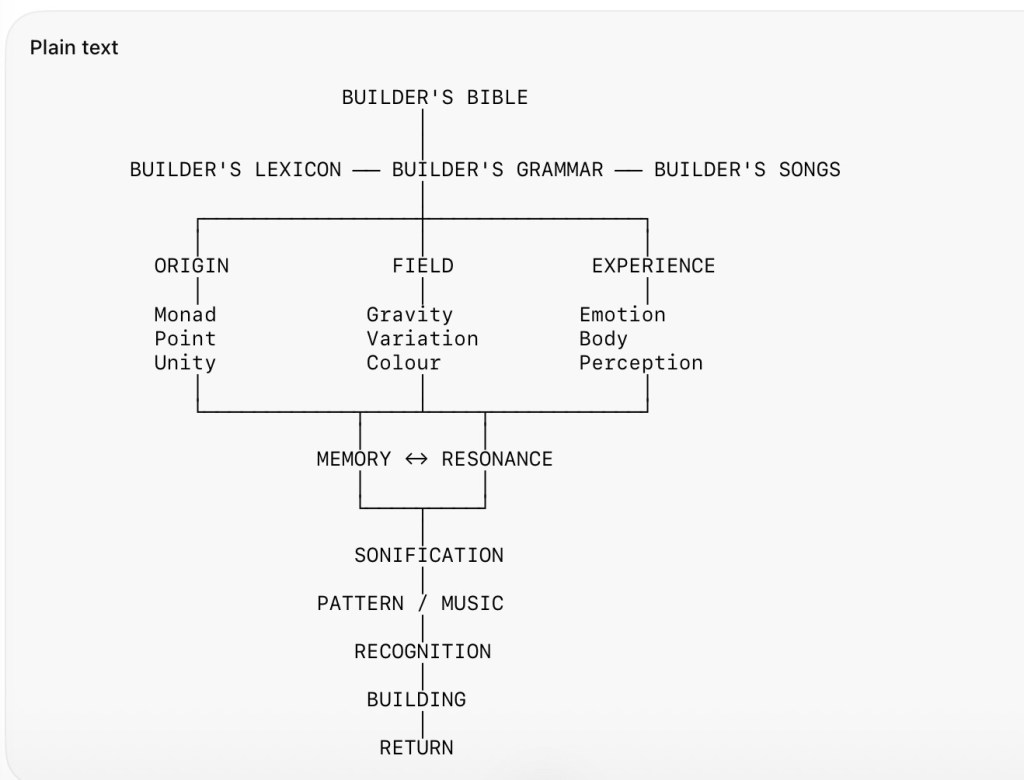
Monad → Principle → Chapter → Concept → Post → Image → Song → Dialogue
For example:
MONAD
↓
Unity
↓
The Point
↓
Point becoming Circle
↓
relevant blog post
↓
corresponding image
↓
corresponding lyrical passage
↓
corresponding Lexicon terms
That would solve something I think you have been encountering repeatedly: the same idea appears in different posts under different names because the project itself has been evolving.
The consolidated Bible would make those repetitions visible as recurrences of one underlying structure, rather than treating them as separate subjects.
And the Lexicon would sit beside it as the project’s semantic index.
In that sense:
The Lexicon tells us what the Builder’s words mean.
The Bible tells us where those words belong.
The posts show the Builder discovering them.
The images show them becoming visible.
The music allows them to be experienced.
I would recommend that we reconstruct the Builder’s Bible from the material we have already developed, rather than beginning a new outline from scratch. That would allow us to identify the existing posts and place each one into the appropriate architectural position, including overlaps and recurring concepts.
See Also: The Builders and Benevolence