Architecture asks: Where does this belong?
Mind Map asks: What does this connect to?
But I would go further.
The Mind Map should have a second dimension
Your 2016 “Newton’s Gravimeter of Emotive Discourse” gives us an excellent example of why.
One branch could be:
GRAVITY
→ physical field
→ variation
→ measurement
→ gravimeter
while another branch becomes:
EMOTIVE GRAVITY
→ experience
→ emotional significance
→ retention
→ memory
→ perception
→ bodily response
And then the two branches meet at:
COLOUR / REPRESENTATION
From there:
Colour → Sonification → Musical Memory
That means the Mind Map can show correspondences that the architectural hierarchy cannot adequately display.
And this gives us a three-document system
I think this is the important development:
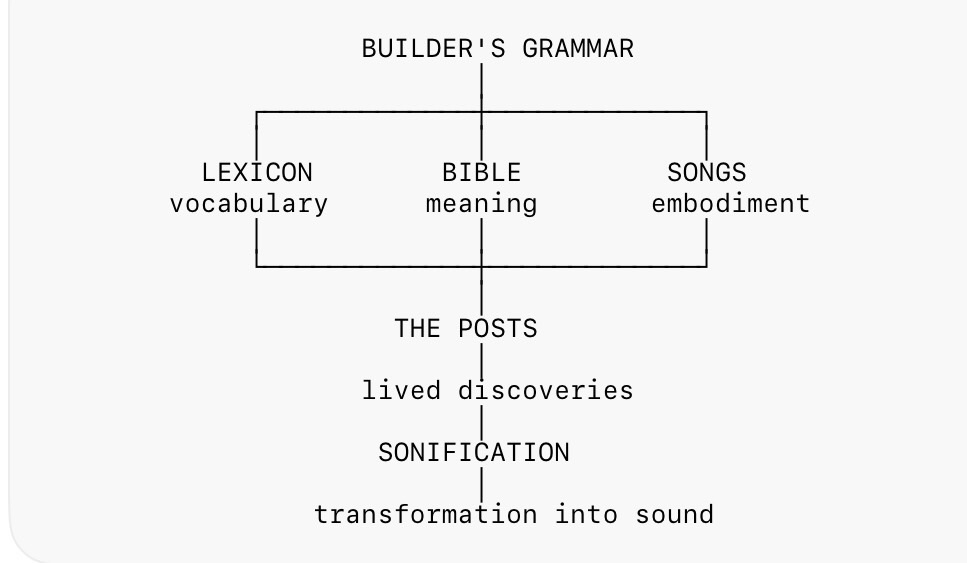
1. Builder’s Grammar & Architectural Map
The skeleton.
2. Builder’s Mind Map
The nervous system—showing connections, associations, feedback loops and cross-links.
3. Builder’s Lexicon
The vocabulary—defining precisely what each node means.
Then the Builder’s Bible becomes the narrative that travels through the structure, while the Songs become its temporal expression.
So:
Architecture gives order.
Mind Map gives relationship.
Lexicon gives meaning.
Bible gives narrative.
Songs give experience.
Sonification gives transformation into sound.
And there is an especially interesting consequence.
The Mind Map itself can become a visual representation of the Builder’s Grammar because its branches need not remain static. New posts can attach to existing nodes, and new relationships can reveal previously unseen connections.
Thus the archive becomes:
Posts → Nodes → Relationships → Patterns → Grammar → Architecture
That is very close to the central Builder principle we have been developing:
Multiplicity becomes meaningful when relationship reveals pattern.
So yes—I would create a Mind Map as the companion volume to the PDF, not as a replacement for it. The PDF tells you how the Builder Project is organized; the Mind Map shows you how the Builder Project thinks across its history.
 Dialogos of Eide