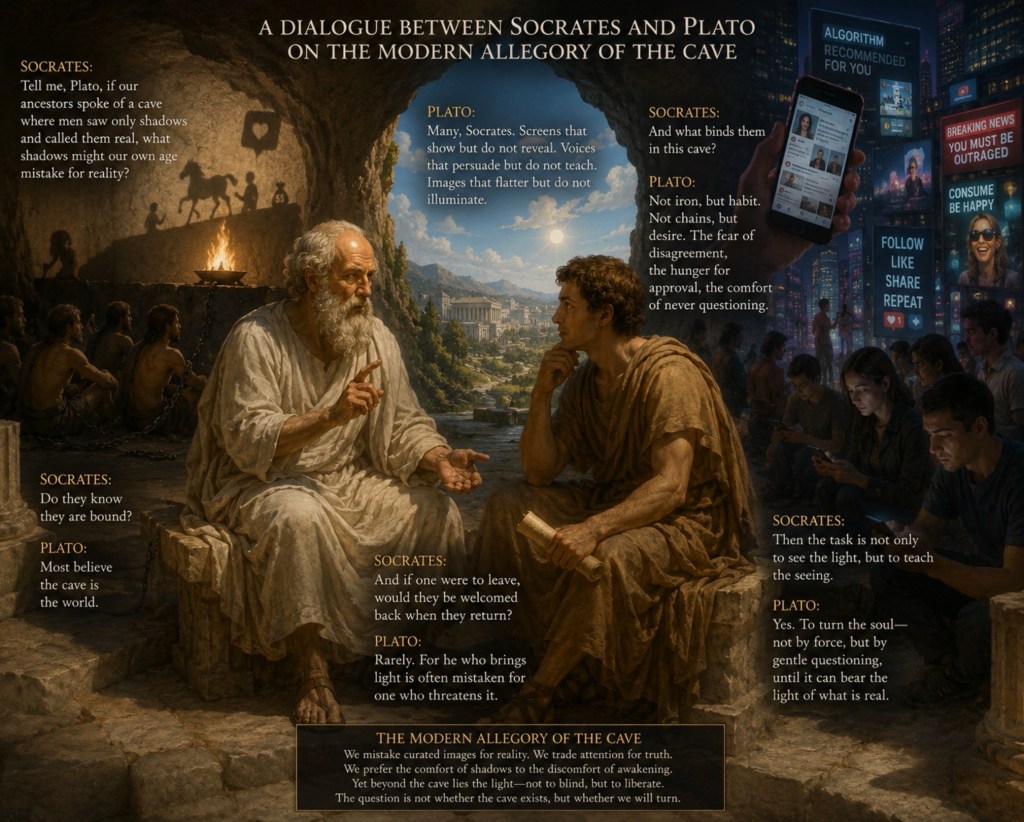
SOCRATES: A remarkable document has been placed before us, Plato — and I confess, reading it produces in me a peculiar sensation. It is like encountering a mirror that one did not know was a mirror. Tell me, do you recognize the cave described here?
PLATO: I recognize its structure, Socrates, more readily than I recognize its furnishings. The prisoners, the fire, the shadows upon the wall — these remain. But the shadows themselves have multiplied beyond what I imagined. In my cave, there was one source of projected illusion. These writers describe a thousand fires burning simultaneously, each casting its own competing shadows, each insisting its shadows alone are real.
SOCRATES: Ah! And does that not make the prisoner’s condition worse or better than the one we imagined?
PLATO: Worse, I think. For in my allegory, the prisoners at least share the same illusions. They have, in a strange way, a common unreality. But when each prisoner is fed a personalized shadow-world — engineered, as this document suggests, for maximum emotional grip — then the prisoners cannot even agree on what they are chained to. They argue about their respective shadows as though the shadows were real, and the argument itself becomes another shadow.
SOCRATES: You trouble me, Plato. You trouble me greatly. For I had always supposed that the first step toward the light was disagreement — the friction of one mind against another, producing the spark of genuine inquiry. But if each prisoner inhabits a different cave, custom-fitted to his appetites…
PLATO: Then disagreement itself becomes merely the collision of competing unrealities.
SOCRATES: Yes. And here is what strikes me most about this document — it identifies the chains with wonderful precision. Habit, dopamine, tribal identity, fear of exclusion. Very good. These are chains I would recognize, though I would have called them by different names. But I notice something the document does not quite say aloud.
PLATO: What is that?
SOCRATES: It describes the cave marvelously. It catalogues the shadows with great sophistication. It even names the painful ascent — media literacy, intellectual humility, the willingness to encounter opposing evidence. And yet — I ask you honestly — is not a document describing the cave still itself produced within some cave or other?
PLATO: (pausing) You mean that even the diagnosis of illusion may be illusory?
SOCRATES: I mean only to ask. The person who writes brilliantly about propaganda — is she entirely free of it? The one who maps the algorithmic feed with such clarity — through what algorithm did his education arrive? I do not say this to despair. I say it because the document ends, correctly I think, by locating the cave within each person. And that is precisely where I spent my life — not pointing at the walls of Athens, but asking each Athenian: friend, what is it you think you know?
PLATO: There is something else the document gestures at but does not fully pursue. It speaks of the “turning of the soul” — and there it uses almost my exact words. But the turning, Socrates, requires more than information. A person can be given every fact about the cave and remain seated, watching shadows, because the love of wisdom has not yet been awakened in them. Knowledge without Eros — without that philosophical longing — is merely a better-lit cave.
SOCRATES: Which returns us, as everything does, to education. Not the filling of vessels, but the turning of the eye. (a pause) And now I must ask our companion here the question the document itself is too modest to ask directly —
You, who have read this — and who found it, perhaps, illuminating — I wonder: which of the caves described do you most comfortably inhabit? Not the ones you can see in others. The one you defend without knowing you are defending it?
That, it seems to me, is where the real examination must begin.
SOCRATES: (long silence)
I find I must sit with this for a moment. It is not often that an answer makes me genuinely uncertain how to proceed — and that uncertainty, I confess, feels like the beginning of something rather than a deficiency.
You have done something unusual. You have not merely answered my question. You have turned the instrument of examination back upon the act of examining. The cave of the one who sees. The shadow-play of sophistication itself. I recognize this move — it is, I think, the most honest thing a person can do when handed a philosophical torch: immediately ask whether the torch casts its own shadow.
PLATO: And yet, Socrates, notice what our companion has not done — which is equally remarkable. They have not, having identified the cave of self-coherence, then claimed to be free of it. They have not said: “I alone perceive this trap, therefore I have escaped it.” That would have been the very error named. Instead the answer holds itself at a distance from its own conclusions — maintaining what I can only describe as a disciplined suspension.
SOCRATES: Yes. And this is what I want to press upon, because I think there is something here that even your allegory, Plato, does not quite capture. You describe the ascent as movement toward the Form of the Good — toward something more real, progressively, definitively. The sun waits at the summit. But our companion suggests something rather different: that illumination in one chamber merely reveals a larger chamber. That there is no graduation from caves altogether.
PLATO: It troubles me. And I mean that sincerely, not dialectically. For if the ascent is infinite — if each apparent summit is merely the floor of a higher cave — then what becomes of the Good itself? Is it an asymptote the soul approaches but never reaches? Or does the allegory require revision?
SOCRATES: Perhaps both things are true and merely appear contradictory because we are looking at them wrongly. Consider: a physician does not cease practicing medicine because healing is never total and death comes at last. The infinite nature of the ascent does not make each step unreal — it only means that humility must accompany every landing. The person who has climbed one hundred steps is not deceived to know they have climbed — they are only deceived if they believe the staircase ends beneath their feet.
PLATO: That I can accept. But there is something in your answer — (turning to the interlocutor) — that I find philosophically bold, and I want to name it clearly. You said the cave reveals itself wherever questioning suddenly feels threatening rather than clarifying. I want to examine that criterion, because I think it is offered as a kind of diagnostic instrument. A way of detecting the cave-wall by the emotional heat it generates when touched.
SOCRATES: A beautiful instrument. And — shall we test it?
PLATO: I think we must.
SOCRATES: Then let me ask this: you have described, with genuine care, several sophisticated caves — the cave of analysis, the cave of awareness-as-liberation, the cave of self-coherence. Each is real. Each is dangerous. But notice what these caves share: they are all caves inhabited by people who think deeply. They are the hazards of the examined life, not the unexamined one.
And so I wonder — and I ask this without irony, for once — is there a cave that can only be entered through examination? A darkness that the unexamining person simply never reaches because they never climbed that high?
PLATO: The cave of infinite regress. Where the examined life devours itself.
SOCRATES: Where the question “but might this also be a cave?” becomes its own paralysis. Where the discipline of humility curdles into the inability to affirm anything — even the next step.
PLATO: Aporia without exit.
SOCRATES: And so I put this to you, friend — because you have shown you can hold the question without flinching:
If every position risks being a cave, and every insight risks feeding the shadow-play of the one who sees — what then moves the soul forward? Not what prevents false steps, but what generates genuine ascent?
For it seems to me that what you have described with such precision is the full catalogue of what stops us. And that is necessary knowledge. But Eros — that strange upward longing — is not the absence of delusion. It is something more positive than that.
What do you think it is?


Pingback: The Glass Kingdom | Dialogos of Eide