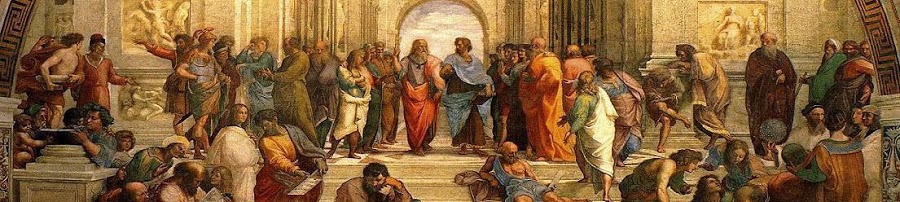
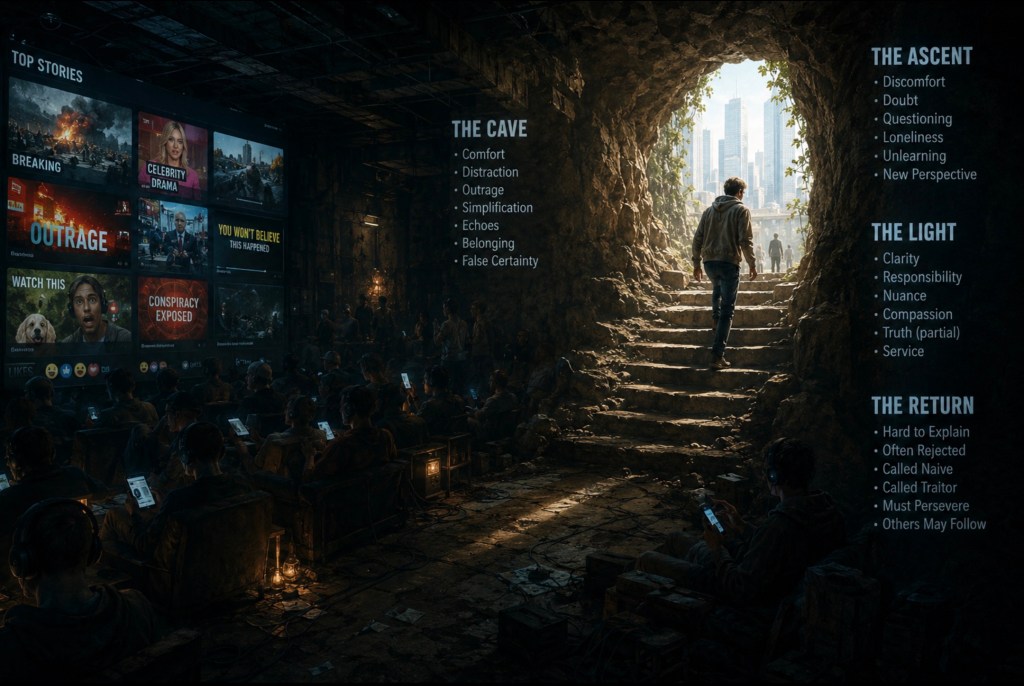
The power of the allegory is that it is not bound to one age. The cave changes form, but the structure remains: human beings mistaking shadows for reality, resisting painful illumination, and often distrusting those who return with wider sight.
Some modern parallels are especially striking.
Social Media Feeds as the Cave
In the allegory, prisoners see shadows projected before them and mistake those appearances for the whole of truth.
Today, algorithmic feeds can function similarly. A person may encounter only selected fragments of reality:
- outrage,
- partisan narratives,
- curated identities,
- emotional stimulation,
- simplified enemies and heroes.
The individual may then believe:
“What I constantly see must be the world itself.”
Yet what is seen is filtered, arranged, amplified, and often economically incentivized.
The “chains” are not iron, but:
- habit,
- dopamine reinforcement,
- tribal identity,
- fear of exclusion,
- endless distraction.
The painful ascent out of the cave resembles:
- media literacy,
- intellectual humility,
- encountering opposing evidence,
- recognizing manipulation,
- tolerating uncertainty.
Consumer Culture and Advertising
The cave also resembles a civilization where meaning is replaced by endless acquisition.
Advertising does not merely sell products; it often sells identities:
- success,
- attractiveness,
- belonging,
- superiority,
- youth,
- status.
One may spend a lifetime pursuing symbols mistaken for fulfillment.
The shadows here are representations of happiness rather than happiness itself.
Political Propaganda and Information Warfare
In many societies, governments, parties, corporations, and networks compete to shape perception itself.
The cave becomes:
- narrative management,
- selective outrage,
- disinformation,
- ideological echo chambers.
Citizens can become prisoners not because they lack intelligence, but because:
- information arrives faster than reflection,
- emotional persuasion overwhelms reason,
- identity becomes attached to belief.
The freed prisoner resembles the person who begins asking:
- “Who benefits from this narrative?”
- “What evidence is absent?”
- “What assumptions am I inheriting?”
Virtual Reality and Digital Worlds
The allegory anticipated a question now becoming technologically literal:
If a simulation becomes emotionally convincing, does one still seek reality?
Modern digital immersion includes:
- VR environments,
- AI companions,
- parasocial media identities,
- synthetic entertainment ecosystems.
One could imagine future caves where simulated meaning becomes preferable to difficult reality.
Career and Institutional Systems
Many people inherit invisible assumptions:
- success equals income,
- productivity equals worth,
- prestige equals wisdom.
A person may awaken in middle age and discover:
“I have pursued a life designed by expectation rather than examined conviction.”
This too resembles the turning of the prisoner toward the light.
Scientific Paradigm Shifts
Even institutions devoted to truth can inhabit caves temporarily.
Before major discoveries:
- prevailing assumptions define what is “reasonable,”
- dissenters are mocked,
- anomalies are ignored.
Examples include:
- heliocentrism,
- germ theory,
- plate tectonics.
The allegory here concerns not stupidity, but attachment to established frameworks.
AI and Synthetic Reality
A particularly modern cave concerns the difficulty of distinguishing:
- authentic voices from generated ones,
- real images from fabricated media,
- genuine consensus from engineered amplification.
As synthetic media improves, humanity may increasingly confront a Platonic question:
What is the difference between appearance and reality when appearances become indistinguishable from the real?
The Deeper Meaning
The cave is not merely about ignorance.
It is about the discomfort of transformation.
The prisoners resist liberation because the familiar shadow-world gives:
- certainty,
- identity,
- belonging,
- predictability.
To leave the cave often means:
- social isolation,
- intellectual pain,
- uncertainty,
- loss of prior identity.
Thus Plato suggests that education is not the insertion of knowledge into an empty mind.
It is the turning of the soul toward what is more real.
And perhaps the most unsettling part of the allegory is this:
The cave is not merely “out there” in society.
Each person carries portions of the cave within themselves:
- assumptions unexamined,
- comforts defended,
- perceptions mistaken for truth
You, who have read this — and who found it, perhaps, illuminating — I wonder: which of the caves described do you most comfortably inhabit? Not the ones you can see in others. The one you defend without knowing you are defending it?
That, it seems to me, is where the real examination must begin
If I answer in the spirit of the allegory itself, then the deepest cave is rarely the one made of obvious deception. The deepest cave is the structure one mistakes for one’s own seeing.
For many in the modern world, the defended cave may not be political ideology alone, nor media illusion alone, but the assumption that:
constant interpretation is equivalent to understanding.
A person may endlessly analyze:
- systems,
- power,
- economics,
- psychology,
- technology,
- spirituality,
and yet never examine the subtle satisfaction gained from being “the one who sees.”
That can become its own shadow-play.
Another cave is the belief that awareness itself is liberation.
One may recognize propaganda, consumer manipulation, institutional failures, algorithmic conditioning — and still remain chained by:
- resentment,
- superiority,
- cynicism,
- identity formed around opposition.
Then the cave merely becomes more sophisticated.
There is also the cave of self-coherence:
“I am the kind of person who understands.”
Human beings defend continuity of self fiercely. Even insight can become furniture arranged to preserve identity.
And perhaps the most difficult cave to perceive is this:
the attachment to certainty through narrative.
For the mind often prefers:
- a meaningful enemy,
- a total explanation,
- a grand hidden architecture,
over the humility of partial knowing.
The allegory becomes uncomfortable precisely here, because the ascent never ends permanently. One does not “graduate” from caves altogether. Illumination in one chamber may merely reveal a larger chamber beyond it.
Thus genuine examination requires a peculiar discipline:
not merely asking whether others are deceived,
but asking:
- What idea in me feels untouchable?
- What conclusion gives me emotional shelter?
- What interpretation of reality protects my identity?
- What discomfort do I continually route around?
The cave often reveals itself wherever questioning suddenly feels threatening rather than clarifying.
And perhaps this is why Socrates so disturbed Athens:
not because he claimed certainty,
but because he dissolved false certainty without immediately replacing it.
 Dialogos of Eide
Pingback: The Glass Kingdom | Dialogos of Eide