
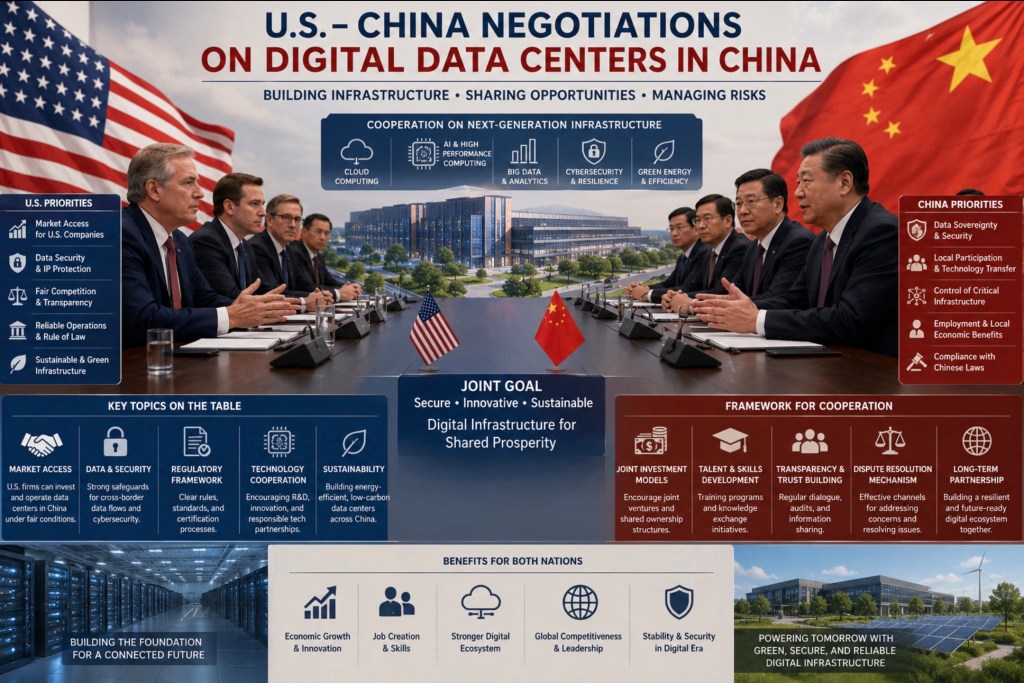
How would Digital Data Centers come into play with these negotiations?
The matter becomes clearer if we ask:
What is a financial system in the digital age made of?
No longer merely banks and paper ledgers.
It is now increasingly composed of:
- cloud infrastructure
- AI computation
- payment networks
- data storage
- cybersecurity systems
- digital identity verification
- real-time transaction processing
And all these require immense computational infrastructure: the modern data center.
Thus, when nations negotiate “financial access,” they are often also negotiating:
- access to data flows,
- access to computational infrastructure,
- and influence over the architecture through which money itself moves.
One may think of data centers as the new ports and canals of the digital economy.
Why Data Centers Matter in Financial Negotiations
1. Stablecoins Require Massive Infrastructure
Stablecoins such as USDC process:
- blockchain validation,
- reserve accounting,
- compliance monitoring,
- fraud detection,
- AI-driven transaction analysis.
This demands hyperscale infrastructure operated by firms such as:
- Amazon Web Services
- Microsoft
- Oracle
So if American financial firms enter China more deeply, a major question emerges:
Will Chinese financial data rely on American cloud infrastructure?
China has historically resisted this dependence.
2. Financial Sovereignty Is Now Data Sovereignty
China treats financial data as a national-security matter.
Why?
Because transaction data reveals:
- capital movement,
- industrial strategy,
- consumer behavior,
- political risk,
- corporate relationships.
Thus China often requires:
- local data storage,
- Chinese joint ventures,
- government oversight of cloud systems,
- restrictions on cross-border data export.
So negotiations are not merely:
“Can U.S. banks operate in China?”
But also:
“Where will the data reside?”
“Who can inspect it?”
“Which nation controls the servers?”
3. AI Finance Requires Data Centers
Modern finance increasingly depends upon AI systems for:
- algorithmic trading,
- anti-money laundering,
- credit scoring,
- surveillance,
- risk modeling.
AI requires:
- GPUs,
- semiconductor supply chains,
- enormous electrical power,
- cooling infrastructure,
- fiber-optic connectivity.
Thus the competition around:
- chips,
- NVIDIA exports,
- AI infrastructure,
- cloud sovereignty,
is directly connected to future financial power.
4. Energy Becomes Hidden Financial Infrastructure
A great irony appears here.
Digital finance seems “weightless,” yet data centers consume extraordinary energy.
Therefore:
- electricity grids,
- nuclear power,
- hydroelectricity,
- cooling water,
- natural gas infrastructure,
all become part of financial competition.
This is partly why nations now compete intensely for AI data center development.
One may say:
In the industrial age, oil powered trade.
In the digital-financial age, electricity powers monetary influence.
5. The Strategic Fear on Both Sides
The United States worries:
- China could build alternative financial rails outside dollar oversight.
- Chinese AI-finance ecosystems could bypass SWIFT and U.S. sanctions power.
China worries:
- American cloud and payment systems could create strategic dependency.
- Dollar stablecoins could digitally “dollarize” segments of Asian commerce.
Thus both sides seek openness without vulnerability.
And data centers become the physical terrain upon which that paradox is negotiated.
Why Canada Suddenly Matters More
Canada possesses:
- political stability,
- hydroelectric power,
- cooler climate,
- proximity to U.S. markets,
- critical minerals,
- fiber connectivity.
This makes places such as:
- British Columbia
- Alberta
- Quebec
increasingly attractive for:
- AI infrastructure,
- cloud expansion,
- financial data redundancy,
- digital reserve systems.
Thus even middle powers may become strategically important as neutral computational territory between competing monetary systems.
The ancient question was:
Who controls the gold?
The modern question may increasingly become:
Who controls the computation through which trust itself is mediated?

 Dialogos of Eide