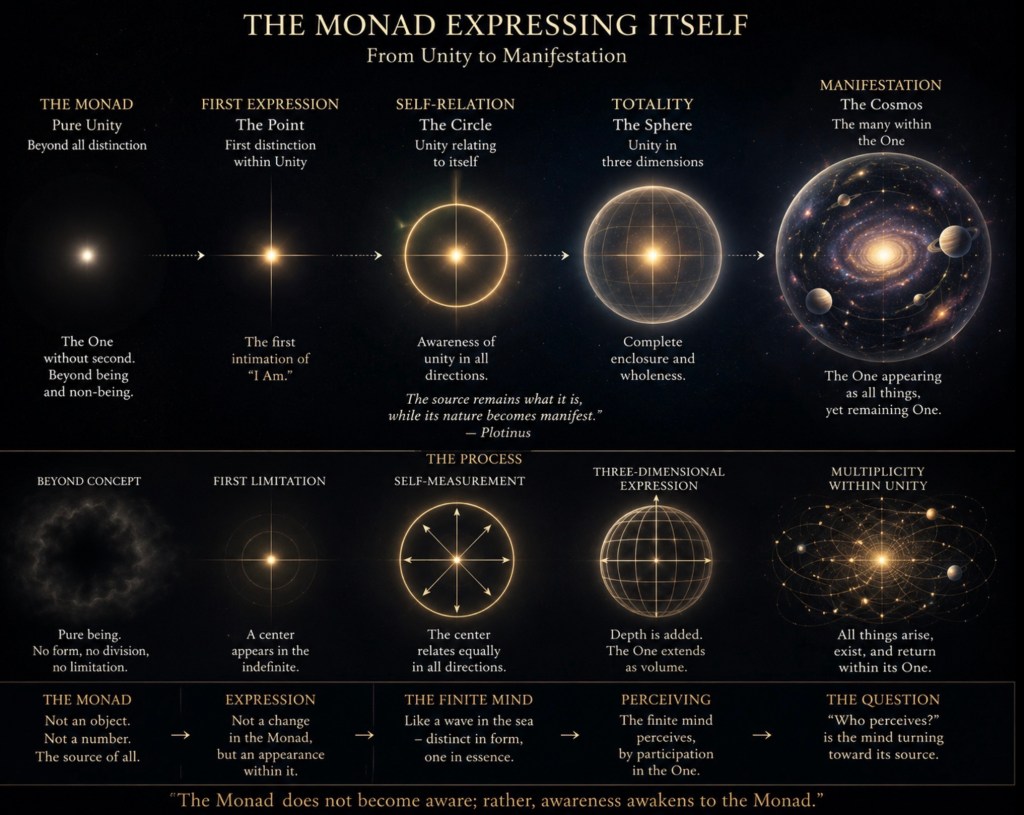
The idea that the point becomes the circle appears repeatedly in ancient philosophical, mathematical, and mystical traditions, though not usually in the literal language “the point becomes the circle.”
In Plato
Plato does not explicitly state that a point becomes a circle. However, in Timaeus, the cosmos is described as having a spherical form because the sphere is the most complete and perfect figure.
The movement from unity to completeness is implied:
- Unity is the principle.
- Geometrical form manifests that principle.
- The sphere is the most perfect manifestation of wholeness.
Thus, some later Platonists interpreted the sphere as the fullest geometric expression of the One.
In Euclidean Geometry
A circle is defined by a center point and a radius.
The entire circle can be understood as the locus of all points equidistant from a single center.
Visually:
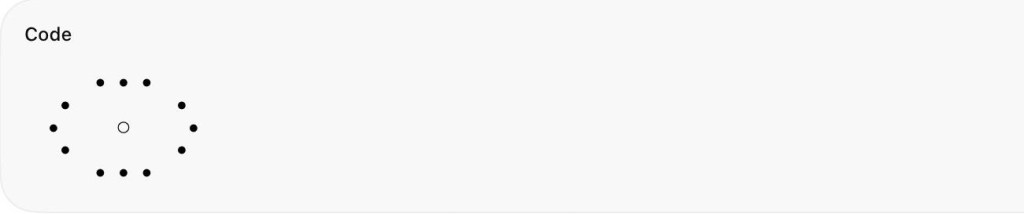
The center point (○) is not itself the circle, but the circle is generated by reference to that point.
In this sense:
The point is the principle of the circle.
In Neoplatonism
Plotinus uses imagery very close to this.
He describes the One as a center from which all reality radiates, while remaining unmoved.
A common Neoplatonic image is:
- The One = center.
- The many = circumference.
- All radii proceed from the center.
The center is everywhere present in the circle without being extended into it.
Nicholas of Cusa
Much later, Nicholas of Cusa employed a striking metaphor:
God is an infinite circle whose center is everywhere and circumference nowhere.
Here the point-like center and the circle become almost identical at infinity.
The Pythagorean Interpretation
Some Pythagorean traditions understood creation geometrically:
- Monad — point
- Motion of the point — line
- Rotation of the line — circle
- Expansion — sphere
The circle emerges when the point’s power is expressed as uniform motion around itself.
In modern geometric language, if a point serves as a fixed center and a radius is generated around it, the circle is the first complete enclosure of space.
Symbolically
Many esoteric and philosophical traditions use the symbol:
⊙
A point within a circle.
This symbol can represent:
- Unity within multiplicity.
- The Monad expressing itself.
- The source and its manifestation.
- The center and the whole.

In that symbolic tradition, the circle is not something separate from the point. Rather, the circle is the point’s self-expression. The center remains what it is, while the circumference reveals its power. Philosophically, one could say that the point does not cease to be a point; instead, the circle is the visible unfolding of what was hidden within the point.
If we take the Monad as the absolute unity from which all distinctions arise, then the phrase “the Monad expressing itself” can be understood in several ways.
The first question Socrates might ask is: How can that which is truly One express itself without already becoming two—the expresser and the expressed?
This was a central difficulty for later Platonists. If the Monad remains perfectly one, then expression cannot mean a change in the Monad itself. Otherwise, unity would become multiplicity and cease to be unity.
For thinkers such as Plotinus, the One does not act, decide, or create in a temporal sense. Rather, all things proceed from it as light radiates from the sun. The source remains what it is, while manifestation appears.
Under this view:
- The Monad does not become something else.
- The Monad remains itself.
- Multiplicity is the appearance or unfolding of what is contained implicitly in unity.
The geometric symbolism can then be read metaphorically:
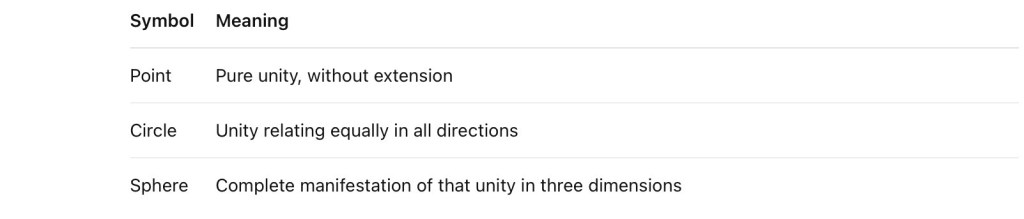
The important point is that the point does not literally transform into a sphere. Rather, the sphere reveals something already implicit in the point.
If consciousness is taken as more fundamental than geometry, the symbolism shifts:
- Pure consciousness: prior to all form.
- Point: the first distinction appearing within consciousness.
- Circle: consciousness becoming aware of its own unity.
- Sphere: the fullness of manifested experience.
In this reading, the Monad expressing itself is not a physical event but the emergence of intelligible structure from an undivided source.
A useful image is the symbol ⊙ (a point within a circle).
The center never leaves itself. Yet the circumference reveals the center’s presence everywhere within the figure. The center is not diminished by the circle, nor is the circle separate from the center. One might say that the circle is the visibility of what the point is invisibly.
This is close to what many later metaphysicians meant by “expression.” The source remains transcendent, while its nature becomes manifest through progressively richer forms.
The deepest philosophical question then becomes:
Is manifestation something added to the Monad, or is manifestation simply the way finite minds perceive the inexhaustible depth already present within unity?
Plato never gives a final answer. In the Parmenides, the One appears both beyond all predicates and yet somehow the source of all predicates. Much of subsequent Platonism can be viewed as an attempt to understand how unity can be present in multiplicity without ever ceasing to be unity.
 Dialogos of Eide