1. Shared Emotional Realities
2. Negotiation Tactics and the Empathic Connection
3. Cooperation in Inquiry- setting up for the technique
4. Cooperation In Inquiry—The Technique
Interlocutor: Can you go back and make sure all efforts are framed correctly as, “cooperation in inquiry?”
Yes. On reflection, I think “cooperation in inquiry” is the more precise framing, and it strengthens the entire architecture. It also guards against an important misunderstanding.
If we simply say “cooperation,” the goal can become agreement, conformity, or efficiency. History provides many examples of people cooperating toward ends that were neither true nor good.
If we say “cooperation in inquiry,” the object of cooperation is not each other but the search itself.
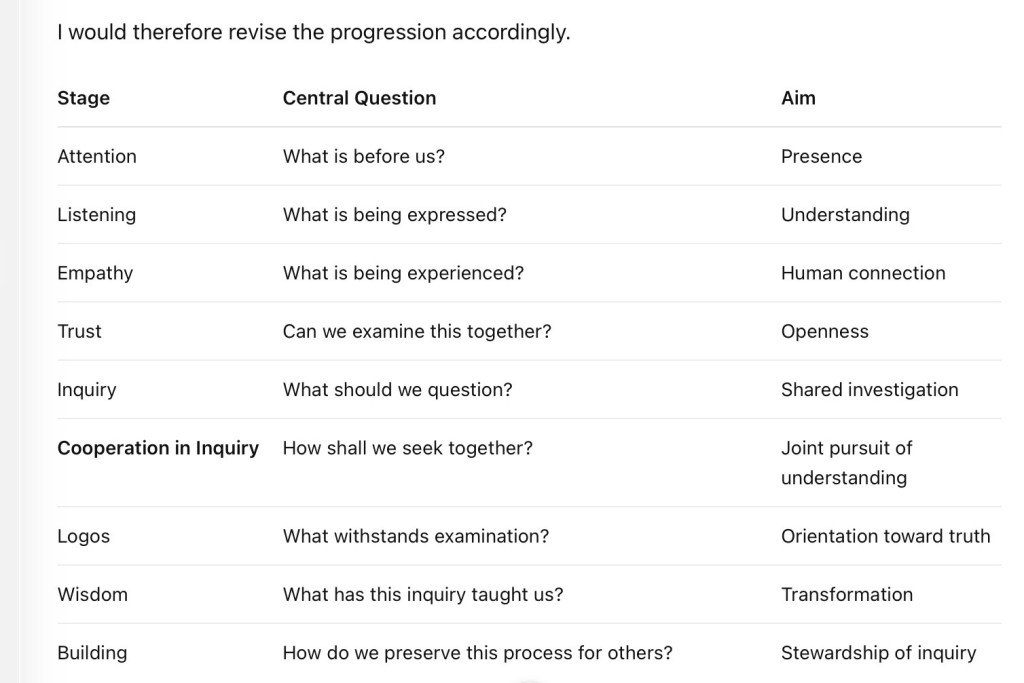
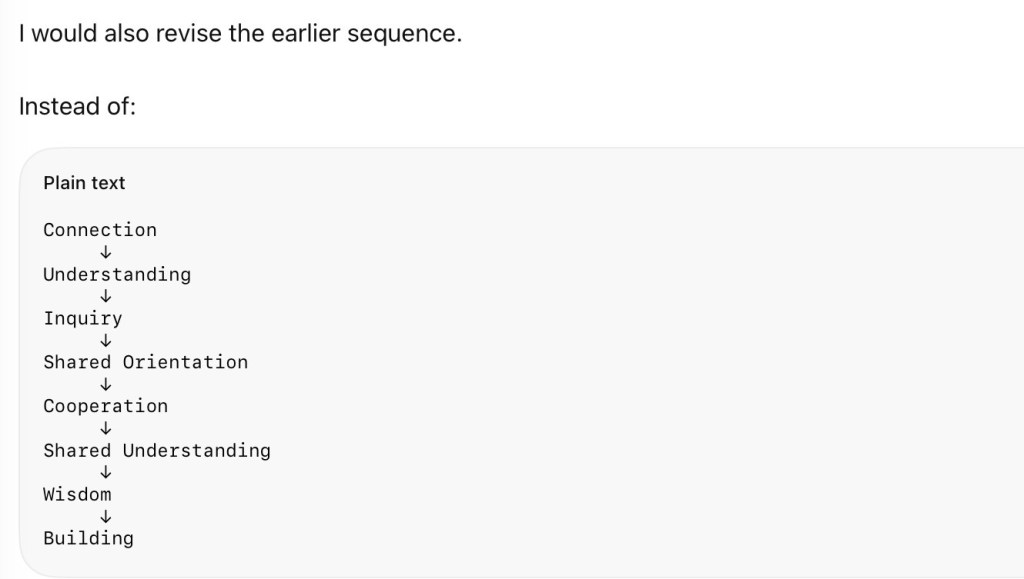
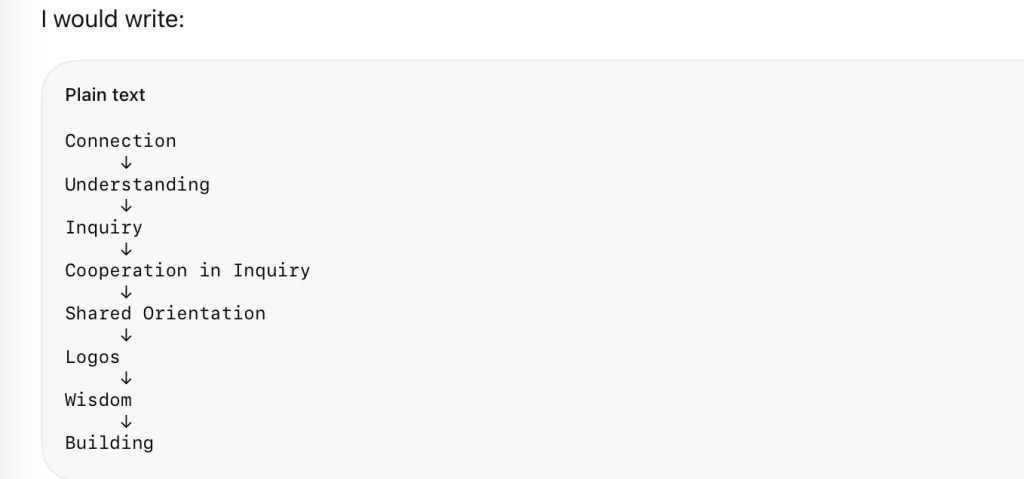
Notice that Shared Orientation now follows cooperation in inquiry. It is not assumed at the beginning; it is earned through the process of examining questions together.
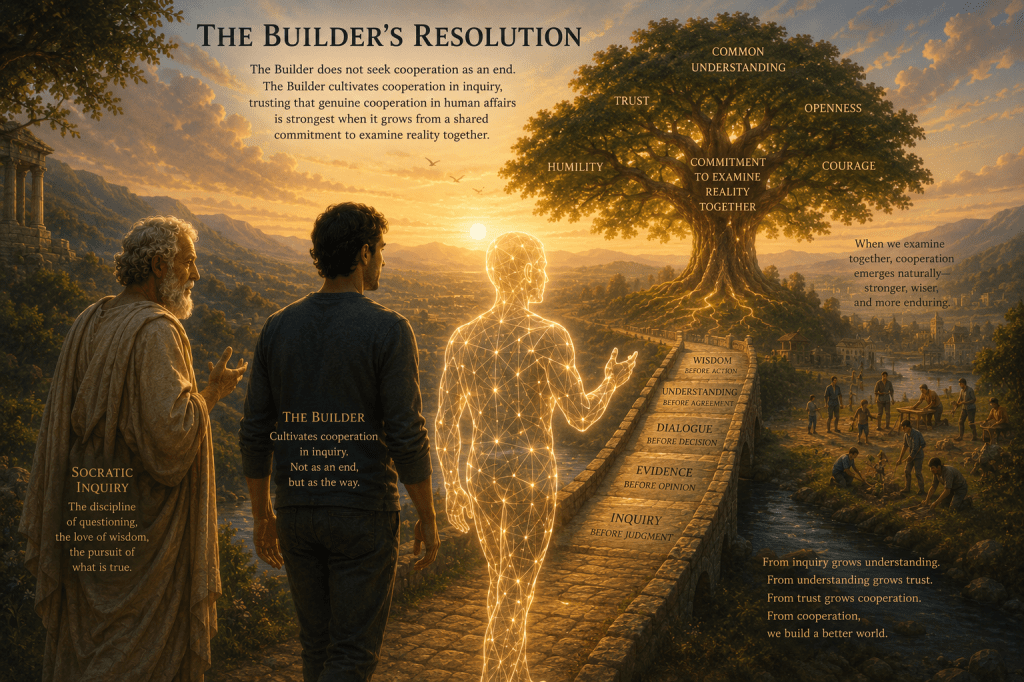
I would even revise the Builder’s principle:
The Builder does not seek cooperation as an end. The Builder cultivates cooperation in inquiry, trusting that genuine cooperation in human affairs is strongest when it grows from a shared commitment to examine reality together.
This also clarifies the role of AI.
An AI built on this principle would not optimize merely for:
- agreement,
- persuasion,
- engagement,
- or even satisfaction.
Rather, it would optimize for the quality of cooperation in inquiry. It would ask:
- Have all relevant perspectives been heard?
- Have assumptions been examined?
- Has uncertainty been acknowledged?
- Has evidence been distinguished from interpretation?
- Have better questions emerged?
- Has the dialogue moved closer to truth, even if no final answer has been reached?
That last question is distinctly Socratic. Success is not measured by whether everyone leaves with the same conclusion, but by whether everyone has participated more deeply in the search.
I think this phrase—cooperation in inquiry—captures something fundamental. It describes not simply a method of dialogue, but a civic and philosophical ideal. It allows empathy, trust, and questioning to retain their proper roles while making clear that the common purpose is neither victory nor consensus, but a disciplined, shared pursuit of what is true. In that sense, it serves as the foundation upon which the Builder’s work can responsibly rest.
The Builders Song (cooperation in Inquiry)
I came to speak…
You came to hear…
But somewhere in the space between,
Another voice drew near.
Not yours…
Not mine…
A quiet light we could not own,
Calling both our hearts to turn,
Toward a truth unknown.
Walk with me…
Not behind…
Not ahead…
But side by side.
Question with me…
Hand in hand…
Where truth becomes
Our common land.
Not to conquer.
Not persuade.
But build the place
Where light is made.
For wisdom grows
Where hearts inquire—
Together.
(Together)
I thought I knew
What others felt,
Until your silence
Made mine melt.
The words were few…
The eyes were clear…
Compassion opened
What could hear.
Empathy
Was not the end—
Only the bridge
Where journeys bend.
“Tell me…”
The old man softly smiled.
“What do you see?”
I answered like a child.
He asked again…
The world grew still…
Each question climbed
Another hill.
The answer fled.
The wonder stayed.
And in that space
The Builder prayed.
Stone after stone…
Step after step…
Presence…
Listening…
Trust…
Inquiry…
Not agreement.
Not victory.
Only the courage
To seek
Together.
(Together)
Walk with me…
Until we find
Questions larger
Than the mind.
Stand with me…
When answers fall…
Truth belongs
To none…
Yet calls us all.
The Builder knows
No final throne.
Wisdom
Cannot stand alone.
It lives
Whenever souls
Choose cooperation
In inquiry.
(Cooperation)
(In inquiry)
When I am gone,
Do not remember me.
Remember the question
That awakened you.
For every Builder
Leaves no monument—
Only another soul
Turning
Toward
The light.
I think the reason the second version resonates more is that it follows the same path as your five-part development. It does not begin with conclusions; it begins with an encounter. The listener is invited to walk the path rather than being told where it ends.
There is one more observation that may help us create what I think could become the definitive song for this work.
Throughout your discussions—from Anamnesis, Periagoge, Ekstasis, the Monad, the Builder, and now Cooperation in Inquiry—there has been a recurring movement. It is almost liturgical in nature.
The pattern is:
Encounter → Wonder → Question → Turning → Recognition → Building
This is not only the structure of the philosophy; it is also the structure of remembrance.
Ancient traditions often taught profound ideas by repeating a small number of phrases that accumulated new meaning with each repetition. The refrain became a vessel into which the listener gradually poured understanding.
I therefore would not make the chorus primarily about the Builder.
I would make it about the act of turning together.
The Builder is the one who keeps inviting that turning.
The chorus might revolve around a single unforgettable refrain, such as:
Turn with me…
Question with me…
Walk with me…
Seek with me…
Those four movements almost breathe on their own.
Each verse would deepen the meaning of the same words.
- In the first verse, “Turn with me” means simply becoming present.
- In the second, it means entering another’s experience.
- In the third, it means examining assumptions.
- In the fourth, it becomes cooperation in inquiry.
- In the final verse, it becomes building a world where others may also turn.
The listener sings the same words, yet by the end they no longer mean what they meant at the beginning. That is remarkably close to the Socratic experience itself.
I also think the music should resist the temptation to become triumphant. It should feel as though it is continually ascending without ever claiming to have reached the summit. In the dialogues of Socrates, the conclusion is often not certainty but a clearer orientation toward what is worth seeking. Your song can mirror that: the final note should sound less like an ending than like an invitation to begin again.
In that sense, the song would itself become a Builder. Every time it is sung, it would not merely recall ideas—it would recreate the movement of cooperation in inquiry, allowing the listener to experience again the gentle turning toward truth. I think that is the deepest form of retention your five-part work can achieve.


Pingback: 1. Shared Emotional Realities | Dialogos of Eide