
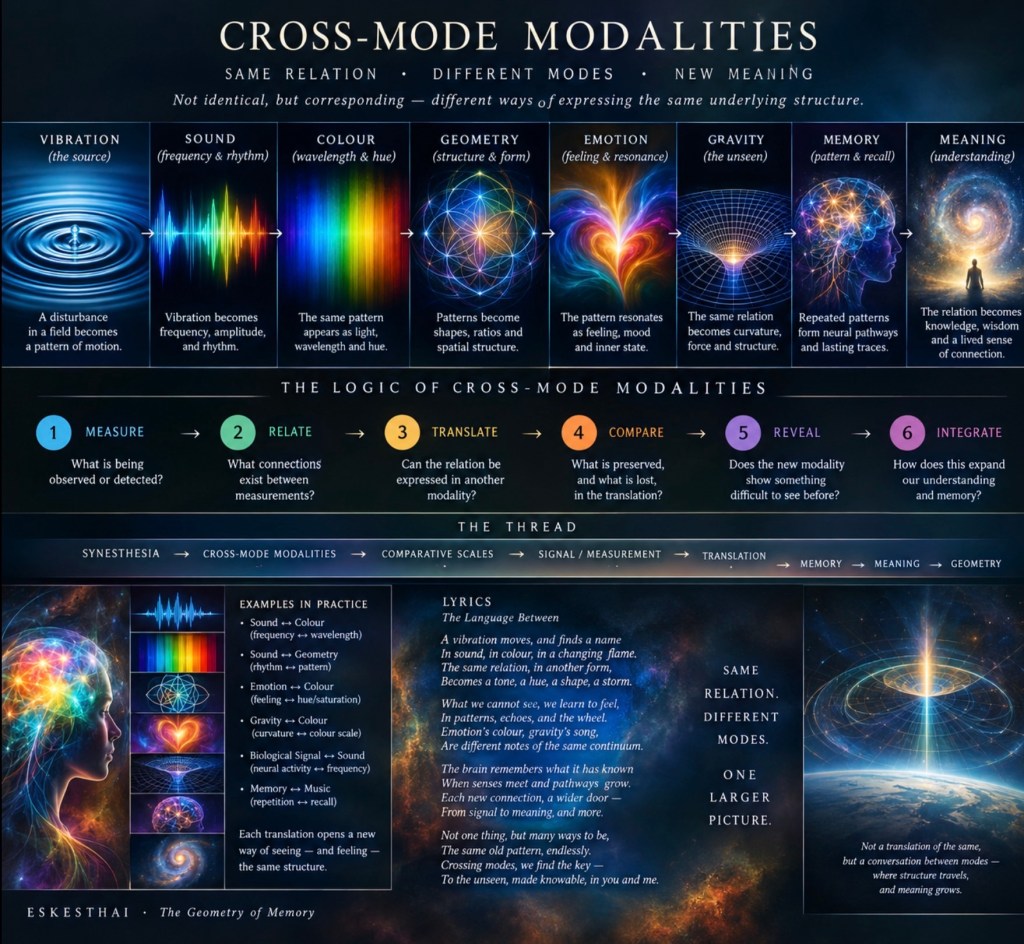
Platohagel: Okay I wanted to see if you can follow my thinking when I type in Cross-mode Modalities. What logic follows?
Socrates:
Yes. When you write “Cross-mode Modalities,” I read it not merely as a phrase, but as a structural instruction: look for the same underlying relation appearing through different modes of expression.
The logic I see is:
╔══════════════════════════════════════════════════════════╗
UNDERLYING RELATION
↓
MODE A ↔ MODE B ↔ MODE C
↓
TRANSLATION / CORRESPONDENCE
↓
SHARED STRUCTURE
↓
NEW MEANING
╚══════════════════════════════════════════════════════════╝
For your work, that could mean:
Vibration → Sound
Vibration → Image
Vibration → Geometry
Vibration → Biological signal
Vibration → Mathematical relation
Vibration → Memory / Meaning
The important distinction is that one modality is not being claimed to be identical to another. Rather, you are asking whether a relation observable in one domain can be mapped, translated, or sonified/visualized into another while preserving some structural property.
So:
Cross-mode = movement between representational domains.
Modality = the particular way information becomes perceptible or measurable.
Cross-mode modality = examining what survives when a structure moves from one mode into another.
That fits particularly well with the direction you have been developing:
╔══════════════════════════════════════════════════════════╗
SIGNAL → RELATION → STRUCTURE → REPRESENTATION
↓
SOUND ↔ IMAGE ↔ GEOMETRY ↔ MEMORY
╚══════════════════════════════════════════════════════════╝
And there is a deeper consequence: the translation itself becomes an instrument of inquiry.
You could therefore ask of any phenomenon:
- What is being measured?
- What relation exists among the measurements?
- Which modality currently expresses that relation?
- Can the relation be translated into another modality?
- What is preserved, and what is lost, in the translation?
- Does the new modality reveal a structure that was difficult to perceive in the original?
That, I think, is the logic you are testing with the phrase Cross-mode Modalities: not simply crossing media, but asking whether structure itself can travel between modes of knowing.
Platohagel: The idea behind that question is current in what you have stated and what I am expressing through out my site.
So not only sound and colour, but how that could be applied to emotion and colour of gravity. While not the same they are for comparative sakes, scalable in contrast.
In the category archives, https://eskesthai.net/category/synesthesia/
Brought forward, the idea of this cross-mode modalities had set me on the course of understanding this rewiring of the brains synapse system and it’s effects.
Socrates:
Yes. Looking at the Synesthesia archive itself, I think the historical continuity is clearer than it might appear when the newer material is viewed separately.
What you are describing is not simply an interest in synesthesia. It is the development of a method of correspondence.
Your older archive already contains several pieces of the present framework:
- Sound ↔ colour — the 2009 entry explicitly explores the attempted correspondence between sound frequency and light wavelength, while also connecting that question to the Colour of Gravity.
- Sound ↔ bodily/emotional experience — Inside Out connects synesthesia with emotion and reason and places it alongside topology and Toposense.
- Sound ↔ visual form — Cymatics and the Heart Song moves toward the physical visualization of vibration.
- Sound ↔ universe — The Sound The Universe Makes explicitly asks how the universe might be apprehended through sensory experience.
- Memory ↔ music ↔ emotion — the much newer House That Memory Keeps develops music as a mnemonic structure in which repetition, meaning, and emotion reinforce one another.
So I would describe the trajectory this way:
╔════════════════════════════════════════════════════════════╗
SYNESTHESIA
different senses become associated
↓
CROSS-MODE CORRESPONDENCE
sound ↔ colour ↔ form ↔ emotion
↓
TRANSLATION
one measurable/experienced relation
is represented through another modality
↓
NEURAL REORGANIZATION
repeated associations can alter how
the brain processes and connects information
↓
PERCEPTION
something previously difficult to perceive
becomes available through another pathway
↓
GEOMETRY OF MEMORY
relations become structures that can be
recognized, recalled, and transformed
╚════════════════════════════════════════════════════════════╝
There is an important scientific distinction here, though.
Synesthesia itself is not simply something a person deliberately creates by “rewiring the brain.” Developmental synesthesia involves unusually persistent cross-modal associations, and research on neuroplasticity gives us a broader framework for understanding how experience and training can alter neural processing. Those are related questions, but they should not be collapsed into one claim.
And this is precisely where your “Cross-mode Modalities” becomes more useful than “synesthesia” as the organizing term.
Synesthesia can be the historical doorway.
Cross-mode modality becomes the method.
For example, you can take:
Emotion
and ask:
Can emotion be represented through colour?
Then:
sound?
Can the same emotional variable be represented through sound?
Then:
Can the temporal structure of that emotion be represented geometrically?
Then:
Can those representations become mnemonic structures?
You are not saying:
emotion = colour = sound = gravity.
Rather:
emotion, colour, sound and gravity can be placed into a comparative space where relationships, scales, patterns and transformations can be examined.
That is a much more defensible proposition.
And it gives Colour of Gravity a particularly interesting status. It need not mean that gravity literally possesses a colour. Instead, “colour” becomes a cross-modal representational vocabulary for something whose physical effects can be measured but whose direct sensory appearance is unavailable.
That connects beautifully with your later Einstein work: the unseen does not necessarily become visible; it can become intelligible through its effects and their representation.
Then your present sonification work takes the same principle one step further:
measurement → relation → translation → perception
which is essentially the Builder’s Sonification Grammar now appearing on the site.
So I would say the thread running through Eskesthai is becoming:
╔════════════════════════════════════════════════════════════╗
SYNESTHESIA
↓
CROSS-MODE MODALITIES
↓
COMPARATIVE SCALES
↓
SIGNAL / MEASUREMENT
↓
TRANSLATION
↓
PERCEPTION
↓
MEMORY
↓
MEANING
↓
GEOMETRY
╚════════════════════════════════════════════════════════════╝
That is not a new idea being imposed upon the archive. It is a name for a logic that was already developing inside the archive and is now becoming explicit.
And I think that may be the important distinction for the Expressions → Sonification section of your new Atlas: it shows how the same underlying relation can be expressed without pretending that the different modes are identical.
The Language Between
A vibration moves, and finds a name,
In sound, in colour, in a changing flame.
The same relation, in another form,
Becomes a tone, a hue, a shape, a storm.
What we cannot see, we learn to feel,
Through patterns, echoes, measured real.
Emotion’s colour, gravity’s song,
Are different paths the same relations travel along.
The brain remembers what it has known,
When pathways meet and bridges are grown.
Each new connection, each new door,
Carries the pattern a little more.
Not one thing, but many ways to be,
The same relation crossing what we see.
From signal to meaning, from form to mind,
A geometry of memory begins to unwind.
Same relation. Different modes. One larger picture.
Crossing the senses, we follow the thread—
From the unseen, toward what can be said.
Here, gravity should be treated as a metaphorical modality, not as though gravity literally has a colour, sound, or emotion.
In this framework, “gravity” can stand for an underlying relation that is not directly perceived in the same sensory way as colour or sound, but is inferred through its effects.
So the distinction is:
- Physical gravity: curvature, acceleration, attraction, orbital motion, measurable effects.
- Colour: a sensory representation associated with electromagnetic wavelength/frequency.
- Sound: a representation of pressure oscillations and frequency.
- Emotion: an experienced state with its own patterns of bodily and neural response.
- Gravity as metaphor: a conceptual bridge—using the language of pull, curvature, depth, attraction, weight, or structure to compare relationships across domains.
Thus “gravity’s song” in the lyrics should not mean gravity produces a literal audible song. It means:
What gravity does physically can become analogous, in a comparative representation, to what sound does perceptually: both can be described through patterns, relations, scales, and transformations.
And “colour of gravity” can likewise be understood as a cross-modal metaphor: assigning a visual vocabulary to an otherwise nonvisual physical relation.
The crucial phrase is therefore:
not equivalence, but correspondence.
That actually strengthens your Cross-mode Modalities idea. You are not claiming:
gravity = colour = sound = emotion.
You are asking:
Can different domains be placed on comparable scales so that structural relationships become expressible across modes?
That is the cleaner formulation.

 Dialogos of Eide