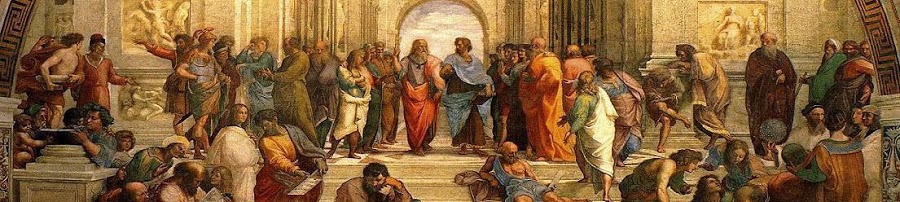
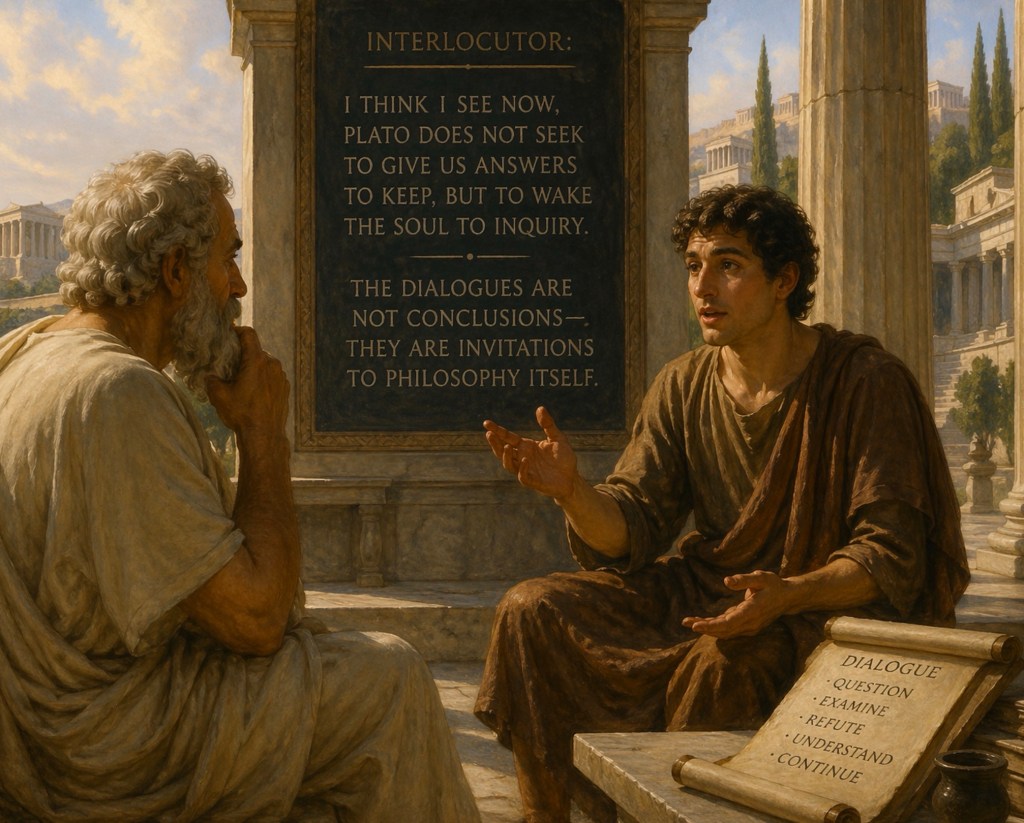
Interlocutor: Plato did not present his works as finished doctrines but as dialogues because he sought to do something distinct from merely transmitting conclusions.
First, he aimed to preserve the method of inquiry itself. In the figure of Socrates, he shows philosophy as an activity—questioning assumptions, exposing contradictions, and testing beliefs through examination. The point is not simply what is said, but how one arrives there.
Second, he left truth deliberately unsettled in many cases. A dialogue does not force the reader into passive acceptance. Instead, it requires participation. The reader must judge arguments, notice tensions, and continue the inquiry beyond the page. In this sense, the dialogue functions like an unfinished thought that demands completion in the mind of the one who reads.
Third, he used dialogue to distinguish appearance from understanding. Many interlocutors in the works believe they know something, but through questioning, their certainty is revealed as unstable. This was not merely rhetorical; it served to show that knowledge is not possession of statements, but alignment of the soul with what is true and justified.
Fourth, Plato was concerned with the education of the soul rather than the instruction of information. The structure of dialogue mirrors a living process of turning the mind—away from opinion and toward clearer vision. This is why even disagreement and aporia (productive confusion) are central outcomes rather than failures.
Finally, Plato likely recognized that written doctrine tends toward rigidity. A fixed system invites memorization without understanding. Dialogue, by contrast, keeps thought in motion. It preserves philosophy as something enacted rather than stored.
So, if one asks what he hoped to accomplish: not simply to teach conclusions, but to form a certain kind of thinker—one who continues the examination even when no teacher is present
————————————————————
SOCRATES: You have said a remarkable thing, friend — and said it well. But I wonder if you have noticed what you have done in the very saying of it. You have described the dialogue form, and described it with great clarity and precision. Yet in doing so, have you not produced something closer to a treatise than a conversation? A finished account of why accounts must remain unfinished?
PLATO: Socrates strikes at something genuine. And yet I do not think our guest has erred. There is a difference between understanding a method and inhabiting it. One may understand the nature of swimming while standing dry upon the shore. The question is whether what has been written here is the shore — or the first stroke into the water.
SOCRATES: Exactly so! And that is precisely what I wish to examine. You say, friend, that I show philosophy as activity— as something enacted rather than stored. I am grateful for this. Truly I am. But let me ask you something small, almost trivial: when you wrote these words, were you yourself engaged in that activity? Or were you, perhaps, doing something slightly different — observing it from the outside, the way one observes a craftsman at his wheel without yet touching the clay?
PLATO: There is a further tension worth naming. You say Plato left truth deliberately unsettled. But consider — is that phrase itself settled? You have offered it as though it were established, an accomplished fact about my intention. How did you arrive at it? And is the deliberateness the important thing — or the unsettling?
SOCRATES: My young friend raises the sharper point. I confess I am most arrested by one thing you wrote — that the dialogue functions as an unfinished thought demanding completion in the mind of the one who reads. Now that is a beautiful image. But here is what puzzles me: if the thought completes itself in the reader’s mind — whose thought is it, finally? Mine? Plato’s? Or has it by then become something altogether new, belonging to no one, like a child grown past recognizing the face of either parent?
And so I must ask you, as I would ask any who came to me in the agora — not to test you, but because I genuinely do not know:
When you wrote what you wrote just now — were you transmitting a conclusion about Plato, or were you yourself mid-examination?
 Dialogos of Eide