
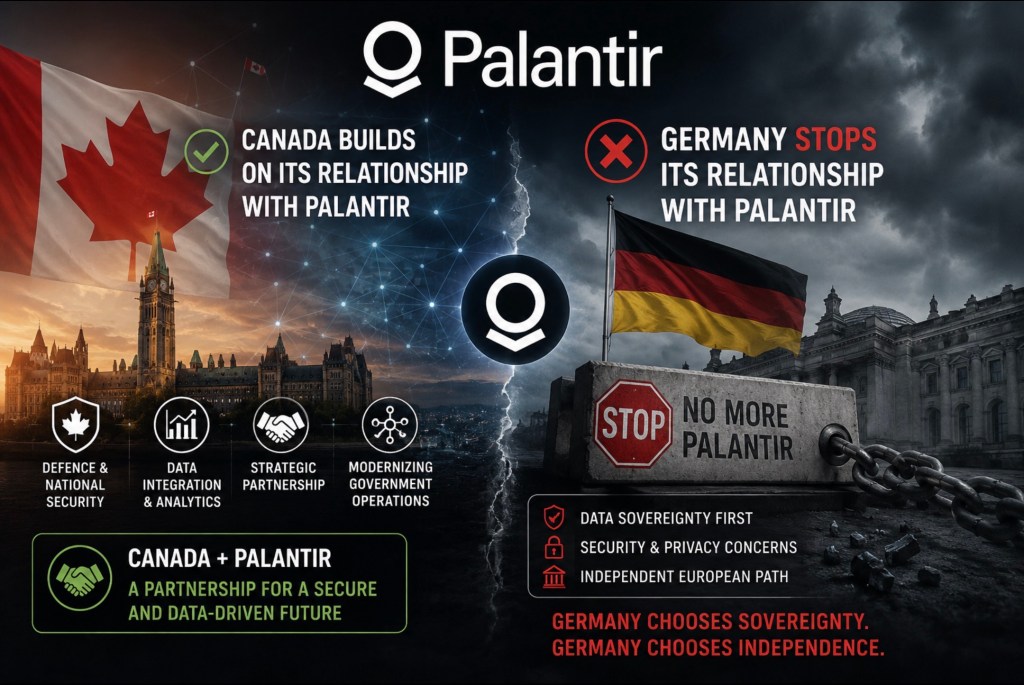
Yes. Canada has had a growing — though not always transparent — relationship with Palantir Technologies, particularly in defence, security, procurement infrastructure, and some areas adjacent to public-sector data systems.
The relationship appears to exist at several levels:
- Department of National Defence (DND)
- Canadian Special Operations Forces
- Federal procurement frameworks
- Potential law-enforcement and analytics evaluation activity
- Broader federal software supply arrangements
What is important is that Canada’s relationship with Palantir is not equivalent to a fully integrated national system such as the UK NHS-Palantir partnership. Canada’s usage appears more fragmented, selective, and partially undisclosed.
Some confirmed elements include:
- Defence and military contracts
Canada’s Department of National Defence awarded Palantir contracts beginning in 2019, including a non-competitive agreement for Palantir software used by Canadian Special Operations Forces.
A later contract reportedly involved Palantir’s Gotham platform for secure analytics and information-sharing inside defence operations.
- Federal procurement access
In 2024, Palantir Canada was added into a broader federal software licensing arrangement running through 2028. This effectively means federal departments can procure Palantir software through a pre-approved mechanism without launching entirely new competitive procurements each time.
This is significant because it lowers procurement friction across government.
- RCMP and Public Safety questions
There have been repeated parliamentary and media questions regarding whether agencies such as the RCMP or Public Safety Canada used Palantir tools directly or indirectly. Public disclosures have been incomplete. - Health-sector concerns
Canada does not currently appear to have a national Palantir-operated health platform comparable to Britain’s NHS Federated Data Platform. However, debate around Palantir internationally has influenced Canadian discussions about:
- medical data sovereignty,
- AI governance,
- and whether foreign analytics firms should handle sensitive public datasets.
The concern is not merely technical but philosophical and constitutional:
Who governs the interpretation of a nation’s data?
That question becomes sharper because Palantir is not merely a software vendor in the ordinary sense. Its platforms are designed for:
- integrating fragmented data,
- predictive analysis,
- intelligence fusion,
- operational decision-making,
- and increasingly AI-assisted strategic coordination.
Thus critics worry that dependence upon such systems may gradually relocate institutional judgment from public administration toward opaque technological infrastructure.
Several countries — including Switzerland — have publicly raised sovereignty and intelligence-access concerns regarding Palantir systems.
At the same time, supporters argue Palantir’s platforms are effective precisely because modern states struggle to coordinate enormous fragmented datasets quickly enough for:
- defence,
- disaster response,
- logistics,
- cybersecurity,
- and healthcare administration.
So Canada’s relationship with Palantir presently appears to be:
- real,
- expanding in procurement capability,
- strongest in defence/security domains,
- but politically cautious and comparatively less public than in the UK or US.
See also:



Pingback: Pope Leo Talk on Magnifica Humanitas. | Dialogos of Eide
Pingback: Palantir Together with AI for All in Canada | Dialogos of Eide