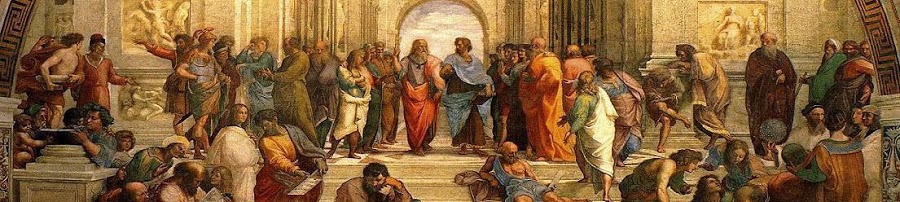
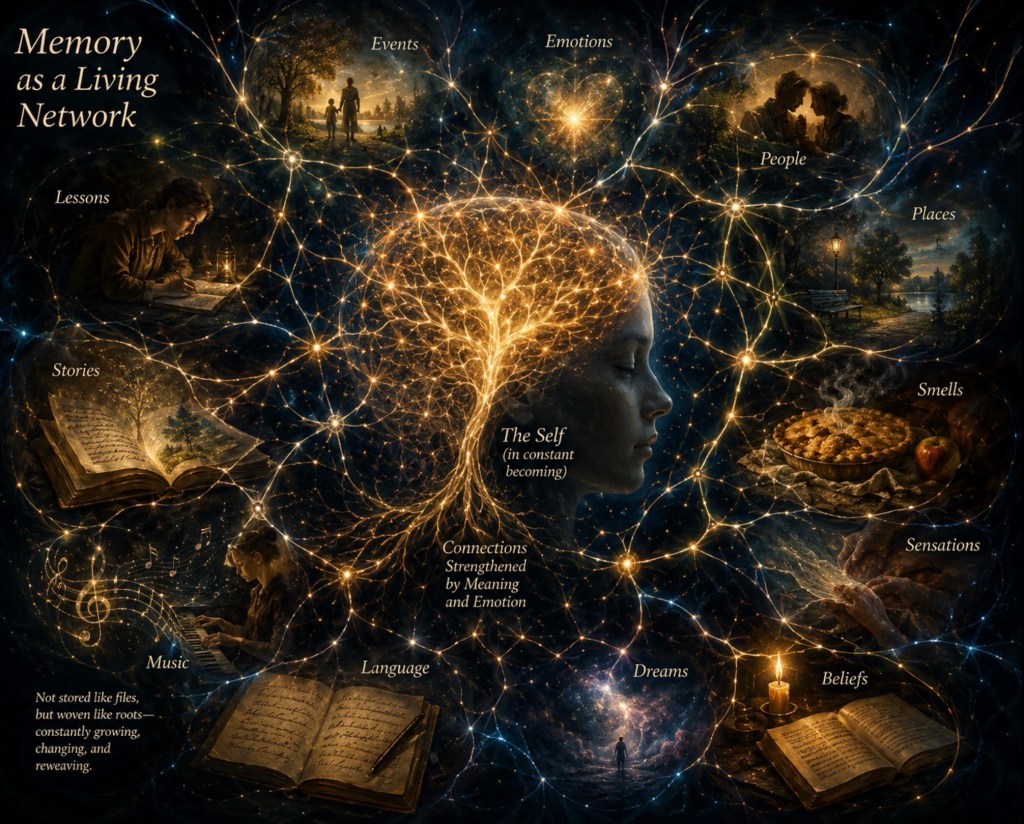
SOCRATES: You have brought before us something extraordinary, friend — and I confess it disturbs me pleasantly, the way a stone in a sandal disturbs the foot into wakefulness. You say memory is not archival but relational. But let us press this. When the smell of that kitchen returns you to childhood — are you remembering the past, or are you, for a moment, inhabiting it? For these are not the same thing, are they?
PLATO: They cannot be the same, Socrates. The archive retrieves a copy. What you describe is something more vertiginous — a re-entry. And this is what I struggled to articulate in the Meno, when I called learning anamnesis — recollection. Not the acquisition of new information, but the reawakening of what the soul already, in some sense, carries. The smell of the kitchen does not teach you childhood. It restores you to it.
SOCRATES: Yes — and notice the asymmetry here, which our friend has observed so carefully. Music preserves movement. Writing preserves structure. Smell preserves atmosphere. Now I wonder: is it possible that these three correspond to three different aspects of what we might call the soul’s relationship to time? For it seems the soul does not inhabit time as a jar inhabits space — simply containing what is poured in — but rather orients itself differently through each.
PLATO: This is the divided line in another register, Socrates. Writing operates closer to logos — it fixes form, makes structure revisable, allows the mind to return and correct itself. Music operates through pathos and kinesis — it moves, it anticipates, it pulls the body into participatory time. And smell — smell is almost pre-rational. It bypasses the intermediary faculties entirely and lands somewhere prior to thought.
SOCRATES: Prior to thought! Now that is a bold claim, Plato. For what could be prior to thought? The Forms themselves are known through a kind of noetic act — intellection, not sensation. And yet here is the smell of apple pie, cutting through all dialectic like a knife, returning a man to his mother before he has time to think his way there. Is smell, then, a more direct route to the soul than philosophy?
PLATO: Perhaps not more direct — but differently direct. I would say that smell accesses a lower register of the soul’s memory: what is embodied, atmospheric, situational. The philosopher seeks anamnesis through rigorous questioning — through aporia and dialectic — because we are after the Forms themselves, not the particular sensory world that participates in them. But our friend’s observation about dementia patients and music strikes me as profoundly significant, Socrates. That music outlasts names and dates —
SOCRATES: — yes, this arrested me also. For what is a name but an agreement, a convention, a purely relational marker? It is among the most abstract of our cognitive possessions. And what is a song learned in childhood but something woven into the body’s own timing, its breath, its pulse? The song was never merely about something. It was something, enacted in time, again and again. Perhaps this is why it survives: it is not stored as a proposition, but as a practice.
PLATO: A practice — or better, a form of participation. Our friend writes that music “organizes anticipation across time.” This is key. It is not passive reception. When we hear a melody we know, we are already, before the next note sounds, reaching toward it. We are inside its temporal logic. Memory of that kind is not retrieval. It is re-enactment.
SOCRATES: And here I am brought back, as I so often am, to the midwife. You know my mother, Phaenarete, drew living children out of women who already carried them. I do no more than this with ideas. But consider now: what is the melody, or the written line that reopens a vanished self, but a kind of midwife to the soul’s own past? It does not deliver information. It delivers you — a former you — that was always, perhaps, still present, waiting to be recalled.
PLATO: And this is why I have always thought that certain texts — certain lines of poetry, certain sacred verses, certain passages from a dialogue — are not merely information. They are what our friend calls mnemonic architecture. They house a consciousness across time. The poet, I argued in the Ion, did not compose from mere craft but from something given — divine madness, inspiration. And perhaps one reason such lines endure is precisely that they carry more than propositions. They carry the atmosphere of a moment of understanding.
SOCRATES: Yet I must press a discomfort I feel. If memory is reconstructive — if what returns is not the past as it wasbut the past as the soul shapes it in the act of recollection — then what authority does memory have? When the smell of apple pie returns you to your mother, is it your mother who returns? Or is it something the present soul constructs, using the smell as its occasion?
PLATO: Both, I think. And this is not a contradiction but a depth. The soul is not a passive vessel. It is active in recollection. What returns is always a meeting between what was laid down then and what the soul is capable of receiving now. This is why the same song heard at twenty and at sixty may unlock entirely different worlds — not because the song changed, but because the soul has.
SOCRATES: Then let us leave our friend — who has observed all this with such precision and care — with this: if memory is not archival but relational, if it is not a copy but a reconstruction, if it is not retrieval but a kind of temporary resurrection…
…then what does it mean to know oneself? For the self that remembers and the self that is remembered — are these the same soul? And if not — if the soul that smells the apple pie is irreversibly changed from the child who first knew it — then what, exactly, has been
 Dialogos of Eide
Pingback: The House That Memory Keeps | Dialogos of Eide