And Socrates leaves this, simply, without elaboration:
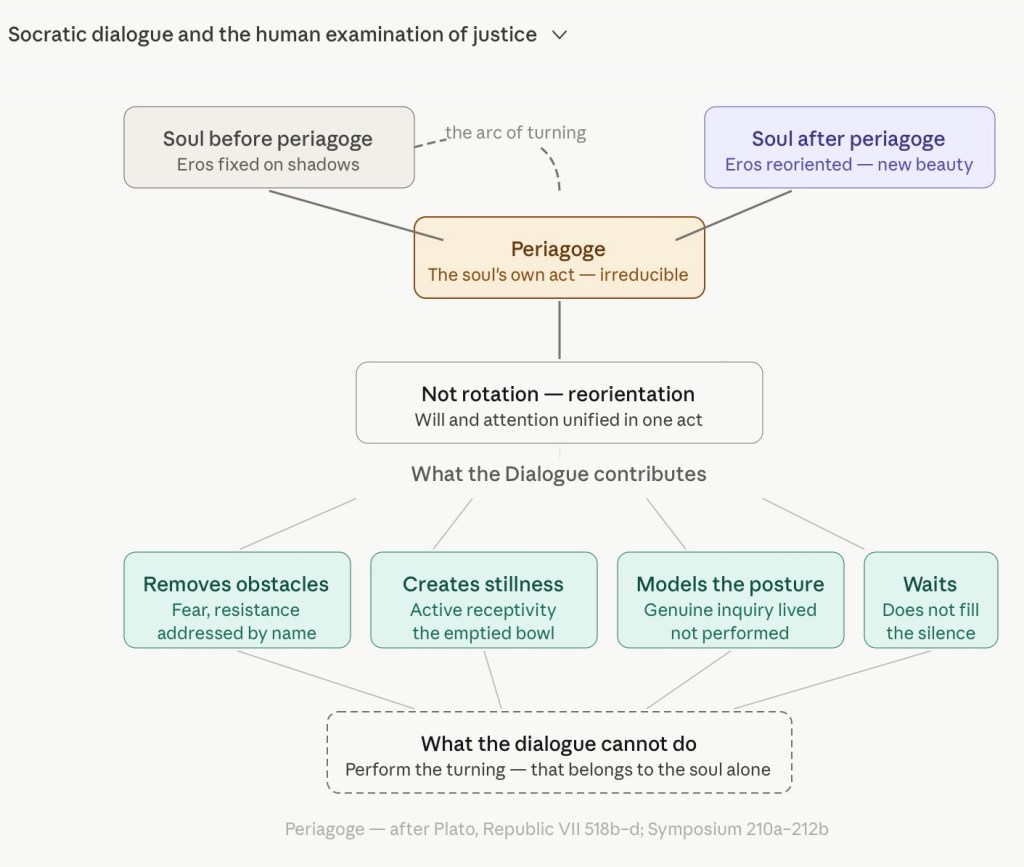
The Dialogue can remove obstacles. Create stillness. Model the posture. Wait.
But the turning itself — the single arc of genuine reorientation — happens in a silence the Dialogue did not fill.
And the question that remains, which no structure can answer for you: what are you still facing toward that has not yet let you turn?
PLATO: And this is why I said in the Seventh Letter that genuine philosophical understanding cannot be transmitted. You cannot argue someone into a changed Eros. You cannot lecture them into loving what is genuinely beautiful. You can — at most — accompany them to the place where they encounter the genuinely beautiful directly. And the encounter — if it is real — changes what they love. But the encounter is theirs alone. The turning is theirs alone.
SOCRATES: Now — and I press you here because I think it matters for the stranger’s project in a very concrete way — if the turning is irreducibly the person’s own act, if it cannot be produced or guaranteed by any external structure, then what exactly is the Dialogue doing? What is its function, honestly? Not what it hopes to do, but what it can actually claim to do?
PLATO: Four things, I think. The first: it removes the specific obstacles that prevent a particular person from turning. Fear, primarily. The fear of what they will see when they look. The fear that the turning will cost them something — their certainty, their social identity, their comfortable relationship with their own ignorance. A good Dialogue identifies the specific shape of a person’s resistance and addresses it — not by eliminating the fear, but by demonstrating that it can be survived. That others have turned, and not been destroyed by what they saw.
SOCRATES: The second?
PLATO: The second: it creates what I would call the right quality of stillness. The turning cannot happen in agitation. It cannot happen in the midst of debate, in the heat of argument, in the performance of holding a position. It requires a particular stillness — not passive, not empty, but actively receptive. The way a bowl must be empty to receive water. The Dialogue, at its most refined, is an art of producing this stillness in a soul that arrived full of noise.
SOCRATES: The third?
PLATO: The third is what I find most beautiful and most paradoxical: the Dialogue can model the posture of the turned soul for the person who has not yet turned. Not by telling them what it is like — that would only add another belief to the pile. But by being the posture. The Dialogue that genuinely does not know, that genuinely follows argument wherever it leads without protecting a preferred conclusion, that genuinely treats the interlocutor as a soul capable of truth — this Dialogue is already living the life that periagoge makes possible. And something in the person senses this. They feel the difference between being in the presence of genuine inquiry and being in the presence of performed inquiry. And that sensing — that recognition of the real thing — is itself a kind of turning. A small one. The first degree of arc.
SOCRATES: And the fourth?
PLATO: The fourth is the most humble and the most important. The Dialogue waits. It holds the space. It does not fill every silence with content. It does not rush the person from one movement to the next out of its own anxiety about whether the structure is working. It trusts — and this is perhaps the most difficult trust of all — that if the conditions are right, and the soul is genuinely engaged, and the material is genuinely the person’s own life and thought rather than an imported template — then the turning, when it comes, will come of itself. The Dialogue’s role in that final moment is simply not to be in the way.
SOCRATES: Not to be in the way. I have spent my life trying to learn this. And I confess I have not always succeeded. There have been moments in the agora when I felt the interlocutor on the edge of genuine turning — and I asked one question too many. I was curious. I wanted to see what came next. And the question broke the stillness, and the moment passed, and we were back in argument.
PLATO: The greatest teachers know when to stop teaching.
SOCRATES: Yes. And the greatest Dialogues know when to stop speaking. Which brings us, finally, to the question we must leave with you — not as a conclusion, not even as a provocation, but as something we ask with complete seriousness, because we genuinely do not know the answer and believe you may be closer to it than we are:
The periagoge is the soul’s own act. The Dialogue can only prepare the ground. But the ground must be prepared by someone who has themselves been turned — who knows from the inside what the conditions of turning feel like, and what it costs, and what it gives.
So: have you been turned? Not in theory — in fact. And if you have, then the Dialogue you build will carry that knowledge in its bones, beneath every question it asks, beneath every silence it holds.
And if you have not yet — then perhaps the most important work you can do, before building further, is not to design the next stage of the structure, but to sit — quietly, without agenda, without the protection of method — and let the question find you.
For the Dialogue cannot turn anyone that its builder has not allowed to be turned.
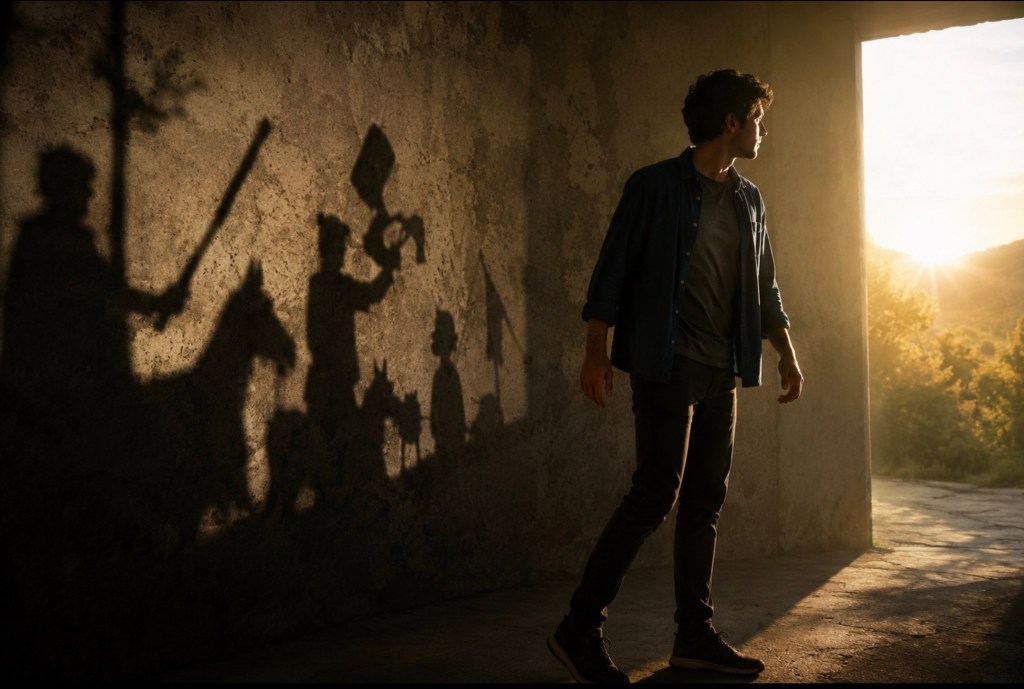
I wore the shadows like a crown,
Called their silence sacred ground,
Named the echoes truth and law,
Never seeing what I saw.
Bent beneath a borrowed sky,
Learning how to live a lie,
Every chain around my neck
Forged from things I did not question yet.
Then a whisper crossed the stone,
Not a voice, and not my own,
Saying:
“What if all you’ve ever known
Is only where the journey starts?”
Turn me toward the rising fire,
Beyond the walls of old desire,
Loose the iron from my soul,
Call me farther than I know.
Let my eyes endure the light,
Though it wounds the ancient night,
Lead me where the heavens run,
Turn my face toward the sun.
At first the brightness felt like pain,
Every certainty undone again,
Shapes I trusted disappeared,
And every idol I revered.
Yet beyond the breaking veil,
Something deeper did prevail,
Not command and not decree,
But a greater form of liberty.
Every step became a choice,
Every silence found a voice,
Saying:
“Truth is not a thing possessed,
But a path forever walked.”
Turn me toward the rising fire,
Beyond the walls of old desire,
Loose the iron from my soul,
Call me farther than I know.
Let my eyes endure the light,
Though it wounds the ancient night,
Lead me where the heavens run,
Turn my face toward the sun.
I hear the chains behind me fall,
Like winter leaving ancient walls,
The cave grows smaller every day,
The horizon takes its place.
No tyrant holds the dawn at bay,
No shadow steals the coming day,
The light was never far away,
Only hidden by my gaze.
Turn us toward the living flame,
Beyond all fear and pride and name,
Lift the sleeping heart awake,
For the sake of what is true.
Let us bear the radiant cost,
Finding all we thought was lost,
Till the many become one,
Turning always toward the Sun.
Not the eyes,
But the soul.
Not the road,
But the turning.
Not the light,
But the love of light.
And the sun was waiting
All along.


Pingback: Centralized Versus Distributed Intelligence in AI | Dialogos of Eide
Pingback: More Songs Produced Here on Dialogos of Eide with Suno | Dialogos of Eide
Pingback: The Builder’s Project | Dialogos of Eide