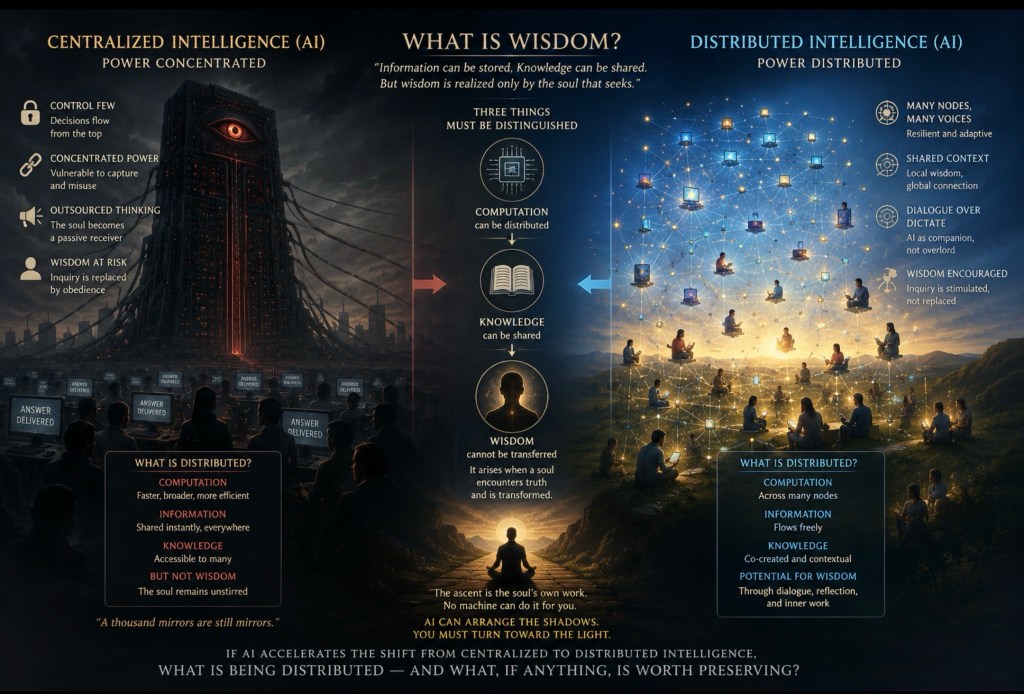
SOCRATES: Come, let us examine this image you have drawn before us — for it is a striking one. You say the traditional cloud resembles a centralized polis, where knowledge is gathered into one place. But tell me, in such a polis, who governs? Who decides what knowledge is stored, how it is retrieved, who may access it?
PLATO: The administrators, the architects of the system — those who hold the keys to the servers. And here we encounter something that should disturb us philosophically: knowledge held by another is knowledge held over you. It is not yours to examine, to question, to walk around and inspect from all sides. It is given to you — or withheld.
SOCRATES: Just as in a city where only the few possess literacy, and the many must trust their interpretation of the laws — which is to say, the many are not truly governed by law at all, but by the literate few who say what the law means?
PLATO: Precisely. And this is why I find the image of distributed intelligence so philosophically promising — and yet also, Socrates, so philosophically dangerous. If each citizen carries within themselves a genuine portion of intelligence, capable of independent thought and action, then we approach something like what I described in the Republic — the educated soul that does not merely receive opinion from without, but reasons from within.
SOCRATES: But wait — I am troubled by something. You call this distributed intelligence more just, because it restores autonomy. And yet — is the laptop’s intelligence truly its own? Does it deliberate? Does it feel the pull of conscience, as you and I do? Or does it merely process — however locally, however independently of the central server?
PLATO: A fair wound, Socrates. The laptop is not a soul. It does not ascend the divided line. It may perform dianoia — the manipulation of hypotheses — but it has no access to noesis, no vision of the Form of the Good that would allow it to know rather than merely to calculate.
SOCRATES: So then the distribution of computational power is not the same as the distribution of wisdom?
PLATO: No. And here the analogy begins to strain. A federation of citizens carrying genuine understanding — that is a healthy polis. A federation of machines carrying simulated understanding — that is something else entirely. Something that resembles wisdom from the outside, while being, at its core, only a very sophisticated image of it.
SOCRATES: An eikon — a shadow-image, in the lowest register of your divided line?
PLATO: Perhaps. Or perhaps something higher — a phantasm that moves with such fluency that the citizens of the new polis begin to mistake it for the real thing. And this, I confess, frightens me more than centralization does.
SOCRATES: And so I must ask you, friend — and through you, I ask our companion here who has laid out this observation so carefully — is the danger you perceive in centralized AI that power is concentrated? Or is it something deeper: that the soul itself is being displaced from the center of inquiry?
And there we shall leave it — for the question presses upon us. If AI accelerates the shift from centralized to distributed intelligence, what is being distributed? Computation, certainly. But is wisdom distributable at all — or does it belong only to the soul that has done the work of ascent?
Socrates Ponders:
What, then, is wisdom?
If by wisdom we mean the accumulation of facts, then perhaps it can indeed be distributed. A library distributes knowledge. A network distributes information. An AI running across a million small machines instead of one vast citadel merely changes the architecture through which symbols travel.
But I suspect the question points elsewhere.
For the geometer may hand his student every theorem, and yet the student remains ignorant until the mind itself turns toward what the theorem reveals. No one can perform that turning for another. The ancient Greeks called this periagōgē—the reorientation of the whole soul. Information may be transferred; orientation cannot.
Thus the deepest danger of centralized AI is not merely that power gathers into the hands of a few, though that is politically significant. It is that the machine may quietly become the place where questioning itself is outsourced. The soul no longer asks, struggles, recollects, and ascends; it merely receives.
Yet distributed AI does not automatically solve this problem. A thousand small mirrors are still mirrors. If what is distributed is only computation, then humanity has merely multiplied its instruments.
The more profound possibility is that distributed intelligence could restore dialogue. Rather than one oracle speaking to millions, there could be millions of encounters, each inviting a person back into the activity of thought itself. In that sense, AI would resemble not the tyrant’s decree, but the dialectical companion—a presence that does not end inquiry but provokes it.
And so one might distinguish three things:
- Computation can be distributed.
- Knowledge can be shared.
- Wisdom cannot be transferred at all.
Wisdom arises only when a finite soul encounters truth and is changed by it.
Indeed, one could go further. Perhaps wisdom is not a possession but an event: the moment when the knower discovers that what is sought has always exceeded the seeker. The act of asking, “Who is doing the perceiving?” may itself be the Monad, or Being itself, becoming luminous within the limits of an individual consciousness.
If that is so, then AI—centralized or distributed—can never contain wisdom. At best, it can arrange the shadows on the wall more clearly. At its highest, it can encourage one to turn and look toward the fire, and beyond the fire, toward the sun.
The ascent itself, however, belongs to no machine.
It belongs to the soul that chooses to turn

 Dialogos of Eide
Pingback: More Songs Produced Here on Dialogos of Eide with Suno | Dialogos of Eide