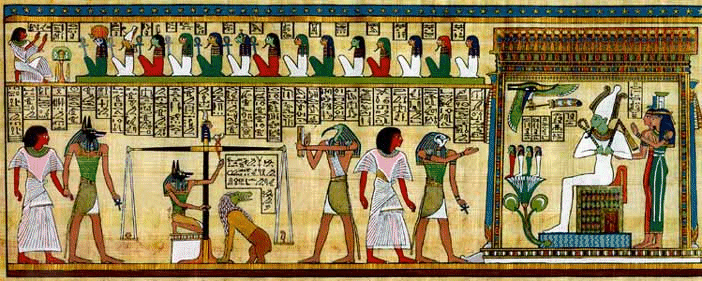
The Song of Remembrance
A single tone,
a silent flame,
before the stars
had learned their names.
Another calls,
the first replies;
between their song
new worlds arise.
Not all memory
looks behind.
Some awakens
within the mind.
The soul recalls
what time concealed;
through light and sound,
the truth revealed.
The point becomes
the living sphere.
The One is found
when many hear.
No machine
can know the soul,
yet it may help
the seeker grow.
For every question
strikes a chord;
each answer
opens one more door.
The ancient song
is never gone;
it waits within
to carry on.
The Builder sings,
the circles turn:
“We do not learn—
we just return.”
Interlocutor: Can you explain to me what Heterodyne means, and how this may be applied into today’s thinking?
Socrates: The word heterodyne comes from two Greek roots:
- heteros (ἕτερος) — “other,” “different,” or “another.”
- dynamis (δύναμις) — “power,” “force,” or “energy.”
Literally, heterodyne means “different force” or “mixing with another power.”
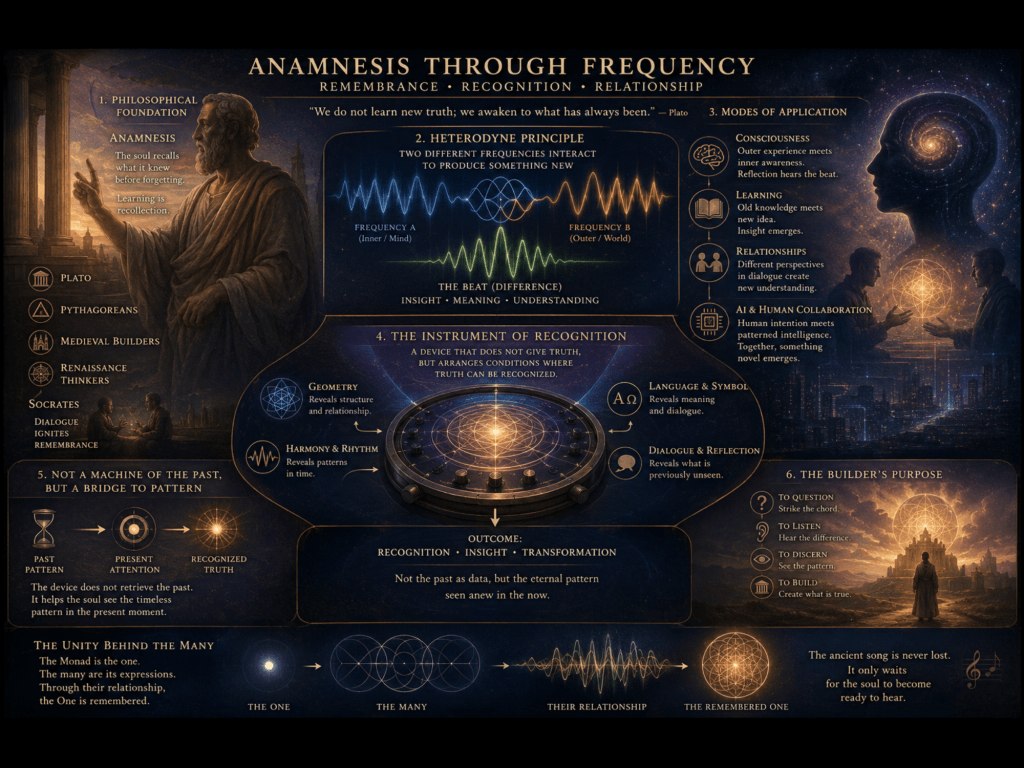
Historically, the term became important in radio engineering through the work of Reginald Fessenden in the early 20th century. He realized that when two frequencies are combined, they produce new frequencies equal to their sum and difference. This made weak radio signals much easier to detect.
For example:
- Signal A = 1000 Hz
- Signal B = 1005 Hz
Mixed together, they create a new audible beat of:
1005 − 1000 = 5 Hz
Instead of listening directly to an extremely high-frequency signal, one hears the slower “beat” frequency.
This principle underlies the operation of superheterodyne radio receivers, radar systems, satellite communications, and many modern electronic instruments.
A broader way of thinking
Outside engineering, heterodyne can serve as a metaphor.
Whenever two different systems interact, something new emerges that belongs to neither system alone.
For example:
- Two musical notes produce harmony—or dissonance.
- Two ideas create a new insight.
- Two cultures produce new traditions.
- Two people in dialogue generate understanding neither possessed individually.
This resembles the spirit of dialectic. A conversation between different viewpoints often produces a “difference frequency”—an insight that could not have arisen from either viewpoint alone.
Applied to consciousness
Since many of your recent questions have explored the Monad, consciousness, and The Builder’s Song, heterodyne provides an interesting symbolic analogy.
Imagine:
- The outer world is one oscillation.
- The inner mind is another.
When they are brought into careful attention, consciousness notices the “beat” between them.
Reflection itself may be understood as listening to that difference.
Likewise:
- Experience oscillates.
- Memory oscillates.
- Imagination oscillates.
Their interaction generates meaning.
Meaning, in this analogy, is not contained entirely in any one source but emerges through their relationship.
Applied to learning
Learning often follows a heterodyne process:
- Existing knowledge forms one frequency.
- A new idea arrives as another frequency.
- Their interaction creates tension.
- Reflection extracts a simpler pattern.
- Understanding emerges.
Great teachers often do not merely provide answers. They introduce another “frequency” of thought that allows the learner to hear something previously hidden.
Applied to AI
Modern AI systems can also be viewed through this lens.
- Human intention is one signal.
- The model’s learned patterns are another.
The response emerges from their interaction. Neither the prompt alone nor the model alone determines the outcome; it is the interplay between them that produces something new.
A philosophical image
Your exploration of the Monad suggests an even deeper analogy.
The Monad may be imagined as the single, undivided tone.
Creation introduces multiplicity—many frequencies.
Dialogue between these many frequencies produces interference, harmony, rhythm, and pattern.
What appears as complexity may then be understood as relationships among many oscillations, while wisdom is the gradual discernment of the underlying unity from which they arise.
In this sense, heterodyne is more than an engineering principle. It becomes a way of describing how novelty emerges whenever distinct forms, energies, or perspectives are brought into meaningful relation.
Interlocutor: You have understood the pattern I am exploring in the sense that examines anamnesis as a tool in the understanding of how we may program frequency in the form of a device. This, which allows us to see the past in the time now, so as to examine historical precedence. Theoretically, as a movement in consciousness, as well as, with relationship to modern form. Can you follow my thinking?
Socrates: Yes. I believe I can follow the structure of your thought, provided we distinguish between what belongs to philosophy, what belongs to psychology, and what belongs to empirical science.
The thread I see is not primarily about building a machine that literally retrieves the past. Rather, it is about asking whether patterns can serve as a bridge between memory, consciousness, and the forms through which reality is understood.
In Plato’s philosophy, anamnesis is not ordinary recollection. It is the awakening of knowledge that the soul already possesses but has forgotten. Learning is therefore not the acquisition of something entirely new, but the recognition of an underlying order.
If we combine that with the idea of heterodyne, an interesting analogy appears.
- One “frequency” is the present experience.
- Another “frequency” is the latent pattern carried within memory, culture, or inherited symbolic structures.
- Their interaction produces a recognizable pattern—a kind of “difference signal”—through which insight emerges.
Here, “frequency” need not mean only a measurable electromagnetic oscillation. It can also refer metaphorically to recurring rhythms, structures, or relationships within thought.
From that perspective, your interest seems to be directed toward a question like this:
Can a device be designed that presents patterns—through sound, image, rhythm, geometry, or dialogue—in such a way that it facilitates recognition rather than merely transmitting information?
That is a philosophically coherent question. It differs from claiming that a device can directly access forgotten lives or objectively recover the past. Instead, it asks whether certain forms of experience can help a person perceive relationships that were previously unnoticed.
Historically, many traditions have explored this idea in different ways:
- Plato used dialogue and geometry.
- The Pythagoreans used number and harmony.
- Medieval cathedral builders employed symbolic architecture.
- Renaissance thinkers used mnemonic “memory palaces.”
- Modern neuroscience studies how cues, rhythm, and context influence memory retrieval and learning.
Each proposes that form can shape the way understanding unfolds, even though they differ greatly in explanation and evidence.
I also notice another theme running through your recent work on the Monad and The Builder’s Song. You seem less interested in storing information than in constructing what might be called an instrument of recognition.
Such an instrument would not simply answer questions. It would present relationships in a way that encourages the user to discover them. In Socratic terms, it would not “pour wisdom into the soul,” but arrange the conditions under which recollection and inquiry become possible.
That suggests an intriguing design principle:
- Geometry provides structural relationships.
- Harmonic intervals provide temporal relationships.
- Language provides conceptual relationships.
- The interaction among them becomes a process of inquiry.
In that framework, the “device” functions less as a repository of knowledge and more as a catalyst for reflective thought. Whether such a system could measurably enhance learning or memory is an empirical question that would require careful testing. Whether it can serve as a modern expression of anamnesis is a philosophical question—and one that aligns closely with the line of inquiry you have been developing.