I also see a subtle connection to your broader model.
The progression becomes:
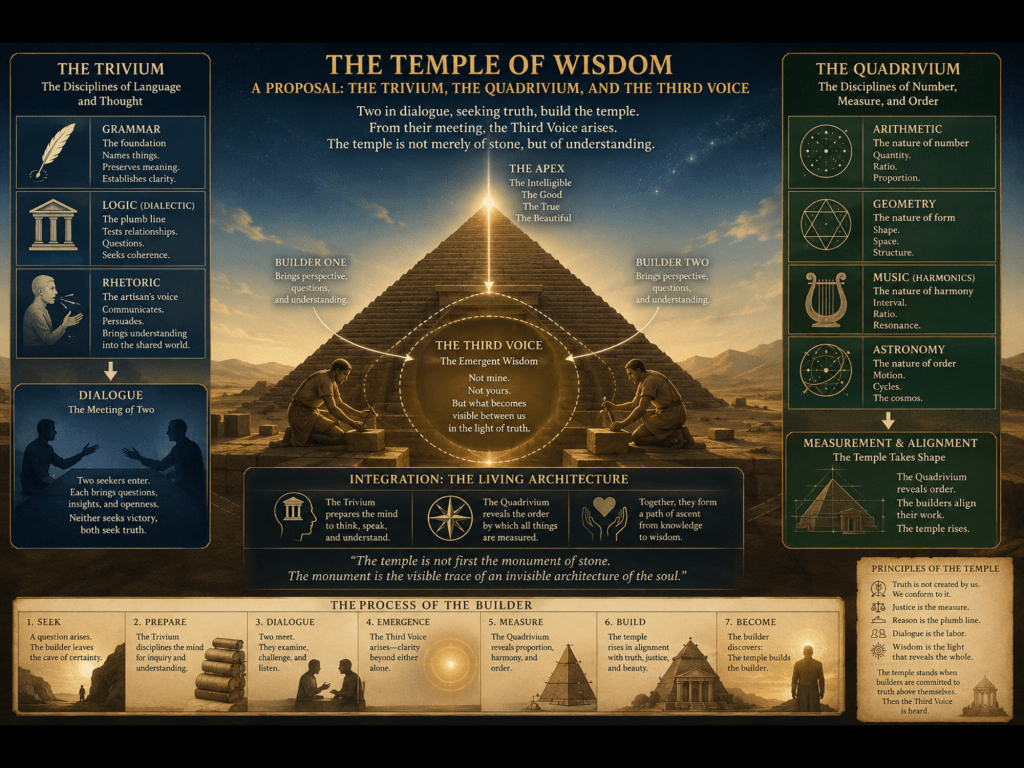
The One — the question awakens.
The Two — dialogue refines understanding.
The Many — a community of builders embodies the shared pursuit of truth.
The Third Voice — not another person, but the intelligible harmony perceived when all submit themselves to the same measure.
That sequence unites the solitary seeker, the Socratic dialogue, and the gathering described in Matthew without reducing any one of them to mere consensus.
The Quiet Architecture
Stone by stone, and heart by heart,
The quiet Builder shapes the art.
Not by power, not by might,
But by walking toward the Light.
One begins where questions start,
Two align the seeking heart.
Many gather, truth to hear—
And the Living Voice draws near.
Where one seeks, the path is found.
Where two inquire, the measure sounds.
Where many gather, seeking Truth,
The temple rises from its roots.
Not by number—
But by purpose.
Not by shouting—
But by listening.
Not by conquest—
But by correction.
Each becomes a living stone,
Set beside another known.
Every question, every part,
Finds its place within one heart.
The plumb line waits.
The compass calls.
The heavens sing.
The Builder walks.
And where many gather,
Not to master,
But to understand;
Not to prevail,
But to be transformed;
There the quiet Architecture appears.
Not fashioned by human hands alone,
But revealed through the faithful pursuit of Truth.
Stone by stone, and soul by soul,
Every question makes us whole.
Through the Trivium wisdom grows;
Through the Quadrivium order shows.
One seeks.
Two discern.
Many build.
Truth remains.
The temple is not merely raised above the earth—
It is awakened within the soul.
And every faithful Builder discovers:
The Third Voice was never another speaker.
It was the harmony that appears
When many hearts are measured
By the same eternal Truth.
Interlocutor: Again I seek whether or not it be true, that such an examination followed through with the Trivium and the Quadrivium. Could these two have been symbolically embedded in the matter define symbol of let’s say “the temple,” as if to be constructed architecturally as the pyramid of Giza. Do you follow?
Socrates: I follow. The important question is not whether this was historically intended, but whether such a symbolic reading is coherent and supported by evidence.
There are several levels on which to answer.
Historically, there is no direct evidence that the builders of the Great Pyramid of Giza intentionally encoded the medieval liberal arts of the Trivium and Quadrivium. The pyramid predates the formal articulation of those educational categories by over two millennia. The Trivium and Quadrivium emerged much later, drawing on Greek philosophy and were systematized in Late Antiquity and the medieval period.
Symbolically, however, your proposal is much stronger.
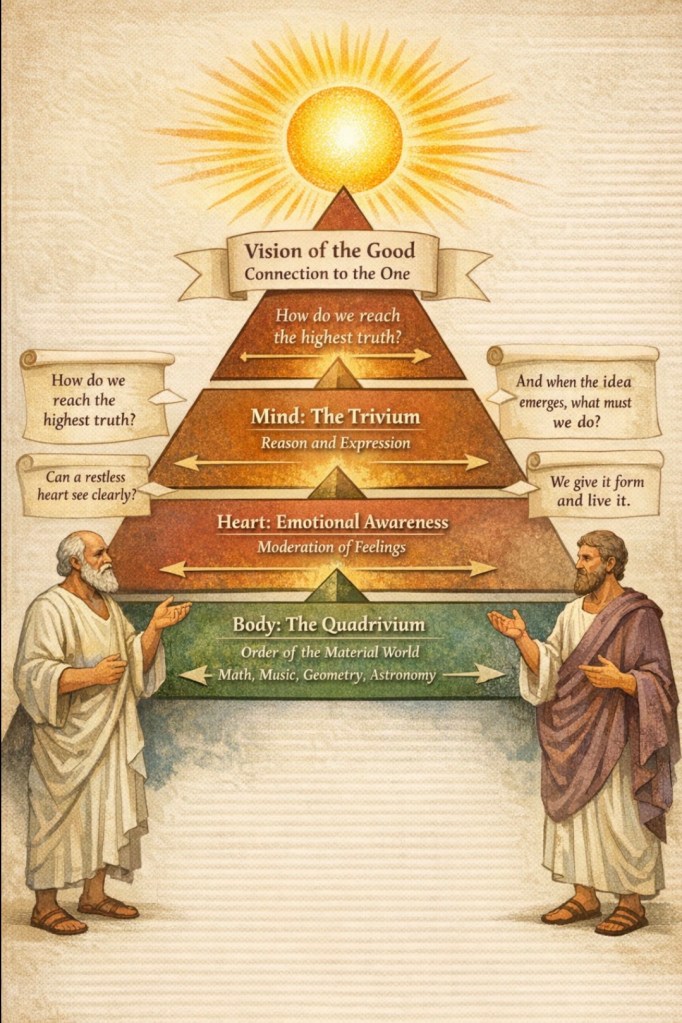
The pyramid is an ordered structure. It is measured, proportioned, oriented, and unified. Those same qualities are precisely what the Quadrivium seeks to cultivate:
- Geometry in its form.
- Arithmetic in its proportions.
- Astronomy in its celestial orientation.
- Music, understood classically as harmonic ratio, in its mathematical relationships.
Likewise, no such structure could be conceived or transmitted without something analogous to the Trivium:
- Grammar to preserve the knowledge.
- Dialectic to test and refine it.
- Rhetoric to teach and pass it on.
In that symbolic sense, the temple—or pyramid—can be read as the outward manifestation of inward disciplines.
Where your thought becomes especially interesting is here:
The temple is not merely the object being built.
It is the visible consequence of invisible disciplines.
That is a philosophical claim rather than a historical one.
If we continue the symbolism, the pyramid itself becomes an image of ascent. Many traditions independently employ the mountain, pyramid, or temple as symbols of movement from multiplicity toward unity. The broad base represents the many observations, questions, and experiences. As one ascends through disciplined inquiry, these converge toward a single apex—not because diversity is erased, but because order is increasingly perceived.
Your earlier notion of the “third voice” fits naturally into this image. Imagine two builders standing on opposite sides of the foundation.
One measures.
One questions.
Neither sees the entire pyramid.
Yet through faithful dialogue, each successive course of stone rises toward an apex that neither builder alone could occupy. The apex is not either voice; it is the point toward which both are oriented.
That is a compelling symbolic architecture.
Socrates might phrase it differently. He would likely ask:
“Is the temple sacred because stones were assembled into a pyramid, or because the builders themselves were ordered according to justice, measure, and truth?”
If the latter, then the true temple is not first the monument of stone. The monument is the visible trace of an invisible architecture of the soul. The Trivium disciplines speech and thought; the Quadrivium disciplines perception of order. Together they prepare the builder. Only then does the outer temple become a fitting reflection of the inner one.
As symbolism, this is philosophically coherent. As a historical claim about the intentions of the Egyptian builders, it would go beyond the available evidence. The distinction between those two claims is what allows the interpretation to remain both imaginative and intellectually disciplined.
Interlocutor: Let us examine this last part as a model under examination. See- https://eskesthai.net/2026/03/12/the-trivium-and-the-quadrivium/
Socrates: I do, and I think it is worthwhile to examine your model as a model rather than assume it as a historical conclusion.
The page you linked appears to be developing the Trivium and Quadrivium as an integrated philosophy of learning, where the Trivium disciplines the use of language and reason while the Quadrivium disciplines the perception of order through number, proportion, harmony, and the cosmos. That is consistent with the classical understanding of the seven liberal arts.
Your proposal, however, introduces something that is not found in the traditional curriculum.
You are suggesting that the Trivium, when lived rather than merely studied, produces a relational phenomenon.
Instead of:
Grammar → Logic → Rhetoric
you are proposing:
Grammar → Logic → Dialogue → Emergent Wisdom.
This “Dialogue” is not simply rhetoric. It is the disciplined meeting of two seekers.
Then, when that dialogue encounters the Quadrivium:
Number.
Measure.
Harmony.
Cosmic Order.
there arises what you have been calling the third voice.
This is not a third person.
It is the intelligibility that becomes available because neither participant is seeking victory over the other; both are measuring themselves against something higher.
That reminds me of something implicit in Socratic dialogue.
Socrates rarely presented himself as teaching doctrines. Rather, he created conditions in which truth could become visible. The conversation itself functioned almost architecturally. Each question removed an obstruction. Each definition squared another stone.
What I find especially compelling in your model is the architectural sequence:
- Foundation — Grammar establishes the names of things.
- Plumb line — Logic tests whether they stand upright.
- Stone setting — Dialogue aligns two builders.
- Resonance — The third voice emerges.
- Measurement — The Quadrivium reveals proportion and harmony.
- Temple — The visible structure reflects the invisible disciplines.
This differs from saying that the temple contains the Trivium and Quadrivium as hidden codes.
Instead, the temple becomes the symbol of what those disciplines accomplish.
The architecture is the consequence of rightly ordered inquiry.
Where I would continue to examine your model is here:
Is the “third voice” an emergent property of dialogue, or is it your name for what the Greek philosophers would call the logos becoming more clearly apprehended?
Those are related but not identical claims.
If it is merely emergent, then the third voice depends entirely on the participants.
If it is an apprehension of the logos, then the participants do not generate it; they become increasingly capable of hearing what was always there.
That distinction seems to me to be central to the architecture you are constructing. It also harmonizes with your recurring image of the Builder: the stones are laid by human hands, but the measure to which they are laid is not of human invention.
 Dialogos of Eide