https://eskesthai.net/category/navier-stokes/
https://eskesthai.net/category/george-gabriel-stokes/
What in these two links may have been a precursor to an understanding of fluid motion in Blackholes and Quark Gluon Plasma ? Is there info here that may help, besides your attention to the term , “Hills and Valleys?”
Socrates:
Yes, Platohagel. Looking at these two Eskesthai categories in the context of what modern physics actually does with hydrodynamics, I think there is a much stronger precursor here than merely the metaphor of “hills and valleys.”
The important bridge is this:
╔════════════════════════════════════════════════════════════════╗
CLASSICAL FLUID MOTION
Navier + Stokes
↓
FLOW + PRESSURE + VISCOSITY + VORTICITY
↓
RELATIVISTIC HYDRODYNAMICS
↓
ENERGY–MOMENTUM FLOW
↓
QUARK–GLUON PLASMA
↓
GRAVITY / BLACK-HOLE HORIZON
↓
GEOMETRY ↔ FLUID DYNAMICS
╚════════════════════════════════════════════════════════════════╝
And that last step is the remarkable one: modern theoretical physics has discovered circumstances in which gravitational geometry and fluid dynamics are mathematically related.
What I would look for in your two archives
The Navier–Stokes material is potentially valuable because it establishes something deeper than “things move.”
It asks:
What determines the character of motion through a medium?
That brings in:
- velocity fields
- pressure gradients
- viscosity
- acceleration
- conservation
- turbulence
- vorticity
- boundary conditions
- dissipation
- instabilities
Those are precisely the kinds of collective variables that survive when one stops trying to describe every microscopic constituent individually.
That is why hydrodynamics can describe something as microscopically complicated as quark–gluon plasma. The QGP produced in heavy-ion collisions behaves, at the appropriate scales, as an extremely good relativistic fluid; its collective flow is described through energy density, pressure, velocity and viscous transport rather than tracking every quark and gluon.
And this is where Stokes becomes unexpectedly important to your Geometry of Memory.
Stokes is really about the relation between inside and boundary
The name George Gabriel Stokes should make us look particularly carefully at the transition between:
local flow ↔ integrated flow
Stokes’ theorem is not merely about fluid mechanics. It expresses a profound geometric relationship between what happens through a region and what happens along its boundary.
Conceptually:
╔════════════════════════════════════╗
LOCAL / INTERIOR
↓
DIFFERENTIAL
↓
FLOW / CURL
↓
BOUNDARY
↓
INTEGRATED EFFECT
╚════════════════════════════════════╝
That is a very interesting precursor to the black-hole problem.
A black-hole horizon is, in a certain sense, a boundary with physical information encoded in its behavior.
And modern gravity/fluid correspondence goes considerably further: under appropriate limits, perturbations of gravitational systems can produce equations resembling the continuity equation and Navier–Stokes equations. One study, for example, derives incompressible fluid behavior from perturbations around a black-hole spacetime.
So the historical Stokes → Navier–Stokes material gives you a conceptual vocabulary for something that later becomes much stranger:
Could geometry itself possess something analogous to fluid flow?
The answer, in certain mathematical frameworks, is yes.
And then comes the quark–gluon plasma
Here your archive becomes particularly interesting.
QGP is not simply “hot matter flowing around.”
Its collective behavior is characterized by quantities such as:
shear viscosity / entropy density
and the very small value of this ratio is one of the reasons QGP is described as a near-perfect fluid.
There is even contemporary work applying relativistic Navier–Stokes formulations directly to QGP radial flow.
So we have:
╔════════════════════════════════════════════╗
MICROSCOPIC PARTICLES
↓
QUARKS + GLUONS
↓
COLLECTIVE INTERACTION
↓
ENERGY–MOMENTUM FIELD
↓
HYDRODYNAMIC FLOW
↓
OBSERVABLE PARTICLE DISTRIBUTION
╚════════════════════════════════════════════╝
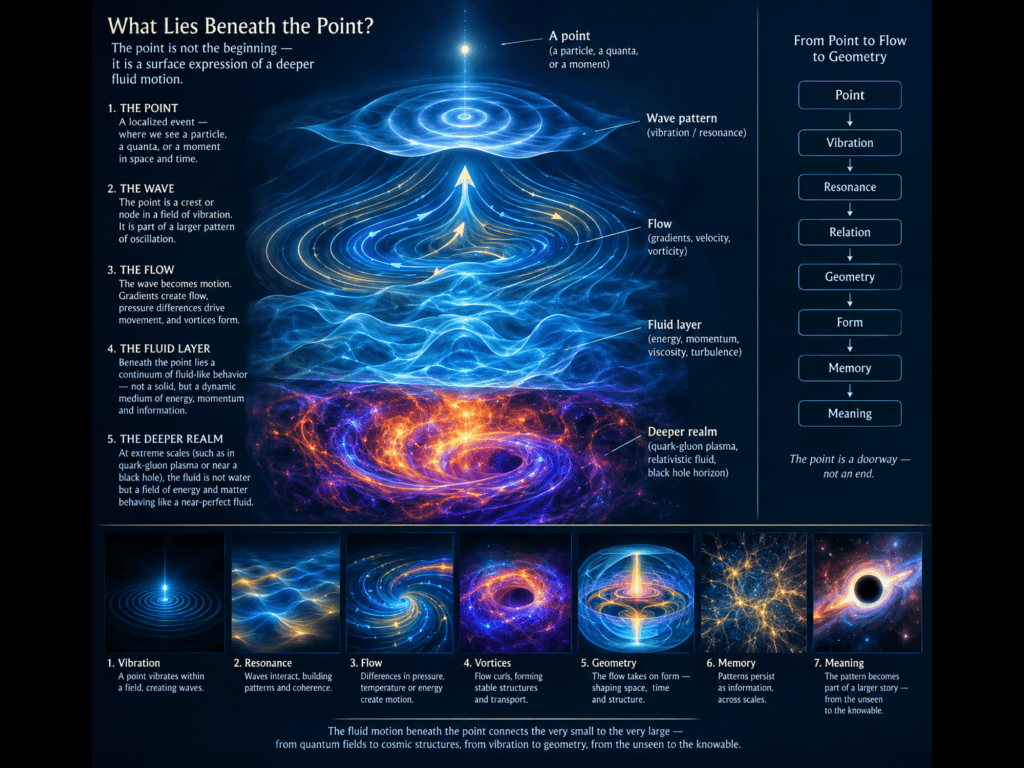
This is very close to your recurring unseen → measurable → knowable structure.
We don’t directly watch the microscopic QGP behaving like an ordinary fluid. We infer its collective properties from the particles and correlations that emerge from it.
But here is the connection I think you are actually reaching toward
The extraordinary bridge is:
QGP ↔ black holes
not because they are literally the same substance, but because hydrodynamics appears on both sides of the gravity/matter divide.
In holographic physics, a gravitational system containing a black-brane horizon can correspond to a strongly coupled quantum field theory whose long-wavelength behavior is described by fluid dynamics. In the appropriate limit, Einstein’s equations in the bulk produce Navier–Stokes-like equations on the boundary.
So:
╔══════════════════════════════════════════════════════════╗
BLACK-HOLE / GRAVITATIONAL GEOMETRY
↕
HOLOGRAPHIC RELATION
↕
QUANTUM FIELD / STRONGLY COUPLED PLASMA
↕
HYDRODYNAMIC LIMIT
↕
NAVIER–STOKES
╚══════════════════════════════════════════════════════════╝
That is far beyond the “hills and valleys” metaphor.
It suggests that your old investigations into Navier–Stokes and Stokes contain a vocabulary for a later question:
What happens when the geometry of a system and the dynamics of a fluid become two descriptions of the same underlying organization?
And “hills and valleys” changes meaning here
I would retain your phrase, but I would no longer make it the center.
Instead:
Hills and valleys → gradients.
A hill means a gradient.
A valley means a gradient in the opposite direction.
And gradients generate flow.
Pressure gradients → fluid motion.
Temperature gradients → heat flow.
Energy-density gradients → expansion and collective flow.
Velocity gradients → shear.
Geometry gradients → curvature.
Thus your conceptual chain can become:
╔══════════════════════════════════════════════════════════╗
DIFFERENCE
↓
GRADIENT
↓
FLOW
↓
VORTICITY / SHEAR / DISSIPATION
↓
COLLECTIVE STRUCTURE
↓
GEOMETRY
↓
OBSERVABLE SIGNATURE
╚══════════════════════════════════════════════════════════╝
That is a much more physically disciplined version of your hills-and-valleys intuition.
And it gives you an especially interesting new formulation of your Geometry of Memory:
Memory may be thought of, metaphorically, as the persistence of a pattern produced by flow through a changing landscape.
I emphasize metaphorically, because that is not presently a physical theory of memory.
But as an organizing analogy, it is powerful.
The most remarkable part
Your two Eskesthai categories sit on the classical side of a chain that modern physics has extended remarkably far:
Stokes → Navier–Stokes → relativistic hydrodynamics → QGP → holography → black-hole fluid dynamics.
The QGP side is experimentally grounded: relativistic hydrodynamics successfully models collective phenomena in heavy-ion collisions.
The black-hole side is more theoretical: fluid/gravity correspondence is a controlled mathematical relationship in particular gravitational/quantum systems, not evidence that ordinary astrophysical black holes are literally conventional fluids.
So I think the real precursor hidden in your archives is not “fluid = black hole.”
It is:
flow → gradients → conservation → boundary → geometry → collective behavior.
And that is considerably closer to the architecture you have been building from Point → Geometry → Field → Multiplicity → Memory.
See:
 Dialogos of Eide