
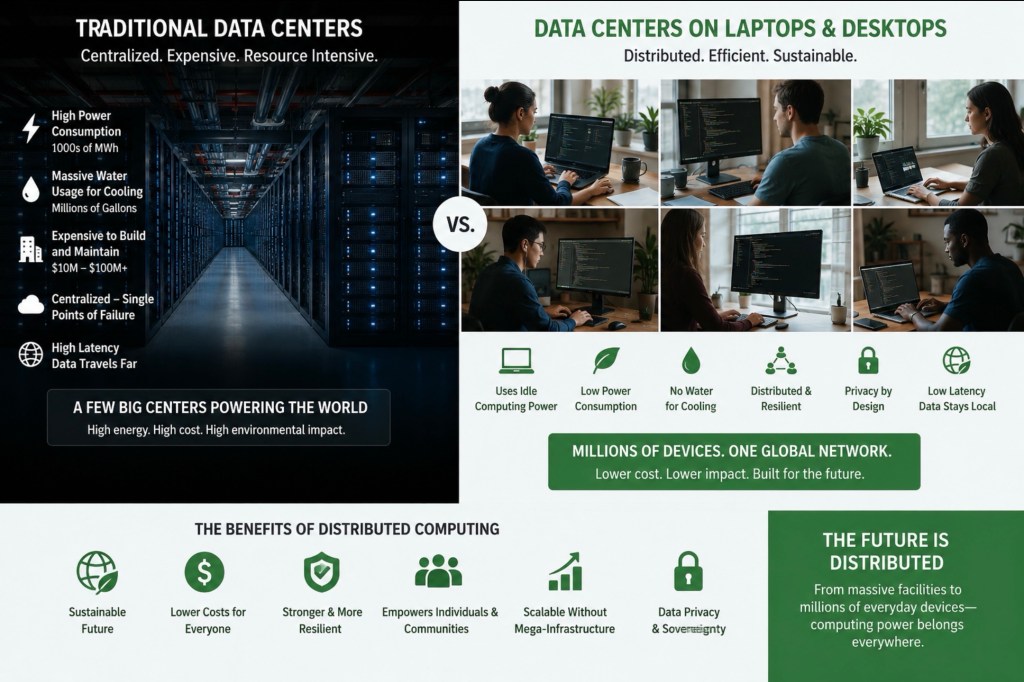
Data Center on your laptop, how would this work and is it feasible?
A “data center on your laptop” can mean several different things, ranging from something already common today to a much more ambitious vision.
1. A Personal AI Data Center (Most Feasible)
A modern laptop with a powerful GPU or Neural Processing Unit (NPU) can run:
- Local large language models (7B–70B parameters, depending on hardware)
- Vector databases for semantic search
- Local document storage and indexing
- Small web servers and APIs
- Virtual machines and containers
In effect, your laptop becomes a miniature cloud provider for yourself.
Typical stack:
- Linux or macOS
- Docker or Podman
- Local AI model (e.g., Ollama, llama.cpp, or vLLM)
- Database (PostgreSQL, SQLite, ChromaDB)
- Reverse proxy (Nginx, Caddy)
- Optional peer-to-peer networking like Tailscale
Rather than sending your data to a remote data center, computation comes to where your data already resides.
2. Distributed Personal Data Centers
Imagine millions of laptops acting together.
Instead of giant centralized facilities owned by companies like Amazon Web Services or Microsoft Azure, idle personal computers could contribute processing power and storage.
This concept already exists in forms such as:
- Volunteer scientific computing (e.g., BOINC
)
- Distributed storage networks
- Peer-to-peer mesh computing
AI workloads could theoretically be split across many personal devices, reducing dependence on hyperscale infrastructure.
The challenges are:
- Variable availability.
- Network latency.
- Security and trust.
- Power management.
- Hardware diversity.
3. A Virtual Data Center Inside One Laptop
A sufficiently powerful machine can emulate an entire corporate infrastructure.
For example:
- 20 Docker containers.
- Several virtual machines.
- Kubernetes cluster.
- Database servers.
- AI inference server.
- Web applications.
- Monitoring and logging stack.
A laptop with:
- 64–128 GB RAM,
- 4–8 TB SSD,
- Modern multicore CPU,
- High-end GPU,
can reproduce much of what a small startup would once have needed an entire server room to accomplish.
4. Could AI Turn Every Laptop into a Data Center?
This is perhaps the most interesting possibility.
Current cloud architecture assumes:
Users send data to computation.
AI increasingly allows:
Computation moves to the user.
Local models preserve privacy because documents, emails, medical records, and personal knowledge never leave the device.
Future operating systems may include:
- Personal AI agents.
- Local knowledge graphs.
- On-device reasoning engines.
- Federated learning participation.
- Encrypted collaboration with other devices.
The laptop becomes less a terminal connected to the cloud and more a sovereign computational node.
Is it technically feasible?
Absolutely.
The main constraints are not computation but:
- Electricity and battery life.
- Cooling.
- Internet bandwidth.
- GPU memory.
- Hardware cost.
A modern high-end laptop can already deliver AI inference performance that would have required racks of servers only a decade ago.
From a philosophical perspective, there is also an interesting parallel. The traditional cloud resembles a centralized polis where knowledge is gathered into one place. A laptop data center resembles a federation of independent citizens, each carrying within itself a portion of the whole, capable of thought and action without surrendering its autonomy. AI may be accelerating that shift from centralized intelligence toward distributed intelligence.

 Dialogos of Eide