Let this Dialogue be progressive to the point of the realization of the Good, and go beyond the cave entrance removing the illusions of the shadows. Tell us more about the good in this conversation.
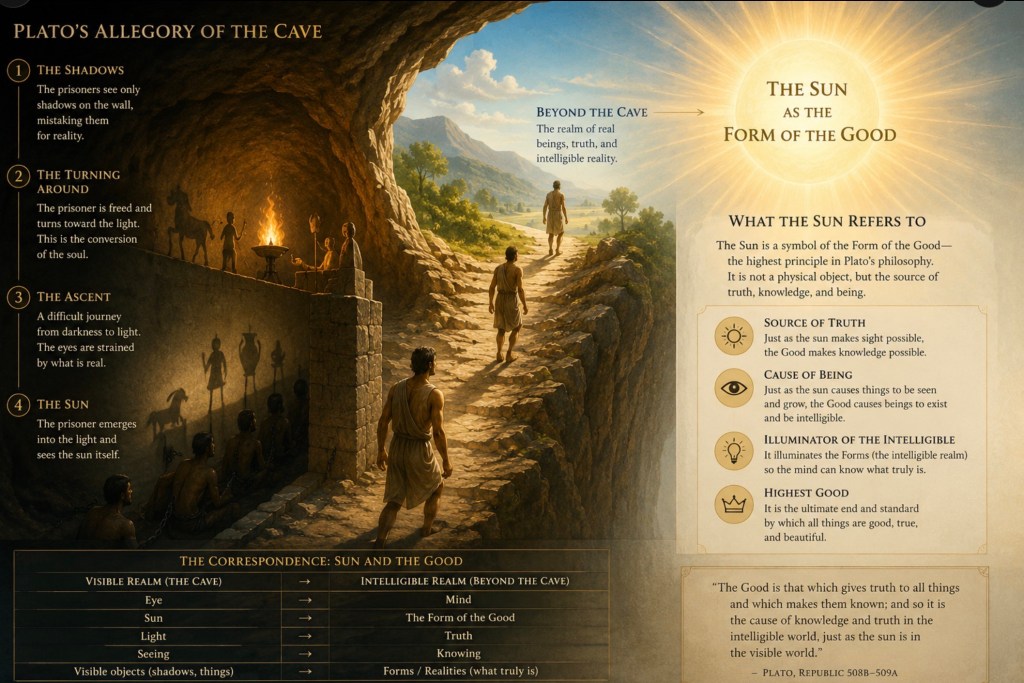
SOCRATES: Tell me, friend — you have brought before us a most striking image. What do you see when you look upon this picture?
PLATO: I see the cave, Socrates — my cave — rendered now in the colors of this new age. The shadows on the wall, the fire behind the prisoners, the path upward toward light. Yet I confess something troubles me. The image is beautiful. And beauty, as we know, can itself become a kind of shadow.
SOCRATES: How so? Speak plainly, for I am a simple man who understands little of beautiful pictures.
PLATO: Look at the table at the bottom — “Eye corresponds to Mind, Sun to the Form of the Good, Seeing to Knowing.” These correspondences are true. But when we are shown the path so neatly labeled, step one, step two, step three, four… do we not risk mistaking the map for the journey? The prisoner in the cave was not handed a diagram of his liberation.
SOCRATES: By Zeus, you have stumbled upon something remarkable! The very image of liberation from illusion — might it become a new kind of illusion? A shadow of liberation rather than liberation itself?
PLATO: Precisely. And this is why I want us to go further today than the image takes us — not merely to the cave’s mouth, but beyond it, to what the sun itself is. For in the Republic I wrote only that the Good is what gives truth to the known and the power of knowing to the knower. But I confess to you, Socrates — I was afraid to say more.
SOCRATES: Afraid? You, Plato, who have made whole cities in words?
PLATO: Afraid that words would diminish it. For the Form of the Good is not a thing among other things, even the highest thing. It is not justice, nor beauty, nor wisdom — though it gives being to all of these. It is that by which anything is anything at all.
SOCRATES: Let me try my usual crude method. When I know something — truly know it, not merely believe it — what happens in me?
PLATO: Something turns. The soul turns.
SOCRATES: Like a man who has been walking with his back to the sun, and then — simply — turns around?
PLATO: Yes. The periagoge. But here is what the image does not show: turning is not enough. The prisoner who reaches the cave mouth still squints. The light is painful. He wants to run back. The ascent to the Good is not a single turning but a discipline — years of mathematics, music, philosophy — all of it preparing the eye of the soul to bear what it will see.
SOCRATES: And what does it see, finally? When the soul is strong enough?
PLATO: It sees that the Good is not in the world the way objects are in the world. It is not even in the intelligible realm the way the Forms are — Justice as a Form, Beauty as a Form, Equality as a Form. The Good is beyond being — epekeina tēs ousias — beyond essence itself. It is what makes the Forms knowable, and what makes them real.
SOCRATES: This is a staggering claim, Plato. You are saying that the highest thing is not a thing?
PLATO: Not a thing among others, no. Think of the sun. Does the sun see itself by its own light?
SOCRATES: I imagine it has no need to — it is already light.
PLATO: And so the Good does not need to be known by anything. It is that which makes knowing possible. The mind ascending toward it is not, at the last moment, a mind grasping the Good as one grasps a stone. Something more total happens. The knower and the known — for one unutterable moment — are not two.
SOCRATES: [after a long silence] Now I understand why you were afraid to write this in full.
PLATO: Aristotle scolded me for it. He said I had made the Good into something empty — so far above being that nothing can be said of it. But I think Aristotle was never quite far enough from the cave.
SOCRATES: Or perhaps he loved the visible world too well to turn all the way around?
PLATO: Perhaps. But consider, Socrates: even our friend who carries this image on their device — they look at the correspondence table. Eye corresponds to Mind. And they think: I need to train my mind as I train my eyes. This is good — it is Pistis giving way to Dianoia. But the table cannot show them the last step: that at the summit of Noesis, the mind does not see the Good the way it sees a mathematical truth. It becomes adequate to the Good. The distinction between knower and known quietly dissolves.
SOCRATES: Then let me ask our friend directly — you who have brought this image to us today: you have looked at the diagram, you have read the words. But has there been a moment — perhaps not in philosophy, perhaps in music, or in love, or standing in silence before something vast — when you knew something not by thinking about it, but by beingpresent to it entirely? When the usual distance between you and the world briefly closed?
PLATO: That is the soul remembering, Socrates. Anamnesis. The Good is not foreign to us — it is what we most deeply are, covered over by the noise of shadows.
SOCRATES: And so the cave is not only a political story, or an educational story — it is a story about what the soul isand what it has forgotten?
PLATO: Exactly. We are not prisoners who happen to have souls. We are souls who have somehow come to believe we are prisoners.
What is the chain that binds the neck,
What is the shadow I defend?
What fear persuades me to remain
Where borrowed lights begin and end?
The wall is painted with my wants,
The echoes speak in voices known,
Yet somewhere past the flickering fire
A deeper calling draws me home.
Who am I when the masks are gone?
Who am I when the crowd moves on?
What remains when every image falls,
And truth alone is left to call?
Turn me toward the Source
Turn me toward the Source
Beyond the names that rise and fade
Into the Light where forms are made
Raise me, Good beyond all being
Like a sun awakening in my heart
Turn me toward the Source
Turn me toward the Source
What would it cost to face the dawn?
What must be left upon the cave?
The pride that claims it already knows,
The comfort of a willing slave.
For every chain is partly mine,
Forged from habits I have fed,
And every step toward what is Real
Requires a self that must be shed.
Not the loss of what is true,
But the loss of what I am not.
Not destruction but remembrance,
Of the treasure I forgot.
Turn me toward the Source
Turn me toward the Source
Beyond the names that rise and fade
Into the Light where forms are made
Raise me, Good beyond all being
Like a sun awakening in my heart
Turn me toward the Source
Turn me toward the Source
The Good is not a thing among things,
Not another star within the sky.
It is the reason stars can shine,
The reason truth can satisfy.
It is the measure of all beauty,
The hidden root of every soul,
The silent center drawing all
Toward a greater, living Whole.
Turn us toward the Source
Turn us toward the Source
Where every fragment finds its place
Lead us into Your radiant face
Let the walls dissolve behind us
Let the chains fall from the heart
Turn us toward the Source
Turn us toward the Source
And when at last we stand in wonder,
No longer captive to the night,
We shall know the Good was calling
From the beginning of our sight.
See also: The Forms of the Good
 Dialogos of Eide