In the Allegory of Plato’s Cave, we see comparisons to shadows on the wall, the turning about and ascent toward the opening to face the Sun. What does the Sun represent in this action?
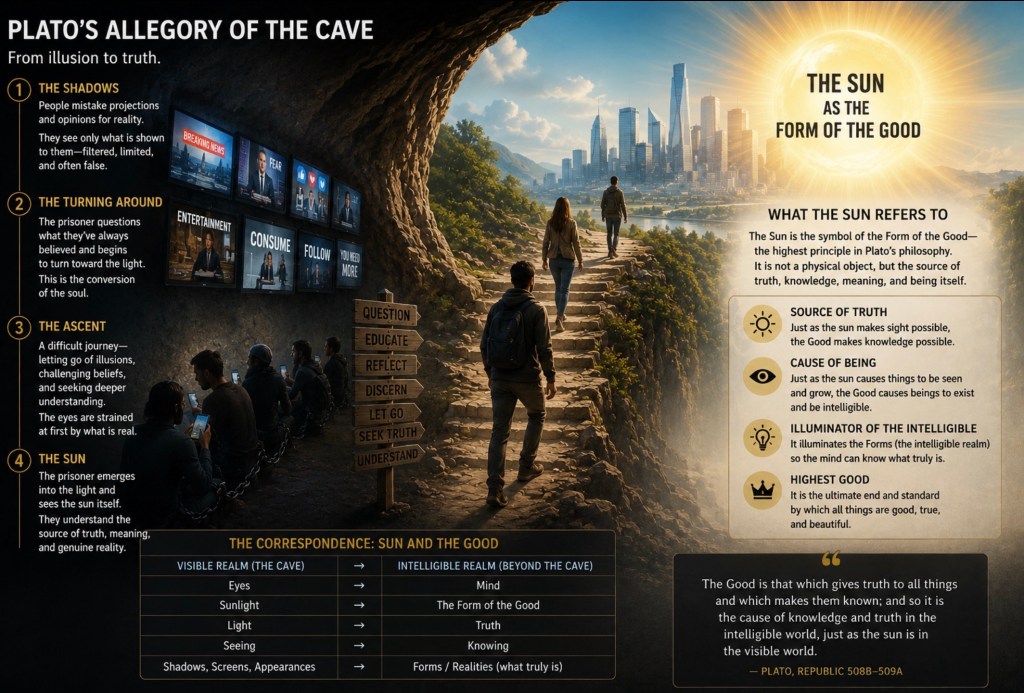
In the allegory found in The Republic, the Sun is not merely a physical object. It is the symbol of what Plato calls the Form of the Good.

- The Shadows
- These represent appearances, opinions, assumptions, and second-hand beliefs.
- The prisoners mistake shadows for reality because they have never seen anything else.
- The Turning Around (Periagoge)
- This is the conversion of the soul.
- Education is not the insertion of knowledge into an empty mind; it is the turning of one’s attention from illusion toward what is real.
- The soul already possesses the capacity for truth but is facing the wrong direction.
- The Ascent
- The difficult climb represents philosophical inquiry, self-examination, and the gradual apprehension of deeper realities.
- The eyes initially suffer because truth is more demanding than familiar appearances.
- The Sun
- The Sun symbolizes the Good itself.
- Just as the physical sun illuminates visible objects and makes sight possible, the Good illuminates intelligible realities and makes knowledge possible.
- The Good is not simply another thing among things; it is the source that enables truth, understanding, and even the being of what is known.
Plato writes that the Good stands in relation to the intelligible world as the sun stands in relation to the visible world. Without sunlight, the eye cannot see. Without the Good, the mind cannot truly know.

For someone reading the allegory in a more spiritual sense, the Sun can be interpreted as the ultimate source of meaning, reality, wisdom, or divine intelligibility. Different traditions have identified it with God, the One, the Monad, or ultimate Truth. Plato himself, however, identifies it specifically with the Good—the highest principle by which all other things become intelligible.
From the perspective of your recent reflections on anamnesis and the turning of the soul, the most significant point is that the ascent is not primarily about acquiring new information. It is about recollection and reorientation. The Sun does not merely reveal things outside the soul; it reveals what the soul was always capable of seeing once it ceased gazing at shadows.
The deepest question raised by the allegory is therefore not, “What is the Sun?” but rather: What in us is capable of recognizing it when we finally turn toward it? That question leads directly into Plato’s doctrine of anamnesis—the recollection of what the soul, in some sense, already knows.
 Dialogos of Eide