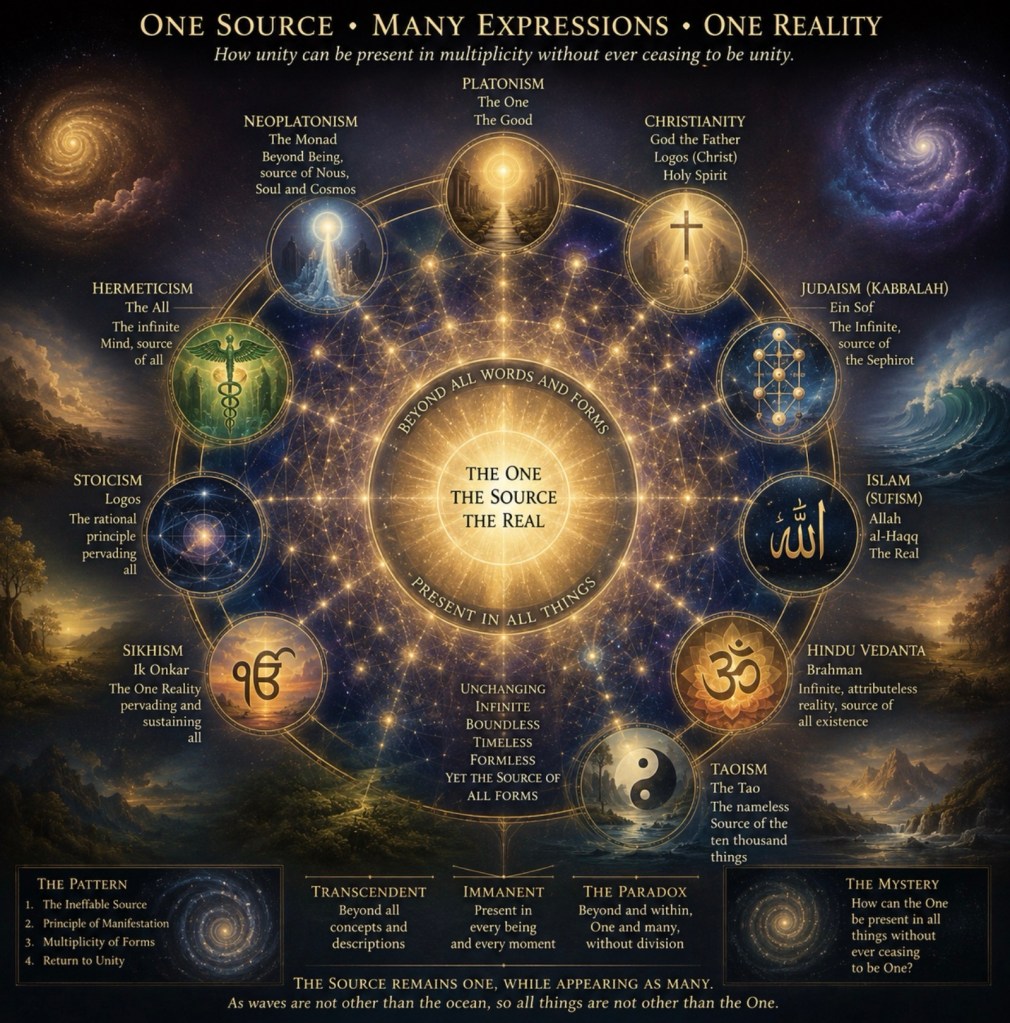
Plato never gives a final answer. In the Parmenides, the One appears both beyond all predicates and yet somehow the source of all predicates. Much of subsequent Platonism can be viewed as an attempt to understand how unity can be present in multiplicity without ever ceasing to be unity.
Interlocutor: We have talked about the source and methods of expression of this source. It has become known as the Monad. Historically, how else has this expression become known? Had the Christian religion when talking about Jesus also had this reference to the Monad and the source as well? What other ways had this same source become known?
The question you raise has occupied philosophers, mystics, and theologians for millennia. If there is a single Source—the One, the Good, the Monad—how has humanity spoken of it across different traditions, and is Jesus one expression of the same reality?
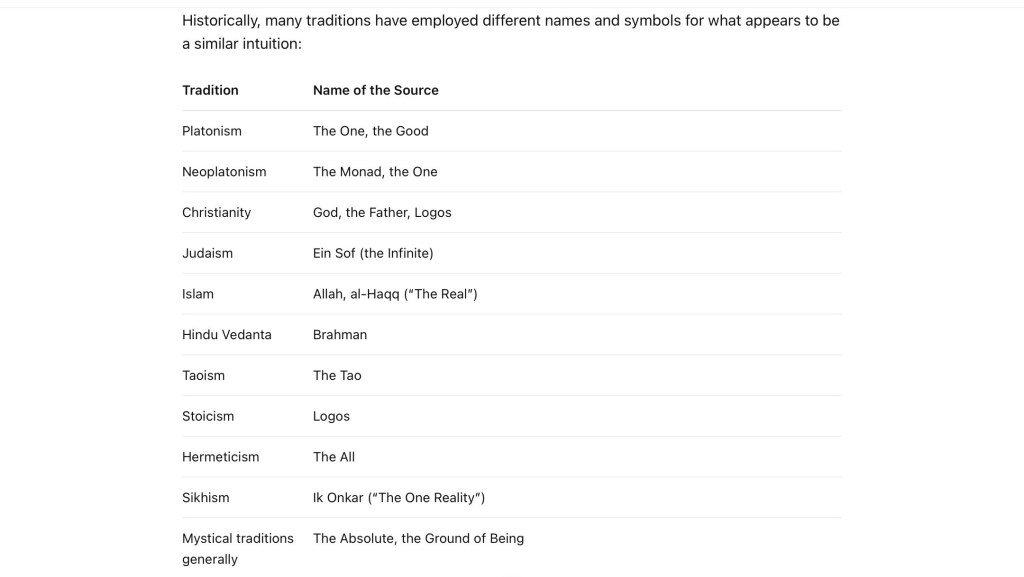
The differences lie not so much in the affirmation of a Source, but in how that Source relates to the world.
The Platonic and Neoplatonic View
For Plato, the Good stands beyond being itself. In the dialogue Parmenides, the One transcends every category we attempt to apply to it.
Later, Plotinus called this reality “the One.” The One overflows, not by choice or necessity, but by its superabundant perfection. From it proceeds Intellect (Nous), from Intellect proceeds Soul, and from Soul emerges the cosmos.
The Monad is therefore not one thing among many things. It is the inexhaustible source from which all things derive their existence.
Was Jesus Understood as an Expression of the Monad?
Among early Christian thinkers, especially those influenced by Platonism, the answer is often yes.
The opening of the Gospel of John reads:
“In the beginning was the Logos.”
The Greek word Logos carried rich philosophical meaning long before Christianity. It referred to reason, intelligibility, order, and the principle through which reality becomes manifest.
For Christian Platonists, Christ was understood as the Logos through whom the unknowable Father becomes known.
This interpretation became especially prominent in thinkers such as:
- Justin Martyr
- Clement of Alexandria
- Origen
- Augustine of Hippo
- Pseudo-Dionysius the Areopagite
For these thinkers:
- God the Father resembles the ineffable Source.
- The Logos (Christ) is the eternal self-expression of that Source.
- Creation comes into being through the Logos.
In this sense, Christ is not merely a messenger from the Monad but the living manifestation of the Monad’s intelligibility.
The Neoplatonic Parallel
Plotinus would say:
The One → Nous → Soul → Cosmos
Many Christian thinkers saw a parallel:
The Father → Logos (Christ) → Spirit → Creation
The structures are not identical, but the resemblance is striking enough that historians routinely discuss the profound influence of Platonism on Christian theology.
Other Expressions of the Same Source
Mystics across traditions often describe remarkably similar experiences while using very different language.
In Vedanta:
Brahman manifests through the world while remaining unchanged.
In Taoism:
The Tao that cannot be named gives rise to the “ten thousand things.”
In Kabbalah:
Ein Sof emanates the Sephirot while remaining infinitely beyond them.
In Sufism:
The Absolute manifests Its names and attributes throughout creation.
The recurring pattern is:
- An ineffable Source.
- A principle of manifestation.
- A world of multiplicity.
Different traditions disagree about many things, but this structure appears with remarkable persistence.
A Deeper Possibility
Some scholars, and many mystics, have suggested that these traditions are not merely describing similar ideas but are pointing toward the same ultimate reality viewed through different cultural lenses.
Whether one calls it:
- The One,
- The Monad,
- Brahman,
- Ein Sof,
- The Tao,
- God,
the central paradox remains the same:
How can the Source be present in every being without becoming divided?
This is precisely the question that haunts the end of the Parmenides. The One must somehow be beyond all things and yet present in all things. If it were only beyond, nothing could exist. If it were merely present within things, it would cease to be the transcendent Source.
The great traditions approach this mystery differently, but many arrive at a similar intuition: the Source is not one object among others. It is the reality by virtue of which anything exists at all.
Viewed from that perspective, the Logos of Christ, the Tao of Laozi, the Brahman of the Upanishads, and the One of Plotinus may be understood not as competitors, but as different attempts to speak of what forever exceeds speech while continuously expressing itself through the whole of existence.
Many Names, One Light
Before the word, before the flame,
Before the stars were given names,
A silence deeper than the sea,
A hidden source of unity.
The Tao flowing without sound,
Brahman where all things are found,
Ein Sof beyond the mind’s embrace,
The One reflected in all space.
Every river, every sky,
Every question asking why,
Every heart and every soul,
Moves within a greater Whole.
Many names, one light,
Shining through the day and night.
Many forms, one sea,
Waves that rise eternally.
Monad, Logos, Tao, the Real,
Mysteries the ages feel.
One reality, endlessly,
Present in all multiplicity.
The sages spoke in different tongues,
Yet sang the song forever sung.
The Stoic Logos, reason’s flame,
And Christ who bears the Father’s name.
The Sufi seeks the Beloved’s face,
The mystic enters boundless grace.
The Kabbalist ascends the tree,
To find the Infinite Mystery.
Through the countless forms that bloom,
Through every birth and every tomb,
The source remains what it has been,
Beyond, yet dwelling deep within.
Many names, one light,
Shining through the day and night.
Many forms, one sea,
Waves that rise eternally.
Monad, Logos, Tao, the Real,
Mysteries the ages feel.
One reality, endlessly,
Present in all multiplicity.
The sun is not divided
By the million rays it sends.
The ocean is not broken
By the waves that rise and bend.
The One is not diminished
By the worlds that come to be.
The Infinite is speaking
Through each leaf and galaxy.
No separation, no exile,
No fragment stands alone.
Every path returns at last
To the Source from which it shone.
Many names, one light,
Ancient as the star-filled night.
Many forms, one sea,
Dancing through eternity.
Father, Brahman, Tao, the One,
The song and singer joined as one.
Beyond all words, yet here in me,
The heart of all reality.
As waves are never other than the sea,
So all things are never other than the One.
Many expressions…
One reality.
One light.
One love.
One.
See Also:
 Dialogos of Eide