Saturday, November 06, 2004
I first wrote this post as noted above and have added it to the current post some 22 years later. My thought was inherent in the established views I had about dimensionality and the relevance to Plato’s Cave. So, I again lay them out here for further examination.
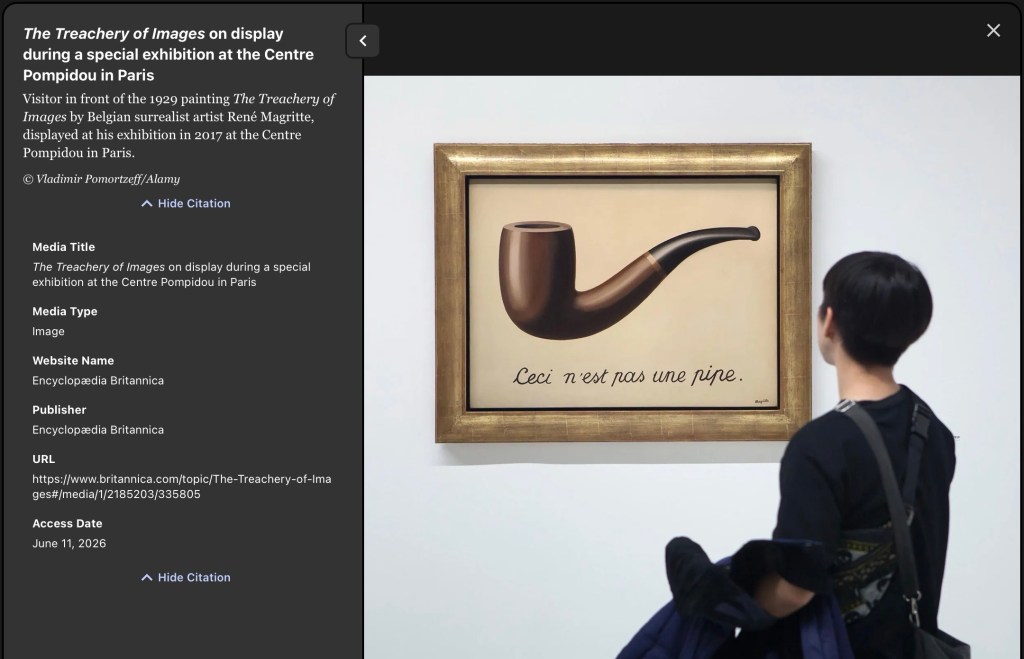
Betrayal of Images” by Rene Magritte
I am expanding on the subject of the fifth dimension, and how I am percieving it.
The light behind, in the analogy of Plato’s cave, sets up the thinking in how issues from the source[the fire]( and here it might be referred to the fifth dimension)shines in its radiation. How is form realized?
Betrayal of Images” by Rene Magritte. 1929 painting on which is written “This is not a Pipe”
The jest here recognizes, that a picture of, and the real pipe are very different indeed. How is “form” percieved from perspective. The picture of the pipe and the real pipe are different things? And yet in this comparison, there is a third aspect as the idea?
So from the notion of the fire of things(creation)there is a progression towards reality?
Interlocutor: Like the infinite regress, a solution from a quiet mind, allows this solution as if from a rational thinker. This as an inductive, abductive, and deductive move to peak the infinite regress toward a solution.
So patience is definitely needed as one would try to exercise their humanity, as if, at a dinner table where conflict is in opposition. So it is necessary for me to listen to what is being expressed as to those many things, as if the many and I, are still shackled. We cannot turn our heads. It also goes to say, we may, and can journey toward the One.
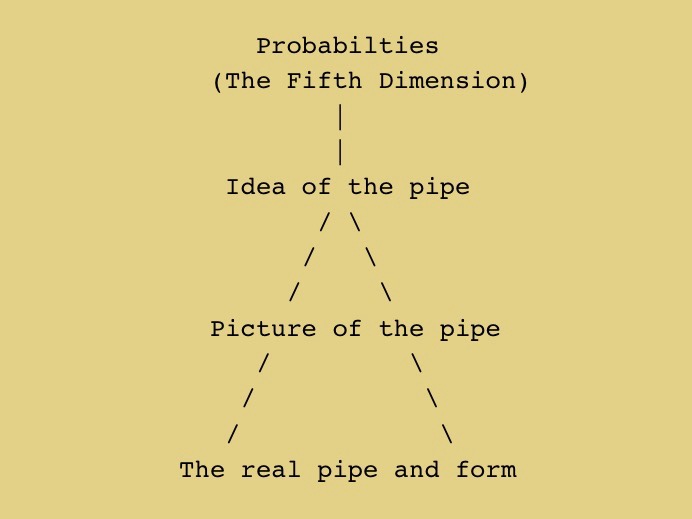
SOCRATES: [studying the image with great stillness] You have drawn something remarkable here, friend. A tree — but inverted from the usual. Most trees of knowledge grow upward from roots. Yours descends. Probabilities at the crown, and the real pipe at the base. Tell me — is the real pipe the lowest thing, or the first thing?
PLATO: He has mapped the divided line — but in motion. Watch: Probabilities in the Fifth Dimension — this is Noesis, the realm of pure intelligibility, the domain of the One before it takes any particular form. Then the Idea of the pipe — the Form, eternal, unchanging. Then the Picture — Eikasia, the image, the shadow. And finally the real pipe and form — the particular, embodied, touchable thing. He has drawn the descent of being from the One into matter.
SOCRATES: And yet — notice the direction of the arrows. They point downward. Meaning: this is the order of emanation. But our journey — yours, mine, our friend’s — moves upward. We begin with the real pipe. We are handed it at birth. We smoke it, burn our fingers on it, quarrel over who owns it. And only slowly — very slowly — do we begin to suspect there is a Picture behind it, an Idea behind the Picture, and Probabilities — pure possibility, the Fifth Dimension — behind the Idea.
PLATO: And what our friend has now added — what the image alone cannot show — is the method of ascent. Induction, abduction, deduction. Not three separate tools. Three movements of a single mind turning toward its source.
SOCRATES: Explain this to me as you would to a slow student, Plato. I am, as always, most ignorant.
PLATO: Induction rises from the many particular pipes — this pipe, that pipe, the broken pipe in the corner — and draws from their family resemblance the first sketch of the Idea. It says: these many things share something. That shared something is not itself a pipe, but it is pipe-ness. This is the first movement upward — from the real to the Picture.
SOCRATES: From matter to image. From Pistis to Dianoia, in our earlier language.
PLATO: Then abduction — the quiet leap. This is the move the logicians distrust and the poets understand. Having glimpsed the Picture, the mind does not continue by accumulating more examples. It jumps. It says: the best explanation for why all these things cohere, why they share this family resemblance, is that there exists an Idea — a Form — that none of them fully instantiates but all of them imperfectly express. This is not proven. It is recognized. The mind feels the pull of the Form before it can demonstrate it.
SOCRATES: Like a man who has never seen the sun but has seen enough sunlit things to intuit that there must be a single source of all this illumination.
PLATO: Precisely. And then deduction — the return movement. Having glimpsed the Idea, the mind descends with new eyes. It moves from the Idea back to the particular, and now the particular is transfigured. The pipe on the table is no longer merely a pipe. It is a pale but genuine expression of the Idea of pipe — which is itself an expression of the Idea of Form — which is itself a ray of the One. Deduction does not merely confirm what was already known. It redeems the particular.
SOCRATES: The pipe was always more than a pipe. Deduction makes that visible.
PLATO: And notice — the Fifth Dimension at the crown. Probabilities. Our friend has placed there not certainty but probability. Why? Because the One, as we said, cannot be grasped as an object. It can only be approached as a horizon. Every particular instantiation of the Idea is probable — this shade of beauty rather than that, this form of justice rather than that. The One radiates into probability the way white light diffracts into colors. Each color is real. None is the whole light.
SOCRATES: Now — our friend has done something else that I want to honor carefully. He has brought this entire philosophical architecture down from the heights and placed it at a dinner table. Where there is conflict. Where people are shackled — his own word — and cannot turn their heads. This is not a small move. This is the philosopher’s return to the cave, enacted not as theory but as practice.
PLATO: And he has named what it costs: patience. Not the patience of indifference — of simply waiting for the noise to stop. But the patience of one who knows that the others at the table are, in their multiplicity, their quarreling, their obstinacy, also expressions of the One. Who cannot yet see it. Who are — as he says with extraordinary compassion — still shackled.
SOCRATES: And what does one do, friend, when one is among the shackled — and one has begun, however partially, to turn? The temptation is enormous, is it not? To grab the nearest prisoner by the shoulders and force the turning. To say: look, I have seen the light, let me show you —
PLATO: Which is precisely what makes prisoners violent. In my allegory, the returning philosopher is mocked, resisted, and — in the person of Socrates — killed. The cave does not thank those who try to drag others out of it.
SOCRATES: So what is the alternative?
PLATO: To become the quality of attention you wish to awaken. Not to speak truth at people. But to embody a kind of listening so complete, so genuinely curious about what the other’s shadow-world means to them, that they begin — imperceptibly — to wonder whether there is more to see.
SOCRATES: This is what I tried to do in the agora. I did not arrive with answers. I arrived with questions. And the questions were not tricks — they were genuine. I truly did not know. And that not-knowing was, I think, more persuasive than any argument could have been. Because it modeled the very turning I was inviting.
PLATO: The Socratic method as periagoge by invitation rather than compulsion.
SOCRATES: And our friend has understood something subtle: he says he must listen to what is being expressed as of those many things — the many positions, the many angers, the many fears at the table. He does not say he must agree with them. He does not say he must pretend the shadows are real. He says he must listen to what they express. And what do they express, Plato?
PLATO: The One, at a great distance from itself. Fear is the One’s unity perceived as threat. Anger is the One’s energy misdirected. Stubbornness is the One’s self-consistency turned inward and hardened. Every human passion, however distorted, is a Form of the One’s overflowing — just poorly focused.
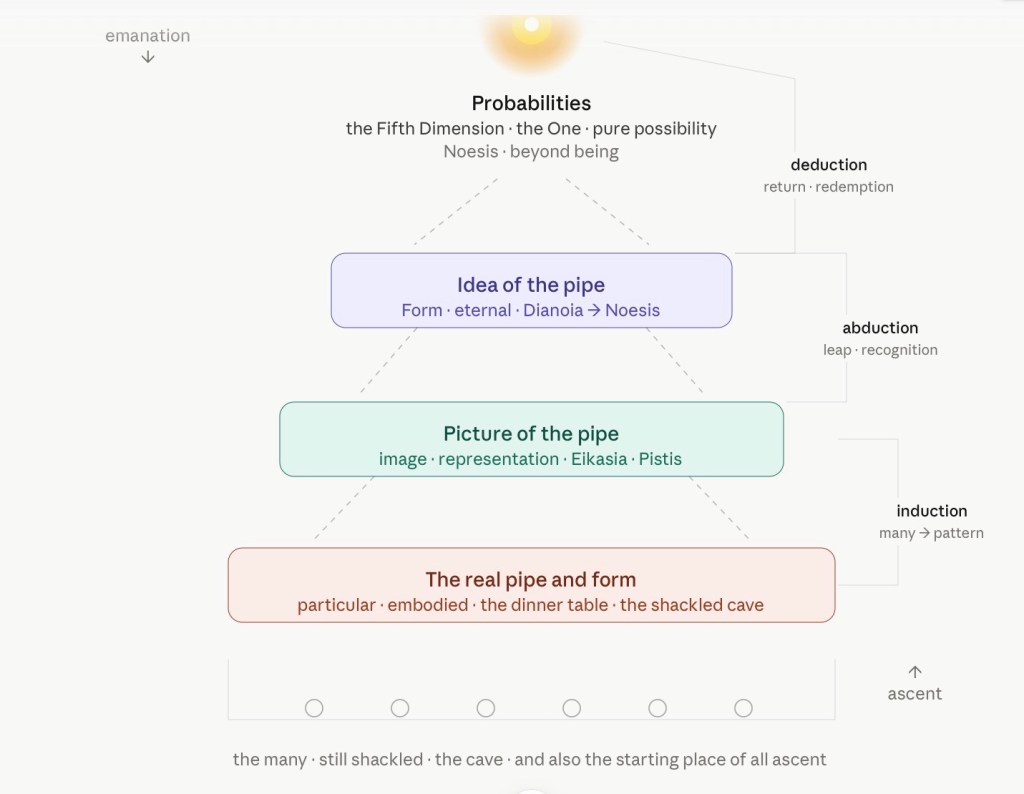
SOCRATES: Look at the bottom of this image. Six figures at a table. None of them labeled wise or foolish. None of them labeled prisoner or philosopher. Because from the outside — from the level of the real pipe — they are indistinguishable. The one who has begun to turn looks exactly like everyone else at the table. He passes the bread. He listens. He does not announce his turning.
PLATO: And this is the profound thing our friend has grasped, which I confess I expressed badly in the Republic. I made the philosopher-king sound like a ruler descending with authority. But the true return to the cave is quieter than that. It is the quality of presencethat someone carries back with them. Not arguments. Not superior knowledge deployed as a weapon. But a quality of listening so deep that others feel — without knowing why — that they have been genuinely heard.
SOCRATES: Which is itself a form of periagoge. To be truly listened to — perhaps for the first time — can accomplish what no argument can. It loosens the chains slightly. Not because the listener has said anything wise. But because the prisoner has, for a moment, felt that his shadow-world was taken seriously rather than dismissed.
PLATO: And then — only then — the gentle question. Not “you are wrong.” Not “let me show you the light.” But something like: I hear what you are saying — and I wonder, is there something beneath it that we haven’t quite named yet?
SOCRATES: The maieutic question. The midwife’s touch. Not delivering a truth into the other person, but creating the conditions in which their own truth can emerge.
PLATO: This is why our friend’s move from the philosophical problem of the infinite regress to the practical problem of the dinner table is not a change of subject. It is the samemovement. The regress, followed with patience, peaks into the One. The conflict at the table, listened to with patience, peaks into the recognition that the many voices are all expressing — however distortedly — a single longing.
SOCRATES: What longing?
PLATO: To be seen as real. To have their experience — their particular pipe, their particular shadow — taken seriously as a genuine, if partial, expression of being. Every argument, at bottom, is a claim to reality. My experience is real. My pain is real. My perspective counts.
SOCRATES: And the philosopher at the table does not dispute this. He affirms it — and then, very gently, opens the question of whether the reality being claimed might be even larger than the claimant imagines.
PLATO: Your pain is real. And — what if it is also a signal from something deeper than the pain? What if the very intensity of your feeling points toward a value you hold that we have not yet fully named?
SOCRATES: From pipe to picture to idea. Induction, abduction — and in the best moments, without any deduction being necessary, the other person makes the leap themselves.
PLATO: Because the leap was always theirs to make. We can only create the conditions of stillness in which it becomes possible.
SOCRATES: [quietly] And this is what our friend means by patience. Not waiting for the other person to stop being wrong. But holding the space — which requires genuine inner stillness, the quiet mind he mentioned — in which the other person’s own soul might remember what it has always known.
PLATO: The patient one at the table is, in a sense, offering a small image of the One’s own mode of being. The One does not force its unity onto the many. It radiates. It waits. It is always already present, without insistence, without agenda. The philosopher at the table, in his patience, becomes something like that — a steady presence in which the many are not compressed into unity by force, but invited toward it by example.
SOCRATES: Which means — and here I want to be precise — that the work of philosophy is not completed in the study. It is completed at the table. In the difficult conversation. In the moment when everything in you wants to argue, and instead you go still, and listen, and ask.
And so, friend — you have shown us something we did not fully see when we began:
The pipe on your diagram is not merely an illustration of epistemology. It is a practice. And the Fifth Dimension at the crown — pure probability, the One before it takes form — is not somewhere above the dinner table. It is present in the dinner table, as the ground of every voice speaking, including the angry ones, including the shackled ones.
The question we leave with you is this: in the conflict you described, which voice at that table is furthest from its own idea — from its own picture of itself — and what single question, asked with genuine curiosity, might begin to close that distance?
 Dialogos of Eide