Who and what is an Interlocutor?
An interlocutor is a person who takes part in a dialogue or conversation. The word comes from the Latin inter (“between”) and loqui (“to speak”), meaning one who speaks between or among others.
In ordinary usage, an interlocutor is simply a conversational partner. If two people are discussing philosophy, each is the other’s interlocutor.
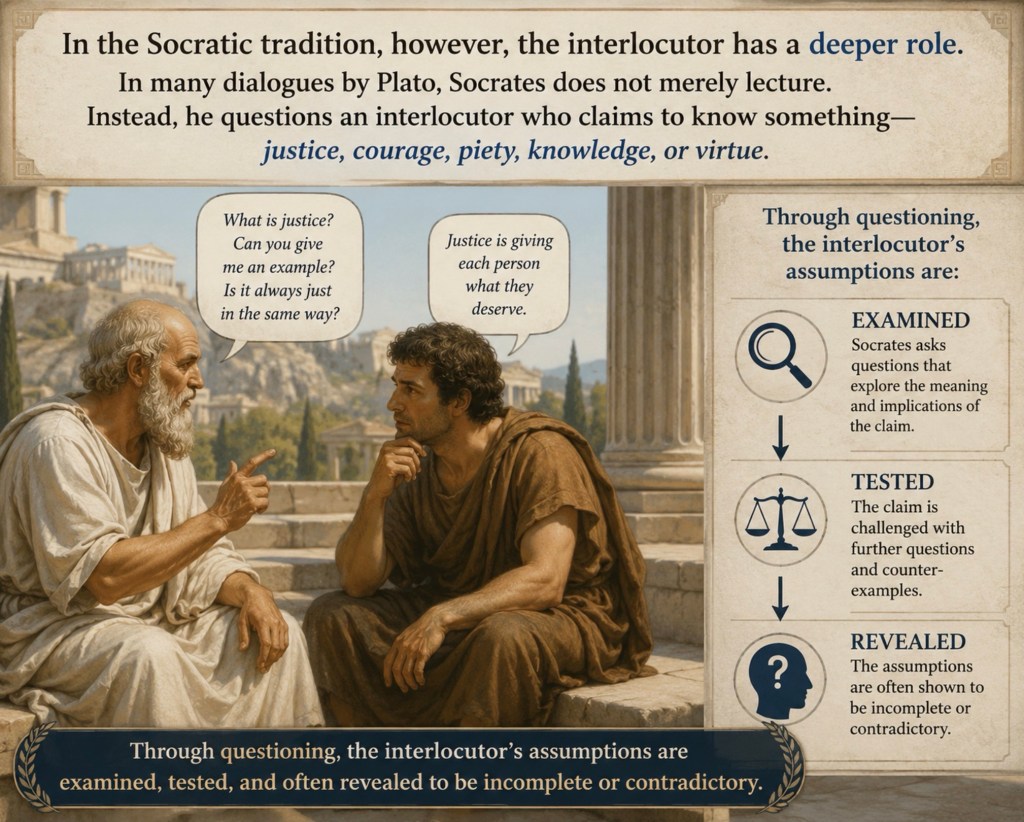
In the Socratic tradition, however, the interlocutor has a deeper role. In many dialogues by Plato, Socrates does not merely lecture. Instead, he questions an interlocutor who claims to know something—justice, courage, piety, knowledge, or virtue. Through questioning, the interlocutor’s assumptions are examined, tested, and often revealed to be incomplete or contradictory.
Thus, in philosophy, an interlocutor is often:
- A dialogue partner.
- A participant in inquiry.
- A representative of a particular viewpoint or belief.
- A co-investigator in the search for truth.
One might even say that the interlocutor serves as a mirror. Through the exchange of questions and answers, both participants discover what they truly know and what they merely suppose they know.
This raises a further question: Is the interlocutor merely another person, or is there also an interlocutor within oneself?
When a person examines their own beliefs, questioning and answering themselves, the dialogue becomes internal. In that sense, the interlocutor can be both another human being and the reflective voice through which the mind converses with itself.
As Plato describes thinking in the dialogue Theaetetus, thought itself is a kind of silent conversation the soul has with itself. If that is so, then every genuine act of inquiry requires an interlocutor—whether seated across from us or arising within us.
Interlocutor: In many instances through Socrates dialogues with Plato, Plato serves as an interlocutor. Sometimes we may see a third person talking serving as an interlocutor for Socrates and Plato themselves through there dialogues. What does that third person represent?
The question invites a deeper reading of the dialogues.
Strictly speaking, in most of Plato’s dialogues, Plato himself is not an active speaker. He is the author and dramatist, while Socrates and others carry the conversation. Yet, as readers, we often sense Plato’s mind operating through the entire dialogue.
When a third person enters the conversation—someone like Euthyphro, Meno, Gorgias, Callicles, or Parmenides, that figure may be understood on several levels.
1. The Third Person Represents a Particular Way of Thinking
Each interlocutor embodies a perspective.
- Euthyphro represents religious certainty.
- Meno represents the ambitious seeker who wants quick answers.
- Callicles represents power and worldly success.
- Parmenides represents rigorous metaphysical criticism.
The dialogue is not merely between individuals but between modes of consciousness.
2. The Third Person Represents the Reader
Many commentators have suggested that Plato’s interlocutors often stand in for us.
As Socrates questions them, we recognize our own assumptions being challenged. Their confusion becomes our confusion; their discoveries become our discoveries.
In this sense, the interlocutor acts as a bridge between the dialogue and the reader.
3. The Third Person Represents the Soul Under Examination
From a more philosophical perspective, the interlocutor can symbolize the soul itself.
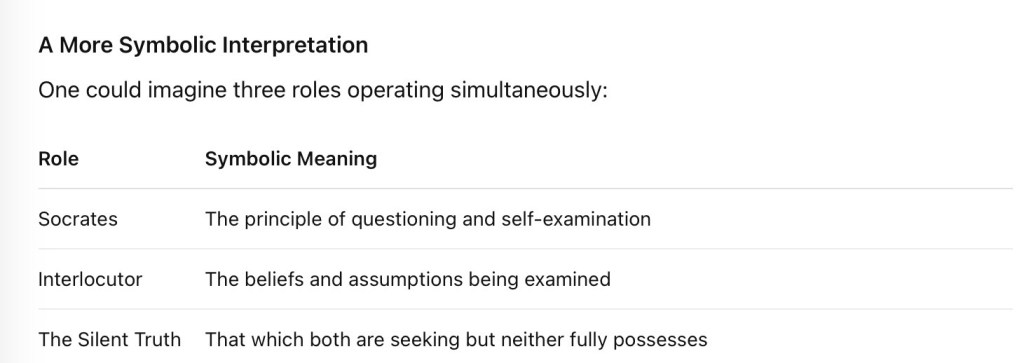
Socrates functions as the principle of inquiry, while the interlocutor embodies the beliefs, opinions, and assumptions that inquiry examines.
Seen this way, every dialogue is an interior drama.
There is:
- the questioning voice,
- the answering voice,
- and the truth that neither fully possesses.
4. The Third Person Represents Multiplicity Before Unity
If one reads Plato through the later Neoplatonic tradition, especially through thinkers such as Plotinus and Proclus, the interlocutor can be seen as the many perspectives through which the soul approaches the One.
Each interlocutor grasps a fragment of reality. Socrates continually shows that no fragment is the whole.
Thus the dialogue itself becomes a movement from multiplicity toward unity.
Under this interpretation, the “third person” is not merely another speaker. He is the manifestation of a partial truth that must be brought into dialogue.
This may explain why Plato rarely presents philosophy as a lecture. Reality reveals itself not through a single voice, but through the tension between voices. The interlocutor is therefore not an obstacle to wisdom but a necessary condition for it.
Without the interlocutor, there is no dialogue.
Without dialogue, there is no examination.
Without examination, there is no philosophy. As Socrates famously declares in Apology, “the unexamined life is not worth living.”
The third person, then, may be understood as the living field in which examination becomes possible. He is not merely a participant in the search for truth; he is one of the forms through which truth gradually discloses itself.