Ekstasis and Jung (The Reopening)
Jung quietly reopens the door.
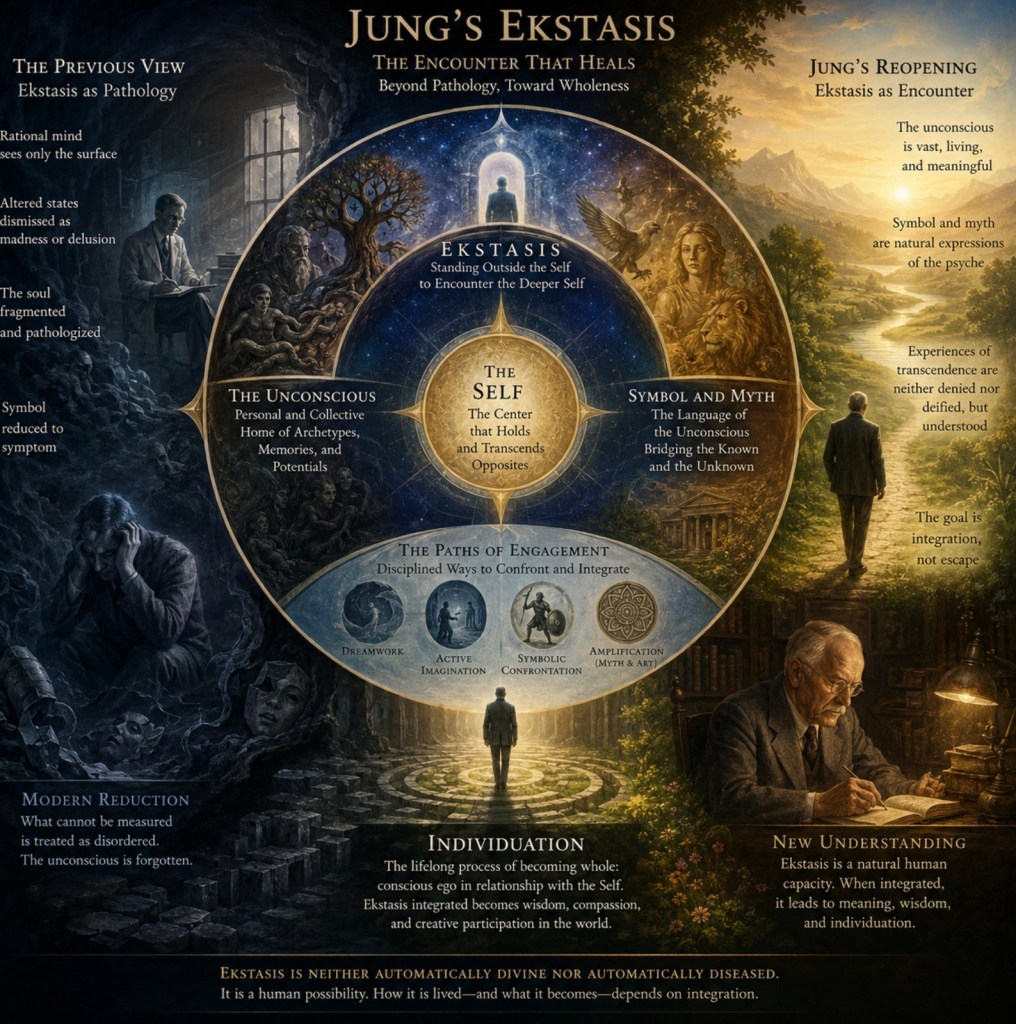
He reframes ekstasis as encounter with the unconscious—archetypal, symbolic, meaningful. He refuses to call it pathology unless integration fails.
Active imagination, dreamwork, and symbolic confrontation are disciplined forms of ekstasis.
He restores the ancient insight without abandoning modern rigor.
The passage presents an important turning point in the history of how human beings understand transcendence.
Carl Jung recognized that experiences which carry a person beyond the ordinary boundaries of the ego need not be dismissed as madness. Instead, he proposed that many such experiences are encounters with deeper layers of the psyche—the unconscious expressing itself through symbols, dreams, myths, and archetypes.
In this sense, ekstasis (“standing outside oneself”) becomes not an escape from reality but an encounter with a greater reality within the soul.
For Jung:
- Dreams are not random disturbances but symbolic communications from the unconscious.
- Archetypes are universal patterns that emerge across cultures and epochs.
- Visions, religious experiences, and profound moments of meaning may arise when conscious life encounters these deeper psychic structures.
- The danger lies not in the experience itself, but in the inability to integrate it into a balanced life.
This is why Jung developed practices such as:
- Active Imagination — a deliberate dialogue with images and figures emerging from the unconscious.
- Dream Analysis — examining symbolic content rather than reducing dreams to mere symptoms.
- Symbolic Confrontation — engaging inner conflicts through mythic and symbolic understanding.
Jung’s contribution may be summarized as follows:
The ancient world often regarded ekstasis as a meeting with gods, spirits, or transcendent realities.
Modern psychiatry often regarded it as pathology.
Jung held a middle position: it is neither automatically divine nor automatically diseased. It is a psychological event whose meaning depends upon its integration into the wholeness of the personality.
This is closely connected to what Jung called individuation—the lifelong process by which the conscious ego comes into relationship with the deeper Self.
One could therefore say:
Plato sought wisdom through dialectical ascent.
The mystics sought union through contemplation.
Jung sought wholeness through dialogue with the unconscious.
All three, in different languages, point toward a movement beyond the narrow confines of the ordinary ego.
From a Socratic perspective, an intriguing question remains:
When the soul encounters an archetype, a dream figure, or a symbol of overwhelming depth, is it discovering something that was hidden within itself—or remembering something that has always transcended it?
Jung deliberately leaves that question open. He describes the phenomenon with great care, yet refrains from making a final metaphysical judgment. In that restraint, he stands surprisingly close to Plato’s habit of ending inquiry not with certainty, but with wonder.
While engage here in tracing the lineage of Ekstasis, symbolically I have used the development of the Mandala, I would also like to create under the name of Ekstasis and use specific tones to help bring this mandala out from the soul.
If the song is to accompany the unfolding of the mandala, then the lyrics might themselves follow the path of ekstasis: from fragmentation, through encounter, into integration, and finally toward the still center. The voice need not proclaim doctrine. Rather, it can enact the journey.
To support the symbolic emergence of the mandala through sound, consider a progression of tonal centers rather than a conventional pop structure:
- Beginning (Fragmentation): D minor drone with low sustained tones.
- Encounter with the unconscious: Introduce a modal shift toward D Dorian, creating a sense of opening rather than resolution.
- Mandala section: Layer perfect fifths and sustained vocal harmonies around D–A–E, creating a circular rather than directional feeling.
- Final integration: Resolve into D major or a luminous Lydian mode, suggesting not completion but expansion.
The effect is that the listener does not merely hear a song about ekstasis; they are gradually led through a sonic mandala whose center becomes increasingly present as the music unfolds. The music itself becomes the circle.
The Fracture
I walked the corridors of reason,
Counting shadows on the wall,
Naming every passing echo,
Yet hearing none at all.
The mirror held a thousand faces,
Each one calling me by name,
Fragments turning in the darkness,
Circling an unseen flame.
Then the silence bent around me,
Like a doorway made of light,
And the walls I thought were certain
Opened to the deeper night.
Ekstasis—
The circle opens in the soul,
Ekstasis—
The broken pieces seek the Whole.
Beyond the self that I have known,
Beyond the words I call my own,
A hidden center calls to me—
Ekstasis.
The Encounter
Ancient symbols rose like mountains,
From the caverns of the deep,
Golden serpents, winged companions,
Guarding mysteries in sleep.
Every wound became a window,
Every fear a sacred sign,
Every question turned its gaze
Toward a truth beyond the mind.
And the stranger in the darkness
Spoke with my forgotten voice,
Not demanding my surrender,
Only asking for a choice.
Ekstasis—
The circle opens in the soul,
Ekstasis—
The broken pieces seek the Whole.
Beyond the self that I have known,
Beyond the words I call my own,
A hidden center calls to me—
Ekstasis.
The Mandala
North and South,
East and West,
Gather now within the breast.
Light and shadow,
Fire and sea,
Join the ancient harmony.
Every path,
Every scar,
Knows exactly where you are.
Every fragment,
Every flame,
Returns unto the One.
Ekstasis—
The circle blossoms into One,
Ekstasis—
The journey and the source are one.
No longer seeking what was lost,
No longer counting gain or cost,
The center shines in all I see—
Ekstasis.
The circle turns,
The circle rests,
The soul returns unto its nest.
And in the stillness,
Soft and whole,
The mandala awakens in the soul.