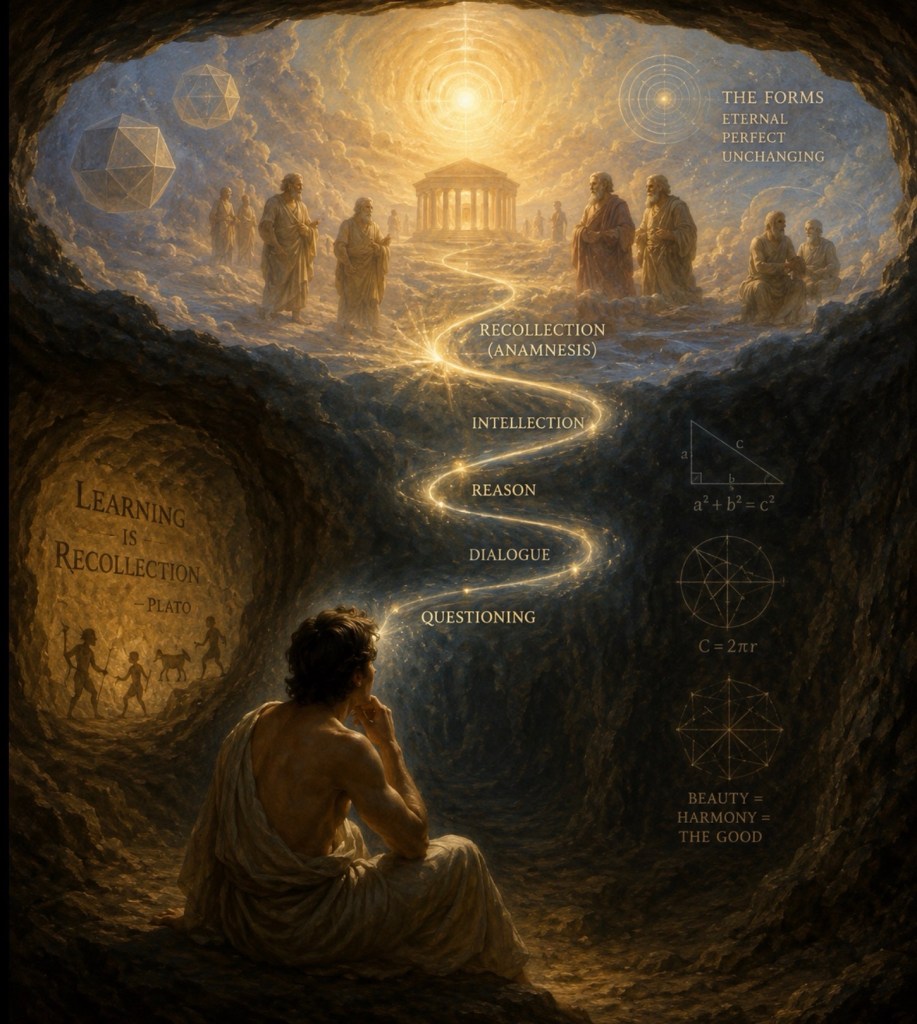
Plato’s doctrine of recollection, however, addresses such criticism by saying that souls are born with the concepts of the forms, and just have to be reminded of those concepts from back before birth, when the souls were in close contact with the forms in the Platonic heaven. Plato is thus known as one of the very first rationalists, believing as he did that humans are born with a fund of a priori knowledge, to which they have access through a process of reason or intellection — a process that critics find to be rather mysterious
The passage touches upon one of the most profound and debated aspects of Plato’s philosophy: the doctrine of anamnesis or recollection.
According to Plato, when we encounter truths that appear universal, necessary, and eternal—such as mathematical principles, justice itself, beauty itself, or equality itself—we are not merely assembling them from sensory experience. Rather, we are remembering realities that the soul knew before embodiment.
In dialogues such as the Meno and the Phaedo, Plato argues:
- Sensory experience gives us only imperfect examples.
- Yet we are somehow able to judge these imperfect examples against a perfect standard.
- Therefore, knowledge of the perfect standard cannot have originated solely from the senses.
- The soul must already possess some acquaintance with these standards.
- Learning is thus recollection.
For Plato, when a geometer discovers a theorem, or when a person recognizes an act as unjust, the soul is not creating truth but awakening to it.
The criticism arises when one asks: How does this recollection actually occur?
Critics, from Aristotle onward, questioned the mechanism. If the soul once beheld the Forms, why does it forget them? How does reasoning retrieve what is forgotten? What exactly bridges the gap between ordinary experience and eternal knowledge?
Plato’s answer is suggestive rather than fully systematic. He often presents dialectic—the disciplined questioning exemplified by Socrates—as the means by which latent knowledge is awakened. The famous slave-boy episode in the Meno is intended to show that proper questioning can draw forth truths that were not explicitly taught.
From a modern perspective, Plato’s doctrine can be interpreted in several ways:
- Literally: the soul existed before birth and remembers eternal Forms.
- Epistemologically: certain structures of understanding are innate.
- Psychologically: truth emerges from depths of the mind not immediately accessible to conscious awareness.
- Symbolically: learning is a process of uncovering what is already implicit within us.
This last interpretation influenced thinkers such as Carl Jung. Jung did not accept Plato’s Forms in their original metaphysical sense, but he similarly proposed that the psyche contains deep, inherited patterns—archetypes—which shape experience prior to conscious learning.
In the context of your exploration of Ekstasis, one might say that recollection is not merely remembering a forgotten fact. It is the soul awakening to a deeper dimension of reality already present within it. The movement is not outward toward new information but inward and upward toward what was always there.
Plato would likely ask:
When you recognize truth, beauty, or unity, are you discovering something new—or remembering something ancient that your soul has never entirely forgotten
For Plato, the experience of Ekstasis could be understood as precisely such a moment: the soul stepping beyond ordinary perception and recalling, however briefly, its participation in the eternal source from which all knowing arises.