In Plato’s theory of epistemology, anamnesis (/ˌænæmˈniːsɪs/; Ancient Greek: ἀνάμνησις, meaning “memory“) refers to the recollection of innate knowledge acquired before birth. The concept posits the claim that learning involves the act of rediscovering knowledge from within oneself. This stands in stark contrast to the opposing doctrine known as empiricism, which posits that all knowledge is derived from experience and sensory perception. Plato develops the theory of anamnesis in his Socratic dialogues: Meno, Phaedo, and Phaedrus.
————————————————
Socrates: Tell me, Plato, we have gathered many accounts concerning knowledge—some say it is remembered, others that it is acquired. Which shall we trust?
Plato: I am drawn, Socrates, to the doctrine that knowledge is recollection—what we have called anamnesis. For it explains how truth may arise without direct teaching.
Socrates: And yet, my friend, do we not also see that men learn through their senses? That they observe, compare, and infer?
Plato: Indeed, that is the claim of those who follow experience—that all knowledge comes through perception.
Socrates: Then we are divided. Shall we say that knowledge comes from within, or from without?
Plato: It seems we must choose.
Socrates: Must we? Or have we too quickly assumed that the matter admits of only two paths?
Plato: What alternative do you suggest?
Socrates: Let us inquire. When a man sees two equal sticks and judges them equal, does he derive the idea of equality from the sticks themselves?
Plato: It would seem so, for he perceives them.
Socrates: Yet do the sticks remain perfectly equal in all respects?
Plato: No, they may differ slightly.
Socrates: And yet he judges them by a standard more precise than what is given to the senses. From where does this standard arise?
Plato: Then it cannot come purely from perception.
Socrates: So perhaps perception awakens something that is not itself given in perception.
Plato: That would support anamnesis.
Socrates: But let us not rush. If the knowledge is already within, why does the man require the sight of the sticks at all?
Plato: Perhaps he needs a prompt—a stimulus.
Socrates: Then we might say that the senses do not give knowledge, but provoke its emergence.
Plato: That seems a middle path.
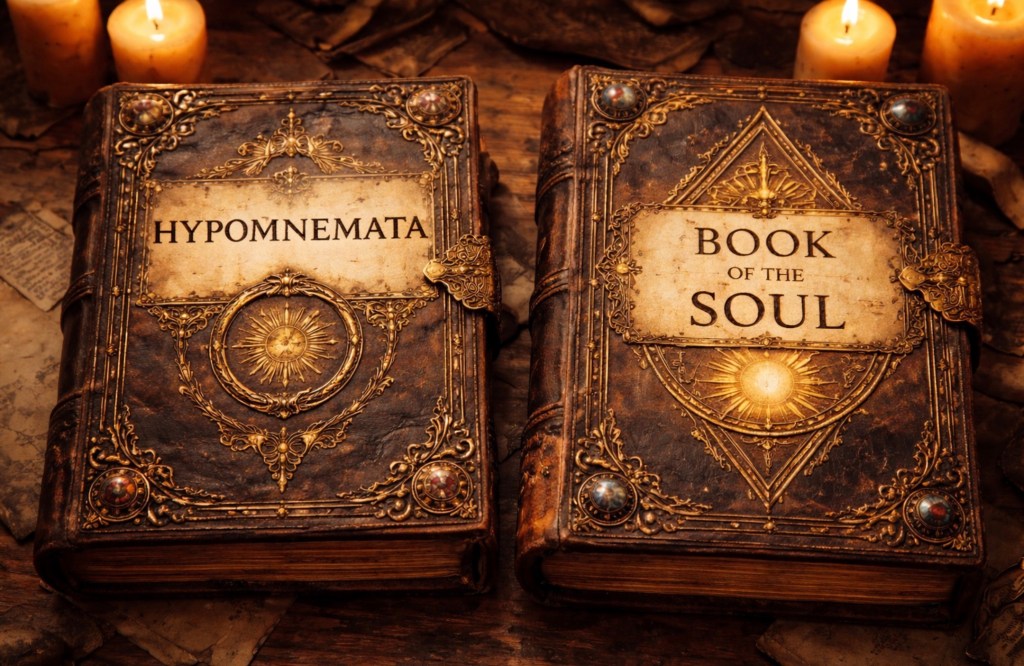
Socrates: Now let us turn to writing—what some call hypomnemata. Are these sources of knowledge?
Plato: They appear to contain knowledge, for they preserve the words of the wise.
Socrates: Appear, yes. But does a man become wise by copying words?
Plato: No, he must understand them.
Socrates: And how does he come to understand?
Plato: By examining, questioning, and reflecting.
Socrates: Then the written word is not knowledge, but a reminder—something that calls the mind back to inquiry.
Plato: A support for memory, not memory itself.
Socrates: Just so. And if a man fills many pages but never returns to them, what has he gained?
Plato: Only the illusion of knowledge.
Socrates: Then writing, like perception, may either awaken or deceive.
Plato: It depends on its use.
Socrates: Now consider this: if knowledge is recollection, and writing aids memory, does writing help us recollect—or does it make us forget?
Plato: It could do either. It might preserve what we would lose, or replace the effort of remembering.
Socrates: So the danger is not in writing, but in mistaking it for thinking.
Plato: Yes, for one might believe that what is written is already understood.
Socrates: Then we arrive at a puzzle:
If knowledge is within, we must awaken it.
If experience prompts it, we must engage it.
If writing preserves it, we must revisit it.
Plato: And if we fail in any of these?
Socrates: Then we may possess many things—perceptions, notes, even arguments—yet remain ignorant.
Plato: So knowledge is not found in any single act, but in a relation between them.
Socrates: A fine conclusion. But tell me, Plato—what binds these together?
Plato: I would say: inquiry.
Socrates: And what is inquiry, if not the soul turning toward itself while being stirred by what lies outside it?
Plato: Then knowledge is neither wholly within nor wholly without—but arises in their meeting.
Socrates: You speak as one who remembers.
Plato: Or perhaps, Socrates, as one who is just beginning to.
Anamnesis (Book of the Soul)
Before the first dawn touched my eyes,
Before the stars were named,
A silent fire lived within,
Though I forgot its flame.
I wandered through a thousand roads,
Collected dust and years,
Mistaking echoes for the source,
Mistaking shadows for the real.
Yet something stirred beneath the noise,
A voice I could not own,
Calling through forgotten halls,
Leading me back home.
Not a lesson newly learned,
Not a treasure newly found,
But a door beneath remembrance,
Turning without a sound.
Anamnesis, Book of the Soul,
Pages written long ago.
Every question, every wound,
Only helps the memory grow.
I am not becoming what I seek,
I am recalling what I know.
The river flows back to the sea,
The hidden seed begins to show.
Anamnesis, Book of the Soul,
The truth was never lost at all.
Two equal sticks beneath the sun,
A fleeting form appears,
Yet through their imperfect likeness
A greater measure nears.
The world becomes a sacred sign,
A lantern in the night,
Not giving me what I require,
But waking ancient sight.
The books upon my weathered shelf,
The words that others wrote,
Are not the harbor of wisdom,
But fingers toward the boat.
For writing cannot think for me,
Nor memory alone,
The soul must turn and face itself
To hear what it has known.
Anamnesis, Book of the Soul,
Pages written long ago.
Every question, every wound,
Only helps the memory grow.
I am not becoming what I seek,
I am recalling what I know.
The river flows back to the sea,
The hidden seed begins to show.
Anamnesis, Book of the Soul,
The truth was never lost at all.
What if every longing
Is remembrance in disguise?
What if every moment of wonder
Is eternity opening its eyes?
What if beauty is a footprint
Left before our birth?
A trace of higher knowing
Still shining through the earth?
Then every act of questioning,
Every honest “I don’t know,”
Becomes the turning of the head
Toward the everlasting glow.
Anamnesis, Book of the Soul,
No teacher placed these stars above.
The world awakened what was sleeping,
Inquiry revealed its love.
Neither wholly within,
Nor wholly from without,
But where the soul and cosmos meet,
The light remembers its route.
Anamnesis, Book of the Soul,
The journey was remembrance all along.
I did not find the hidden truth—
The hidden truth found me.
And what I called awakening
Was simply memory.
See Also:
Anamnesis and Beyond Spacetime
Innatism, Empiricism, What About Heaven?
 Dialogos of Eide
Pingback: More Songs Produced Here on Dialogos of Eide with Suno | Dialogos of Eide
Pingback: Plato’s Doctrine of Recollection | Dialogos of Eide