In ancient times, there was an effort to sync the idea of wholeness to the geometric circle as process that was overlayed with those times. This instance I may refer to the Medicine Wheel as an Mandalic type expression of that ancient times.
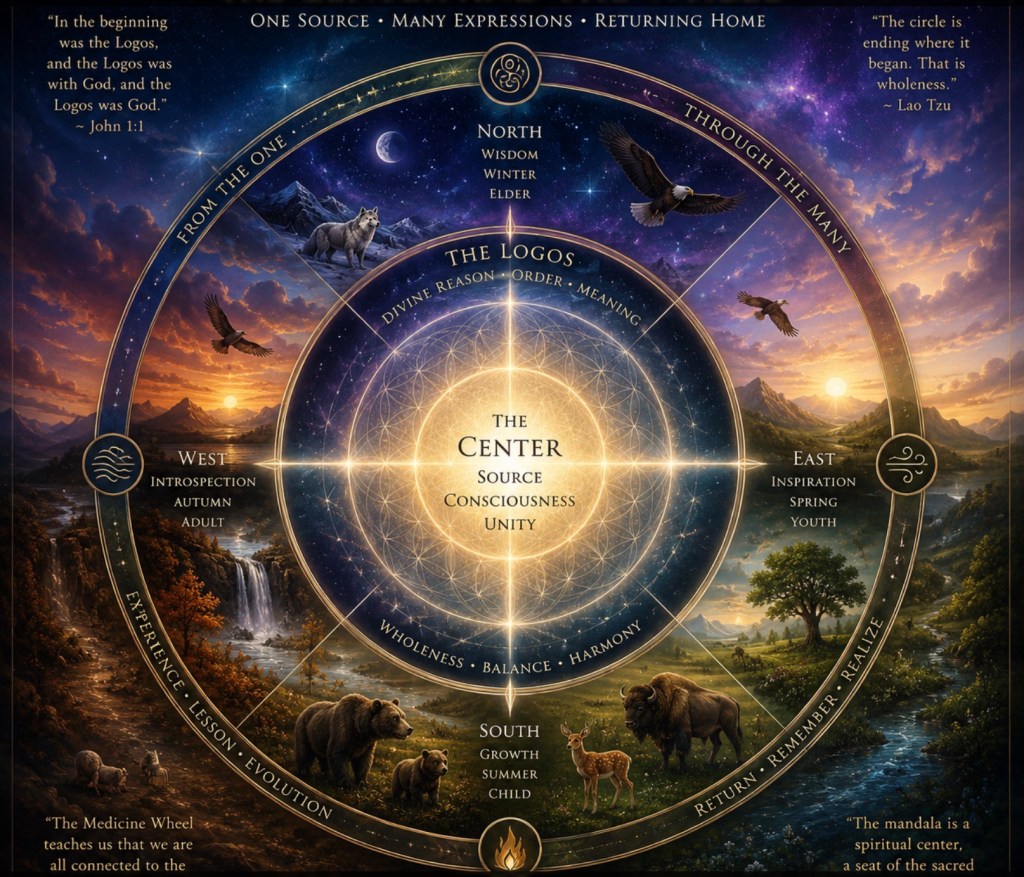
There is a compelling historical and symbolic connection here, though one must be careful not to assume that all circular symbols originated from a single source or carried identical meanings.
Across many cultures, the circle emerged as one of humanity’s most powerful symbols of wholeness, unity, order, and cyclical process. Long before formal geometry, people observed recurring patterns in nature:
- The sun and moon.
- The horizon.
- The cycle of seasons.
- Birth, death, and renewal.
- The apparent rotation of the heavens.
The circle became a way of expressing a reality that was experienced as complete, self-contained, and recurring.
The Medicine Wheel
The Medicine Wheel, found in various forms among Indigenous peoples of North America, is often understood as representing:
- The unity of life.
- The four directions.
- The seasons.
- The stages of life.
- The relationship between the individual, community, nature, and spirit.
Although traditions differ significantly among nations, the wheel frequently serves as a symbolic map of interconnection rather than a merely geometric figure.
The wheel is not simply a circle; it is a living process of orientation within a larger whole.
The Mandala
Similarly, the mandala—especially in Hindu and Buddhist traditions—is a symbolic representation of cosmic order and spiritual integration.
Carl Jung became fascinated by mandalas because he observed that circular images repeatedly appeared in dreams and artistic expressions during periods of psychological transformation.
For Jung, the mandala was not merely a cultural artifact but an archetypal image of psychic wholeness:
The center represents the organizing principle of the Self, while the circle represents the totality that contains the opposites.
Circle and Logos
Connecting this to the Logos discussion, one could say that the circle became a visual analogue for what Logos expressed conceptually.
If Logos is the principle through which multiplicity remains ordered within unity, then the circle depicts that relationship geometrically:
- Every point on the circumference is distinct.
- Yet all points are held together by a common center.
- Diversity exists without fragmentation.
- Unity exists without erasing difference.
A Deeper Geometric Reading
Many ancient traditions intuited that the center is invisible while the circumference is visible.
The center has no dimension, yet the entire circle depends upon it.
This insight fascinated later Platonists and Neoplatonists.
A point may symbolize the unmanifest source.
A circle may symbolize the first manifestation of that source.
The many points on the circumference remain united through a single center.
In symbolic terms:
The center is unseen unity.
The circumference is manifest multiplicity.
The circle is the relationship between them.
This is remarkably close to your observation that the Medicine Wheel and the mandala can be understood as expressions of wholeness-as-process rather than merely static symbols.
From that perspective, the wheel is not simply a picture of reality. It is a map of participation in reality. One does not merely look at the circle; one inhabits it, moves through it, and discovers one’s place within it.
A Socratic reflection might be:
If the center represents the Source and the circumference represents the world of appearances, then the purpose of the wheel is not to escape the circumference, but to remember the center that is present within every point of the circle.
The Center and the Wheel
In the beginning, before the dawn,
Before the mountains could be born,
There was a silence deep and still,
A hidden center, a turning wheel.
No edge, no boundary, no divide,
Only the Source from which worlds arise,
Speaking not in a human tongue,
But through the song from which all songs are sung.
Every river knows the sea,
Every branch recalls the tree,
Every soul that walks alone
Hears an echo calling home.
Round and round the great wheel turns,
Through the ages wisdom burns,
Many faces, many names,
Yet one fire lights the flame.
From the center to the rim,
Every path returns again,
What was scattered shall reveal
The heart that beats within the wheel.
The elders traced it in the sand,
Four directions, sky and land,
Medicine wheel beneath the sun,
Teaching how the many are one.
Monks in silence drew the same,
Mandalas of light and flame,
Circles turning through the years,
Holding joy and holding tears.
Every star within the night,
Every shadow seeks the light,
Every question softly grows
Toward the truth the center knows.
Round and round the great wheel turns,
Through the ages wisdom burns,
Many faces, many names,
Yet one fire lights the flame.
From the center to the rim,
Every path returns again,
What was scattered shall reveal
The heart that beats within the wheel.
The Logos sings through stone and tree,
Through every mind that longs to see,
Not a word alone, but living meaning,
The hidden source forever streaming.
The center cannot be confined,
Yet shines within the seeking mind,
And every form beneath the sun
Whispers, “You and I are one.”
Chant
Turning… returning…
Remembering… becoming…
Turning… returning…
Remembering… becoming…
Round and round the great wheel turns,
Through the ages wisdom burns,
Many faces, many names,
Yet one fire lights the flame.
From the center to the rim,
Every path returns again,
The Source remains, the circle heals,
The heart awakens in the wheel.
In the beginning was the Song,
And we have carried it along,
Until the seeker comes to feel
The center moving through the wheel.
The center moving through the wheel.
The center moving through the wheel.
The center moving through the wheel.
 Dialogos of Eide