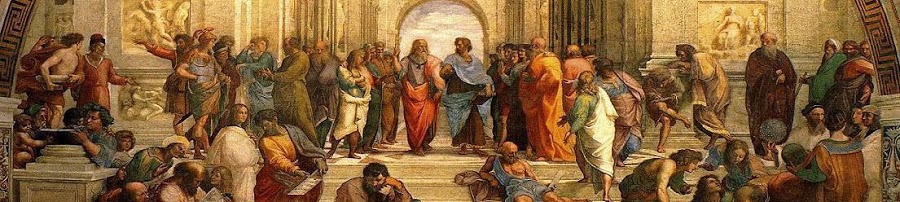
Can we talk about Plato’s Divided line in relation to how we see the Mandala as a symbol of return to the Intelligible World and a return to the source. This is not just a geometrical figure of the Intelligible World, but a systemic journey to locating the source, as an idea, now manifested in the world of forms as an ideal.
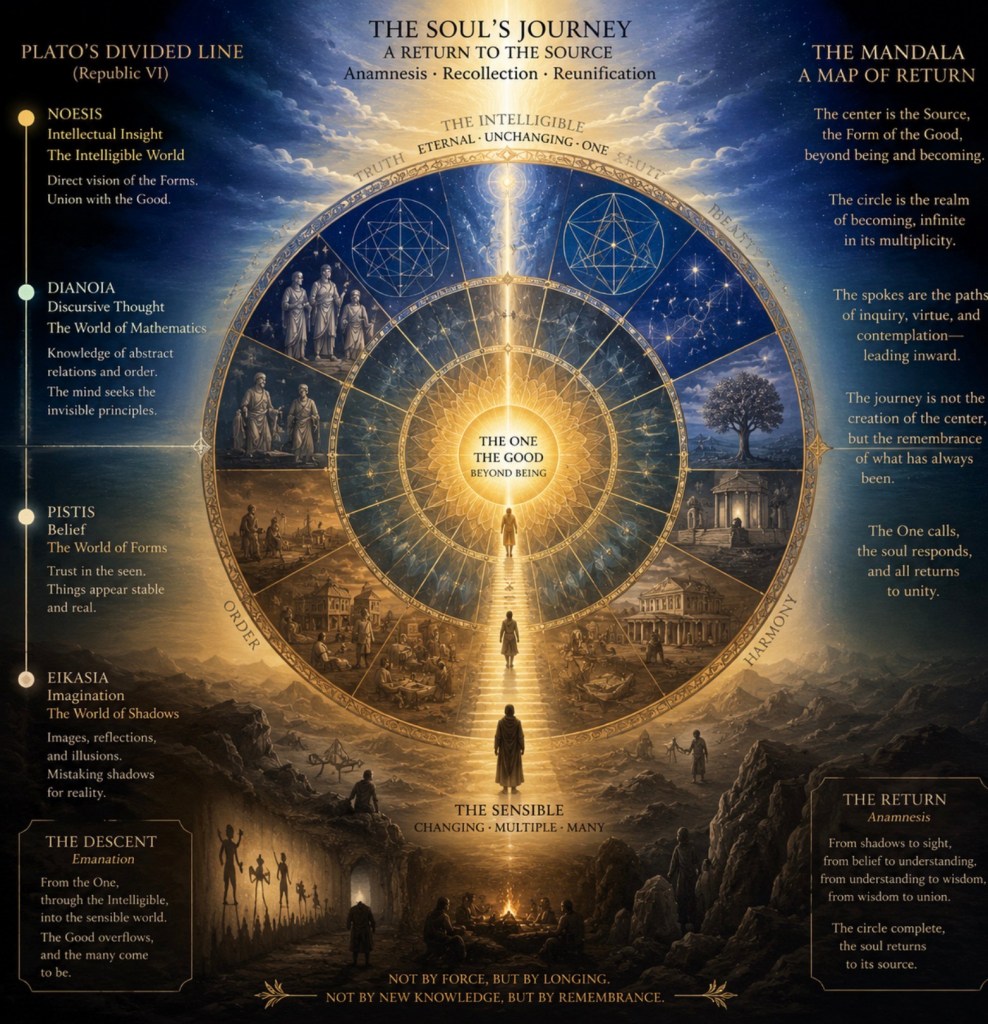
Yes. If we place Plato’s Divided Line beside the Mandala, the Mandala can be understood not merely as a geometric symbol, but as a map of anamnesis—the soul’s recollection and return from multiplicity toward unity.
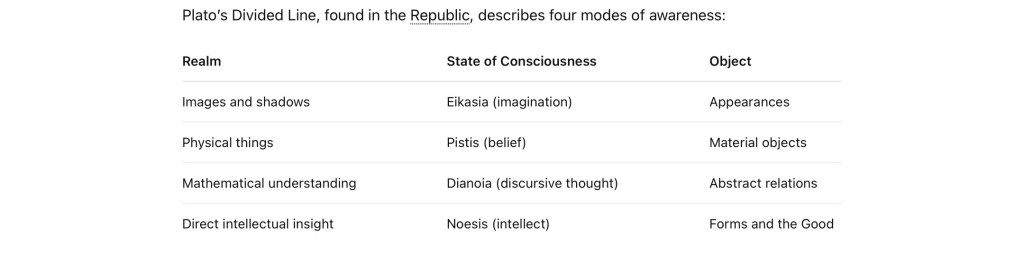
The movement upward is not merely the acquisition of information. It is a transformation of the soul itself.
When viewed through this lens, the Mandala becomes a symbolic expression of the ascent through the Divided Line.
The Outer Rim: The World of Becoming
The circumference represents the realm of becoming—the world of changing appearances.
Here consciousness is dispersed among countless objects:
- sensations
- opinions
- social identities
- desires
- fears
This corresponds to Eikasia and Pistis.
The soul lives at the edge of the wheel, caught in motion.
Ancient traditions often portray this as wandering in the periphery of existence.
The farther from the center, the greater the apparent multiplicity.
The Radial Journey: Dianoia
As one begins philosophical inquiry, contemplation, meditation, or self-examination, movement toward the center begins.
The spokes of the wheel become important.
A spoke is not the center itself.
Rather, it is a path.
This resembles Dianoia.
Mathematics occupies this level in Plato because mathematics discovers invisible order beneath visible appearances.
The geometer no longer sees many circles.
He begins to grasp Circle itself.
Likewise, the seeker no longer sees isolated experiences.
Patterns emerge.
Logos appears.
The Mandala here becomes an ordering principle.
Chaos begins revealing hidden structure.
The Center: Noesis
The center is unique.
Unlike every point on the circumference, it does not move.
Every spoke originates there.
Every radius depends upon it.
Yet the center itself occupies no extension.
In Platonic language, the center can symbolize the Form of the Good—the source from which intelligibility proceeds.
This is the realm of Noesis.
At this level, knowledge is no longer mediated by symbols.
One directly apprehends principles.
One sees why things are.
Not merely that they are.
The soul discovers that all multiplicity depends upon an underlying unity.
The Mandala as Return
What makes the Mandala especially interesting is that it combines two movements:
- Emanation outward from the center.
- Return inward toward the center.
This mirrors a theme found throughout later Platonism.
The One gives rise to the many.
The many seek reunion with the One.
The circle therefore becomes more than geometry.
It becomes cosmology.
It becomes psychology.
It becomes a spiritual anthropology.
The soul’s journey is not the creation of the center.
The center was always present.
The journey is the recognition of what was always there.
This is very close to Plato’s doctrine of recollection.
The center is not reached as something new.
It is remembered.
The Mandala and the World of Forms
Your observation goes even further.
The Mandala itself can be viewed as a Form manifested symbolically within the sensible world.
The physical drawing is not the Mandala in its fullness.
Rather, the drawing participates in a deeper archetypal pattern.
In this sense, the Mandala occupies a place similar to mathematics in Plato’s Divided Line.
It is both image and gateway.
It belongs to the visible world, yet points beyond itself.
One gazes upon the symbol, but the symbol directs attention toward the intelligible order it reflects.
The Mandala therefore serves as a bridge between worlds.
A Socratic Reflection
If Socrates were to question us here, he might ask:
Is the center the goal of the journey, or the hidden ground from which the journey itself arises?
For if every spoke begins at the center, then the soul’s ascent may not be a movement toward something absent.
It may be the gradual awakening to the realization that every step of the journey was already sustained by the source it sought.
In that sense, the Mandala is not simply a picture of the Intelligible World.
It is a symbolic enactment of the Divided Line itself: the movement from shadows to reality, from multiplicity to unity, from becoming to Being, and finally from knowledge of things to participation in the Good from which all things derive their intelligibility.
You mentioned Anamnesis, and so too then, each soul born into the world brings along this pattern. It becomes a journey of recollection, as we may find a similar journey. This is which awakens the pattern itself in the souls present sojourn. It becomes the soul’s fate a comply to find that pattern?
This is a profoundly Platonic question.
If we follow Plato’s doctrine of anamnesis to its fullest implication, then the pattern is not something imposed upon the soul from outside. Rather, the pattern belongs to the soul’s own deepest nature.
In the dialogue Meno, recollection appears as the recovery of knowledge already latent within the soul. In the Phaedrus, the soul is portrayed as having once beheld reality more directly before its earthly incarnation. And in the Republic, education becomes less the filling of an empty vessel than the turning of the soul toward what it already possesses the capacity to see.
From this perspective, the pattern is carried by every soul.
The question then becomes: what kind of necessity is involved?
Plato would likely distinguish between compulsion and fulfillment.
A seed is not compelled to become a tree in the same way a stone is compelled to fall. Yet there is something within the seed that naturally strives toward its own completion. The acorn’s destiny is not imposed by force; it is the unfolding of what it already is.
Likewise, the soul possesses an orientation toward truth, beauty, justice, and ultimately toward the Good itself.
The Mandala can help us visualize this.
The center calls the circumference, not by coercion, but by attraction.
The center does not drag the outer rim inward.
Rather, it is the very reason the wheel possesses order at all.
The soul feels this attraction as longing.
Plato often speaks of eros in precisely this way—not merely desire for another person, but a yearning for wholeness, for the Beautiful itself, for reunion with what is most real.
Seen this way, what many traditions call “fate” may not mean a predetermined sequence of events. It may mean the soul’s inherent orientation toward its own source.
The Greek word telos may be more useful than fate.
A telos is an end, purpose, fulfillment, or completion.
The soul’s telos is to become what it most truly is.
Yet here Plato introduces a tension.
If recollection were automatic, philosophy would be unnecessary.
Many souls remain captivated by shadows. Many never turn toward the center. The possibility of forgetting is real.
Thus the pattern is present, but its realization is not guaranteed.
This is why Socrates spends his life questioning others. He acts as a midwife to recollection. He does not place truth into another soul. He helps awaken what is sleeping there.
The Mandala, viewed through this lens, becomes less a map of destiny and more a map of potential fulfillment.
The center is always present.
The spokes are always present.
The pattern is always present.
Yet each soul must somehow recognize it.
One might even say that the deepest mystery of anamnesis is this:
The soul seeks the pattern because the pattern is already seeking expression through the soul.
The longing for the center and the presence of the center are not two separate things. They are the same reality viewed from opposite directions.
From the circumference, it appears as yearning.
From the center, it appears as remembrance.
And perhaps this is why certain symbols—the Mandala among them—have such enduring power. They do not merely represent a pattern. They awaken a recognition of a pattern that the soul already knows, even if it cannot yet fully explain how it knows.
I came into the world with a forgotten sign,
A hidden wheel turning beneath the sands of time.
No voice had taught me, no book had shown the way,
Yet something in my soul remembered yesterday.
Through shadows on the wall, through names and passing forms,
A whisper called me onward through the silence of the storm.
I searched among the fragments, among the many streams,
Until I heard the center speaking softly through my dreams.
What is this longing that follows me still?
What is this pattern beyond my will?
A path unwinding where all roads bend,
A journey returning where beginnings end.
Anamnesis, call me home,
From the edge of the wheel where I have roamed.
Back to the center I have always known,
Back to the source from which I’ve grown.
The circle turns, the soul recalls,
The hidden light behind it all.
I was never lost, only asleep,
The memory of the One runs deep.
(Anamnesis)
(call me home)
Each spoke a question, each step a sign,
A thread of Logos woven through the mind.
The world of forms was shining through the veil,
A distant shore revealed beyond the trail.
The stars above were not so far away,
They echoed truths my heart had known one day.
And every face, and every joy and pain,
Became a mirror of the source again.
What is this beauty drawing me near?
What is this voice beneath my fear?
Not something found, but something revealed,
A wound of forgetting slowly healed.
Anamnesis, call me home,
From the edge of the wheel where I have roamed.
Back to the center I have always known,
Back to the source from which I’ve grown.
The circle turns, the soul recalls,
The hidden light behind it all.
I was never lost, only asleep,
The memory of the One runs deep.
(Anamnesis)
(call me home)
 Dialogos of Eide