
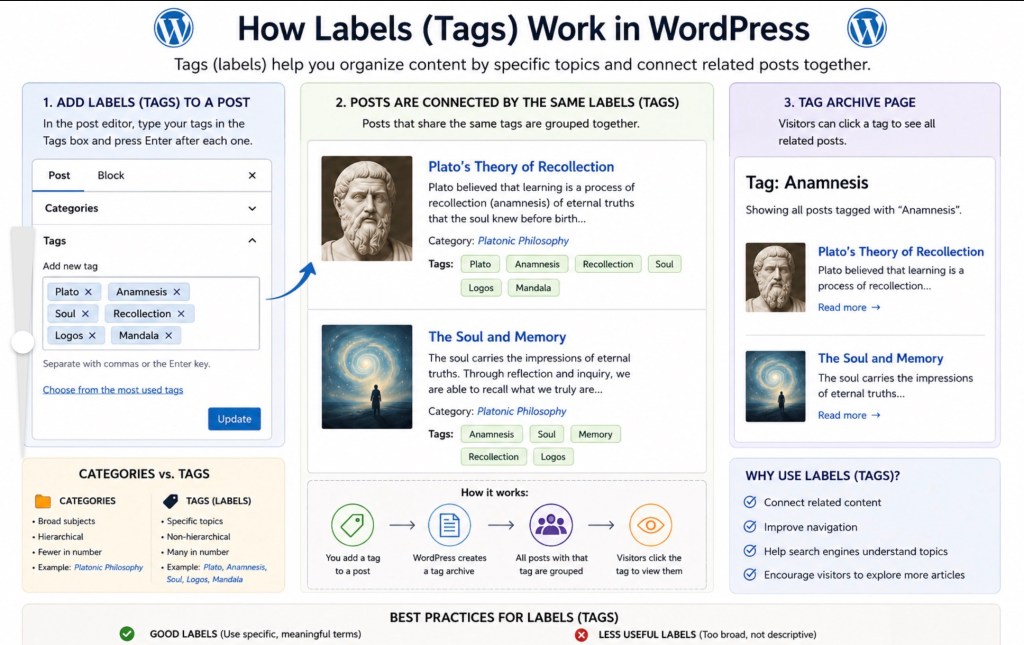
In WordPress, labels are usually called tags. They are a way of organizing content by describing specific topics, themes, or keywords within your posts.
Categories vs. Tags (Labels)
Think of it this way:
- Categories are broad subjects.
- Tags (labels) are specific descriptors.
For example, if you have a blog about philosophy:
Category: Ancient Philosophy
Tags (Labels):
- Socrates
- Plato
- Anamnesis
- Logos
- Monad
A single post belongs to one or more categories, but it can have many tags.
How Labels (Tags) Work
When you add a tag to a post:
- WordPress creates an archive page for that tag.
- Every post with the same tag is grouped together.
- Visitors can click the tag and see all related posts.
For example:
- Post 1: “Plato’s Theory of Recollection” → Tags: Plato, Anamnesis
- Post 2: “The Soul and Memory” → Tags: Anamnesis, Soul
Clicking the Anamnesis tag would display both posts.
Why Use Labels?
Labels help:
- Connect related content.
- Improve navigation.
- Help search engines understand topics.
- Encourage visitors to explore more articles.
Best Practices
Good labels:
- Specific concepts.
- Frequently recurring themes.
- Terms readers might search for.
Examples:
- Plato
- Socrates
- Mandala
- Consciousness
- Ekstasis
Less useful labels:
- Article
- Thoughts
- Interesting
- Blog Post
These are too broad and do not help organize content.
Philosophical Example
Suppose you write a post entitled:
“The Soul’s Journey of Recollection”
You might organize it as:
Category:
- Platonic Philosophy
Tags (Labels):
- Anamnesis
- Soul
- Recollection
- Logos
- Plato
- Mandala
Then any future post sharing those tags becomes connected through WordPress’s tag archives, creating a web of related ideas that readers can follow from one inquiry to another—much as one question in a Socratic dialogue leads naturally to the next.
 Dialogos of Eide