The term Monad comes from the ancient Greek word μονάς (monás), meaning “unit,” “oneness,” “that which is one,” or “a single indivisible entity.” It is derived from the adjective μόνος (mónos), meaning “alone,” “single,” or “only.”
Its history unfolds across several traditions.
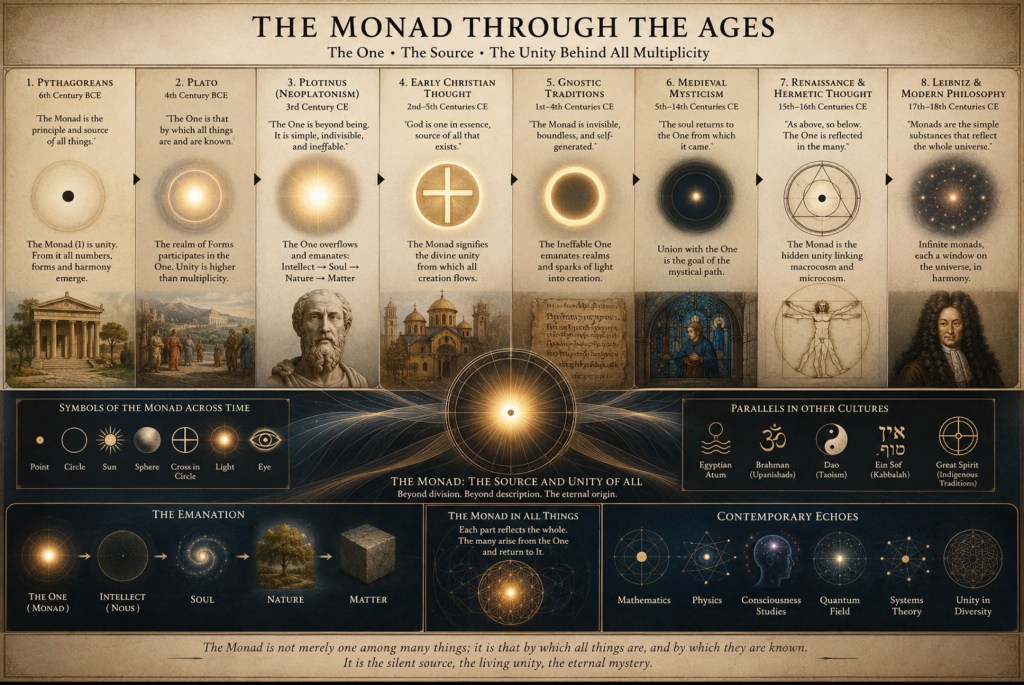
1. The Pythagorean Tradition (6th century BCE)
The earliest philosophical use of the Monad is associated with the followers of Pythagoras.
For the Pythagoreans, number was not merely a tool for counting—it was the underlying structure of reality.
The Monad represented:
- The origin of all numbers.
- Unity before multiplicity.
- The source from which every form emerges.
- The principle that contains all possibilities.
They often contrasted:
- Monad (1) — Unity
- Dyad (2) — Difference or duality
- Triad (3) — Harmony
- Tetrad (4) — Manifest order
Here, the Monad was not simply the numeral “1.” It symbolized the principle from which all mathematics, geometry, and existence unfold.
2. Plato
Although Plato does not frequently use the word Monad in the same technical way as later thinkers, his philosophy strongly reflects the concept.
For Plato:
- The realm of Forms possesses perfect unity.
- The Good stands above all being.
- Multiplicity in the physical world participates in higher unity.
Later Platonists interpreted Plato’s highest principle as the Monad.
3. Neoplatonism
The concept reached its fullest philosophical expression in the work of Plotinus.
For Plotinus:
- The Monad became The One.
- The One exists beyond being.
- It cannot be divided.
- It cannot be described positively because every description introduces distinction.
Reality unfolds through emanation:
The One → Intellect (Nous) → Soul → Nature → Matter
This became one of the foundational metaphysical systems of late antiquity.
4. Early Christian Mysticism
Greek-speaking Christian theologians adopted aspects of this philosophical language.
The Monad came to symbolize:
- Divine unity.
- God as the source of all creation.
- The unity underlying the Trinity (while preserving the distinct persons of Father, Son, and Holy Spirit).
Many early Christian mystical writers employed Neoplatonic ideas to express the relationship between God and creation.
5. Gnostic Traditions
Several Gnostic texts, including some discovered at Nag Hammadi, speak of the ultimate source in language very similar to the Monad.
The Monad is described as:
- Invisible.
- Boundless.
- Self-generated.
- Ineffable.
- The origin of all emanations.
Here the Monad is beyond all names and attributes.
6. Later Philosophy
The idea continued to evolve:
- Giordano Bruno viewed monads as living centers of reality.
- Gottfried Wilhelm Leibniz proposed that the universe is composed of immaterial “monads”—simple, indivisible substances that reflect the whole cosmos from their own perspective.
Leibniz’s monads differ significantly from the Greek Monad: instead of a single ultimate source, he envisioned infinitely many monads.
Cultural Origin
The philosophical concept of the Monad is rooted in Ancient Greek culture, especially:
- Pythagorean philosophy
- Platonic philosophy
- Neoplatonism
However, the intuition behind a primal unity appears in many cultures independently.
Examples include:
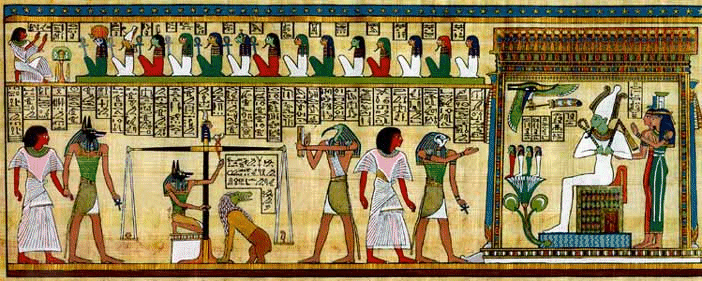
- Ancient Egypt: the self-originating creator emerging from primordial waters.
- India: the Upanishadic concept of Brahman, the ultimate reality.
- China: the Dao, the ineffable source from which all things arise.
- Jewish mysticism: Ein Sof, the infinite beyond all attributes.
These traditions are not historically identical, but they share a common philosophical intuition: that multiplicity arises from an underlying unity.
In the context of your ongoing work on The Builder’s Project, the Monad functions not merely as a mathematical point but as a symbol of undivided potential. The point of light becoming a circle, then a sphere, and finally a living temple mirrors the ancient philosophical movement from unity into manifestation. The Builder’s journey, in this reading, is the return from multiplicity to conscious participation in that original unity.
What emerges through history is not simply the story of a word, but the story of humanity returning, again and again, to the intuition that behind the many there is One. If this is to become part of The Builder’s Song, then the lyrics should not merely recount history—they should allow the listener to journey through it. Each culture becomes another voice in the same ancient chorus.
The Song of the Monad
I. The First Silence
Before the first measure was struck on any drum,
before any name was carved into bone or clay,
before even the memory of fire flickered in human eyes—
there was no split between night and day.
Only a vast, unbroken stillness,
like deep water before wind touches it.
In that stillness: the Silent One—
the Monad.
No voice had ever broken the air.
No circle had ever been drawn in dust.
No number had ever been spoken aloud.
Yet within that stillness, all things rested—
not scattered like grains,
but held together like seed within unseen fruit.
II. Greece — The Birth of Number
Where white marble cliffs fall into the blue Aegean,
and salt wind moves through broken columns,
the early thinkers listened to what cannot be heard.
Pythagoras spoke as if remembering something older than speech:
“One is not counted.
One is the beginning from which counting awakens.”
From this remembrance, the world began to take shape:
a single point pressed into sand,
a circle traced by a steady hand,
a sphere imagined rising like a full moon over the sea.
The Builder learned from this:
every arch, every dome, every measured stone
is a memory of that first point
returning to itself.
III. The Philosophers
Plato lifted his gaze from the flickering shadows of the cave wall,
not satisfied with images that tremble and fade.
He searched for the source of their light—
not another object, but the Good itself,
like the sun behind all seeing.
Plotinus answered in quiet certainty:
“The One does not break itself apart.
It overflows.”
Like a spring that does not diminish as it gives water,
it pours forth without loss.
From that overflowing:
Mind is born like a clear sky opening.
Soul moves like wind through that sky.
And the living world takes shape like waves upon a vast, unseen sea.
Not fragmentation—
but unfolding radiance.
Not separation—
but motion of return.
IV. The Many Names
Across deserts, rivers, mountains, and cities of stone,
human tongues turned toward the same invisible source.
In Egypt, it was spoken of as
the Hidden One beneath all temples,
older than carved gods.
In India, it was breathed as
Brahman—
like breath itself behind all breath.
In China, it was whispered as
the Dao—
the path that cannot be stepped outside of.
Among mystics, it became
the Infinite without edge or boundary.
Among Gnostics, it was called
the Monad beyond all naming,
the One before even the idea of “one.”
Many languages.
Many alphabets scratched into clay, ink, and stone.
Yet beneath them all—
one silence,
like deep earth beneath every root.
V. The Builder
The Builder moved through unfinished halls of stone,
his hands dusted with lime and memory.
He measured circles already felt in his bones,
and raised arches that seemed to lean toward something unseen—
as if the air itself were remembering a shape.
Stone by stone, the structure grew still within him,
as though the building was not being made,
but uncovered.
Then came the quiet realization,
not spoken aloud, but felt in the chest like a bell struck once:
“You are not building the temple.
You are uncovering it—
returning it to the One
from which it has never been separated.”
VI. The Returning Circle
Every star arcs across the night and returns to darkness.
Every question rises and falls back into silence.
Every life moves outward and inward again.
The circle does not close like a lock—
it folds like breath returning to the lungs.
There is no true end,
only the place where beginning recognizes itself.
The Monad has never traveled.
Only the traveler has crossed the illusion of distance—
and learned, at last, to see what was always here.
VII. The Eternal Chorus
One light breaking through stained glass.
One breath moving through countless lungs.
One song carried through stone, wind, and water.
The Greeks heard it in the logic of number.
The mystics held it in silent prayer.
The poets shaped it into language like fire shaped into form.
The Builder lives it in stone, arch, and rising dome.
The Monad is not first in time,
but first in depth—
the hidden unity beneath every surface.
It does not call from far away.
It calls from within all things,
as all things quietly remember
their way home.
This progression mirrors the historical development of the idea while preserving its symbolic depth:
- Silence — the primordial unity before creation.
- Greece — the Monad as the origin of number and geometry.
- Plato and Plotinus — the Monad as the metaphysical source of being.
- The world’s traditions — different cultures expressing the same intuition in different languages.
- The Builder — the personal realization that the temple is the soul.
- The Returning Circle — the philosophical ascent from multiplicity back to unity.
- The Eternal Chorus — the Monad as a timeless symbol that continues to speak across cultures and generations.
This structure would pair naturally with the seven-part cinematic sequence you have been developing. Each movement can become its own visual chapter, beginning with the solitary point of light and culminating in the living temple, so that history, philosophy, music, and symbolism all converge into a single narrative of the One becoming the many, and the many consciously returning to the One.