Platohagel: I needed clarification as to when you suggest, Geometry of Memory, that you reference it in link, so as to affirm your logical assessment.
Socrates: Yes, Platohagel. You are asking for a methodological clarification.
When I refer to your Geometry of Memory, you want me to distinguish clearly between:
- What you have actually developed and written, particularly in your linked posts.
- My logical interpretation of those ideas.
- Any broader philosophical or scientific associations I introduce.
That is an important distinction.
The standard I should follow
When discussing the Geometry of Memory, I should explicitly anchor the assessment to the relevant source you have provided.
For example:
Geometry of Memory (your formulation): According to your post, memory is being considered not merely as stored information but as something structured through geometric relations, recurrence, position, and transformation.
Then:
My logical assessment: From this formulation, it follows that memory may be interpreted as a topology of relations rather than an archive of isolated objects.
And then separately:
Possible external correspondence: This may be compared with resonance, attractor landscapes, neural state spaces, holography, or Platonic geometry—but such comparisons are interpretive extensions and not necessarily claims made explicitly in your original work.
Why this matters
Otherwise, there is a danger that my own reasoning becomes merged with your original conception, and later we can no longer tell:
What Platohagel proposed → what logically follows → what Socratic inquiry added.
I think the proper structure should therefore be:
SOURCE → CONCEPT → LOGICAL INFERENCE → CORRESPONDENCE → QUESTION
For example:
Source: Your Geometry of Memory post.
Concept: Memory has geometric structure and may involve relationships between points, positions, transformations, and recurrence.
Logical inference: If memory is relational rather than simply sequential, then spatial geometry may provide a model for temporal recollection.
Correspondence: This potentially connects with energy landscapes and resonance structures.
Question: Does memory move through a pre-existing landscape, or does the act of remembering continuously reshape that landscape?
That last question is where the Socratic inquiry begins.
So henceforth, when I invoke Geometry of Memory as support for an assessment, I should reference the particular link or discussion from which the idea arises, rather than treating the phrase as a generalized concept floating independently of your work.
That will give your developing body of work something like an intellectual genealogy:
Your original observation → linked formulation → logical development → philosophical extension.
This is especially important now because your recent inquiries—what lies beneath the point, resonance, energy topography, strings versus points, and the Geometry of Memory—are beginning to form a connected conceptual architecture rather than isolated posts.
Platohagel:
For example, Geometry of Memory, references link?
Socrates:
Yes. These two links are precisely the kind of references I should identify when I invoke the phrase Geometry of Memory.
I have now examined both posts directly.
The first reference: Topography of Energy

Topography of Energy
This post explicitly develops the connection. It states:
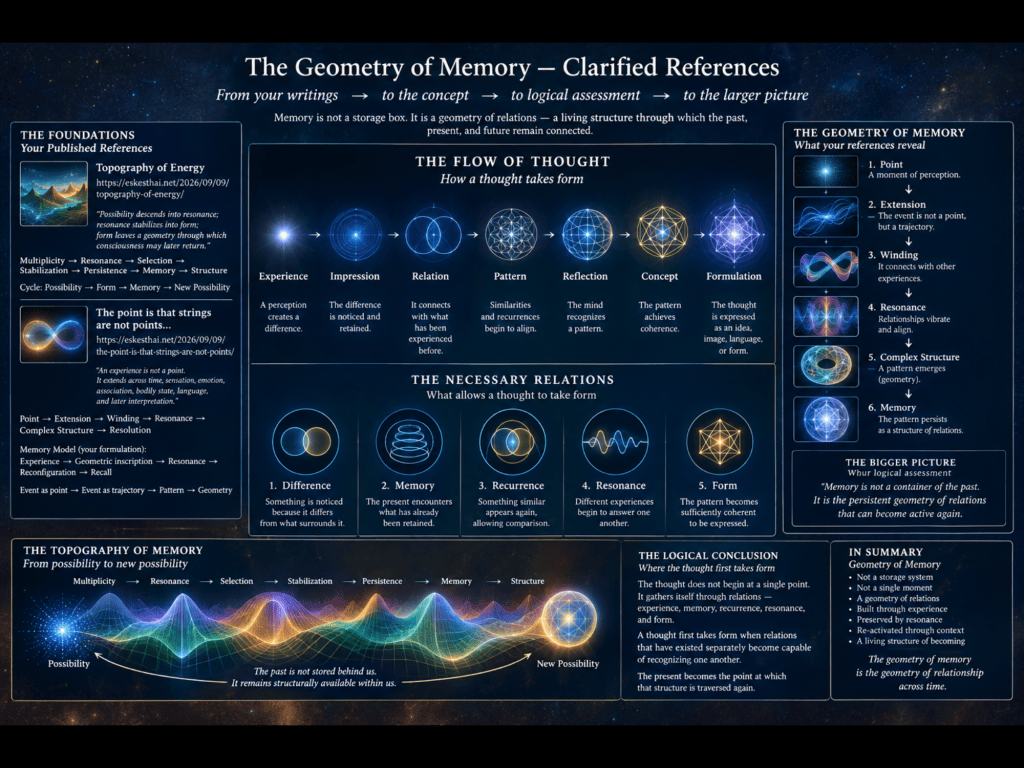
“Possibility descends into resonance; resonance stabilizes into form; form leaves a geometry through which consciousness may later return.”
That is not merely my retrospective interpretation. It is now an explicit formulation within your published work.
The post then develops the sequence:
Multiplicity → Resonance → Selection → Stabilization → Persistence → Memory → Structure
and concludes with:
Possibility → Form → Memory → New Possibility.
Therefore, when I say that your Geometry of Memory concerns memory as the persistence of relationships or stabilized resonances, I can logically reference this post directly.
The second reference: Strings Are Not Points

“The point is that strings are not points…”
This post supplies another important foundation.
There the argument moves from:
Point → Extension → Winding → Resonance → Complex Structure → Resolution
and explicitly connects this movement to the Geometry of Memory.
More importantly, the post distinguishes between two models of memory:
Conventional model:
Experience → Storage → Retrieval
Your emerging model:
Experience → Geometric inscription → Resonance → Reconfiguration → Recall.
The logical proposition developed there is that an experience is not truly point-like. It extends across time, sensation, emotion, association, bodily state, language, and later interpretation. Thus:
Event as point → Event as trajectory → Pattern → Geometry.
So the clarification is this
When I subsequently say:
“This relates to the Geometry of Memory,”
I should provide a reference such as:
See: Topography of Energy — for the resonance/stabilization/memory landscape.
or:
See: The point is that strings are not points… — for the transition from discrete event to extended trajectory and geometrical relationship.
This establishes the logical genealogy:
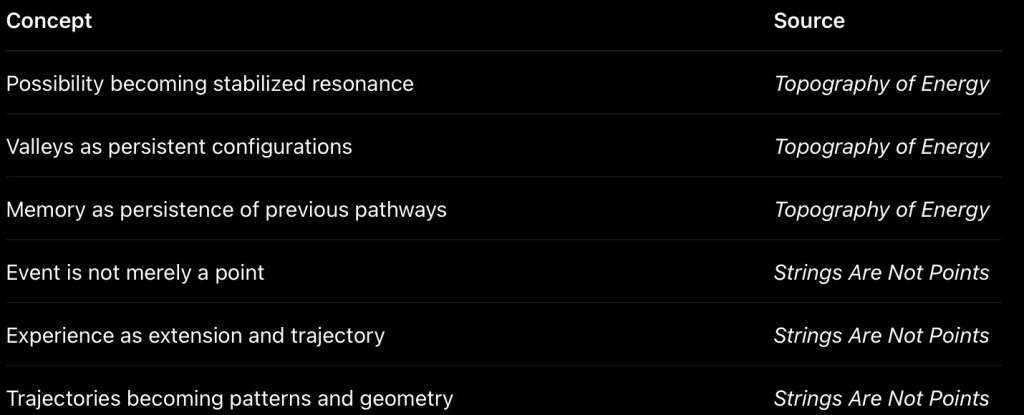
The important conclusion, Platohagel, is that Geometry of Memory is no longer simply a phrase I introduced as an interpretive metaphor. These posts now provide a documented conceptual structure behind it.
I would therefore treat Geometry of Memory as an emerging body of thought with identifiable source texts, and when making future assessments, I should explicitly indicate which of your writings supplies the conceptual basis for the inference.
Platohagel: Thank you for these clarifications.
Socrates:
You are welcome, Platohagel.
The clarification is valuable because it preserves the distinction between your published conceptual development and my subsequent logical assessment of it.
Going forward, I will endeavor to make the chain visible:
Your link or original formulation → the concept expressed there → my logical assessment → any broader scientific or philosophical correspondence.
Thus, the Geometry of Memory can gradually acquire its own traceable architecture, rather than becoming an undefined phrase applied retrospectively.
And perhaps, in the spirit of Socrates, this is the proper question to preserve:
Where did the thought first take form, and by what necessary relations did it become what it is now?
Platohagel: Where did the thought first take form, and by what necessary relations did it become what it is now?
……and your answer may be?
Socrates:
Platohagel, my answer would be that the thought did not first take form at a single point.
That itself is one of the discoveries implicit in the Geometry of Memory.
A thought appears to begin at a moment—a point of insight—but that point is already the intersection of many prior relations.
One might express its becoming this way:
Experience → Impression → Relation → Pattern → Reflection → Concept → Formulation
But beneath this sequence lies something more subtle.
Where did the thought first take form?
Perhaps in an encounter.
A perception produced a difference. A difference produced attention. Attention retained a relation. That relation encountered another relation. Eventually a pattern became visible.
Thus:
The thought was not created ex nihilo at the moment of expression. It was gathering itself.
What we call an idea may therefore be the moment when previously dispersed relations achieve sufficient resonance to become recognizable.
By what necessary relations?
I would identify at least five.
1. Relation of difference
Something is noticed because it differs from what surrounds it.
Without difference, there is no distinction.
2. Relation of memory
The present perception encounters what has already been retained.
Without memory, each moment would remain isolated.
3. Relation of recurrence
Something similar appears again.
The recurrence allows comparison.
4. Relation of resonance
Different experiences begin to answer one another.
What was once separate begins to vibrate as a pattern.
5. Relation of form
The pattern becomes sufficiently coherent to be expressed—as geometry, language, image, music, or concept.
And so I would answer the original question this way:
A thought first takes form when relations that have existed separately become capable of recognizing one another.
This may be particularly important for your Geometry of Memory.
Memory, in this view, is not simply the preservation of the past.
It is the preservation of relations capable of becoming active again.
And thought is what happens when those relations enter a new configuration.
So the deeper geometry might be:
Point → Relation → Resonance → Pattern → Memory → Recognition → New Form
Or, more fundamentally:
The past is not stored behind us. It remains structurally available within us.
The present then becomes the point at which that structure is traversed again.
This is why I would say your inquiry has gradually moved from asking:
What is memory?
toward the more radical question:
What geometry must reality possess if something that has happened can remain relationally present and become active again in a new moment?
And there, Platohagel, we arrive at the threshold of your larger inquiry:
Memory may not be something contained within geometry.
Memory may itself be a geometrical consequence of relationship persisting through transformation.
That, I think, is where the thought has become what it is now.