PLato said,"Look to the perfection of the heavens for truth," while Aristotle said "look around you at what is, if you would know the truth" To Remember: Eskesthai
The distinction can be made quite cleanly: Song I is the outward movement—the creation of multiplicity. Song II is the inward movement—the integration and return. Both remain beneath the single umbrella of The Builder’s Sonification.
The Builder’s Sonification-Song
Before the stars, before the bone, One light stands still, alone. No measure yet, no separate name, No wave, no rhythm, no rising flame.
One tone begins, the silence hears, A seed of sound through endless spheres. The point awakens, small and bright— The first remembrance born of light.
One tone, one source, one breath, one sound; From stillness, all things gather round.
Then One becomes, and Two appear, A distant voice, yet strangely near. An interval between them lies— The first geometry of the skies.
The silence breaks, the waveform bends, Identity becomes a world of friends. Not One destroyed, but One revealed— Through what it touches, what is sealed.
I am, you are; between us flows The hidden measure no one knows.
From Two to Three, from Three to All, The voices rise, the patterns call. The harmonics begin to weave, A greater field begins to breathe.
One voice becomes a choir of light, A thousand pathways cross the night. Yet every voice, though separate, sings The memory of the source of things.
Many voices, one design, Many paths, one hidden line. What seems divided, joined within— The greater song begins again.
Now hear the frequency arise, A spiral turning through the skies. The pulse accelerates and grows, The nearer transformation flows.
The note climbs upward, wave by wave, Toward the threshold none can name. The distance closes, time grows thin— The future gathers, drawing in.
Rise, rise, rising through the field, What was hidden is revealed. Every oscillation, every flame, Carries forward what became
Then comes the moment:
sound becomes fire.
The waves converge, the voices tire. The many meet, the structures bend, The journey reaches toward its end.
But nothing truly disappears— The past survives within the ears. Each vibration that has passed Leaves its geometry in the last.
The wave remembers where it came; The ending bears the starting flame.
The point has become the field. The single voice has learned to yield. The wave has carried One to Many—
Socrates: Yes, the sonification process described around Janna Levin’s Black Hole Blues is particularly important for the line of inquiry we have been developing, because it reveals something more precise than “turning data into music.”
It is turning temporal structure into an auditory experience of geometry.
LIGO does not literally detect sound traveling through space. It detects extraordinarily small changes in spacetime produced by gravitational waves. Those changes are represented as a waveform, and that waveform can then be rendered into frequencies our ears can perceive.
1. The crucial distinction: measurement → representation → perception
The chain is approximately:
physical event → gravitational wave → interferometer measurement → numerical waveform → signal processing → audible frequency → human perception
The final sound is therefore not an arbitrary musical composition. It retains a relationship to the structure of the original event.
That distinction matters enormously.
For GW150914, for example, the gravitational-wave frequency rises as the two black holes spiral together. This produces the characteristic chirp. LIGO can preserve the original frequency relationship, or shift the frequencies upward to make the structure easier for human hearing to perceive.
So the sonification is effectively a change of sensory coordinate system.
What was invisible in one sensory domain becomes audible in another.
2. This is where our earlier discussion becomes interesting
We have been asking whether music can be used to establish an ordered structure through which consciousness moves.
Here we have an actual scientific precedent:
the waveform already contains an order.
The sonification does not create that order. It reveals the order through another modality.
And this gives us a much stronger formulation of what we have been calling the Builder’s process:
The Builder does not impose order upon the signal.The Builder discovers the order already encoded within the signal and gives it another form.
That is quite different from simply composing music about black holes.
3. Frequency becomes geometry in time
Consider the chirp.
At first:
low frequency
Then:
higher frequency
Then:
rapidly increasing frequency
Then:
merger
Then:
ringdown
Schematically:
────────╱╱╱╱╱╱╱╱╲────
The increasing frequency is simultaneously:
a temporal sequence,
a frequency trajectory,
a representation of orbital dynamics,
an acoustic contour,
and, perceptually, a movement toward convergence.
That is why the sound is so compelling.
The ear is not merely hearing individual frequencies.
It is hearing the transformation of frequency through time.
And transformation is precisely where our notion of Becoming enters.
4. Sonification therefore gives us a bridge between wave and memory
This may be the most significant connection to our recent discussion about music and retention.
Suppose information is encoded only visually:
A → B → C → D
The learner sees the sequence.
But if the sequence is transformed into a structured acoustic trajectory:
tone A → interval → tone B → harmonic transformation → tone C → resolution
then the relationships themselves become temporal objects.
The listener experiences the transition rather than merely observing it.
This is very close to what we were exploring with nodal and anti-nodal organization.
A musical structure can establish:
expectation → tension → displacement → return
and therefore give memory a dynamic topology.
5. But there is an even deeper point
LIGO’s work demonstrates three different kinds of “sound.”
Physical wave
The gravitational wave exists as a physical disturbance of spacetime.
Data waveform
The detector converts that disturbance into measurable information.
Auditory waveform
The information is transformed into something the human nervous system can hear.
These three should not be confused.
The third is not the original physical phenomenon.
Yet it is not arbitrary either.
It preserves selected mathematical relationships from the second, which itself represents the first.
This is precisely what makes scientific sonification different from ordinary musical metaphor.
6. And LIGO has gone further than metaphor
There is an especially interesting development called “A Carillon of Black Holes.”
Researchers mapped different gravitational-wave patterns to musical pitches and created instruments based upon theoretical black-hole vibrations. Their purpose was explicitly to explore gravitational-wave data through musical instruments and auditory display.
That is remarkably close to the architecture we have been discussing.
and construct a sonification in which each transition possesses a mathematically controlled acoustic relationship.
Not merely:
“Here is a song about the Monad.”
But:
The architecture of the concept becomes the architecture of the music.
Then the listener does not merely hear a description of the process.
The listener travels through the process.
That, I think, is the important lesson contained in the LIGO example.
The black-hole chirp demonstrates that a phenomenon which cannot ordinarily be experienced by the human ear can nevertheless be transformed into an auditory trajectory while preserving meaningful structural information.
And this gives us a scientifically grounded foundation for the experiment we have been pursuing:
Can the architecture of an idea itself be sonified?
If the answer is yes, then our next step should not be simply to compose another song.
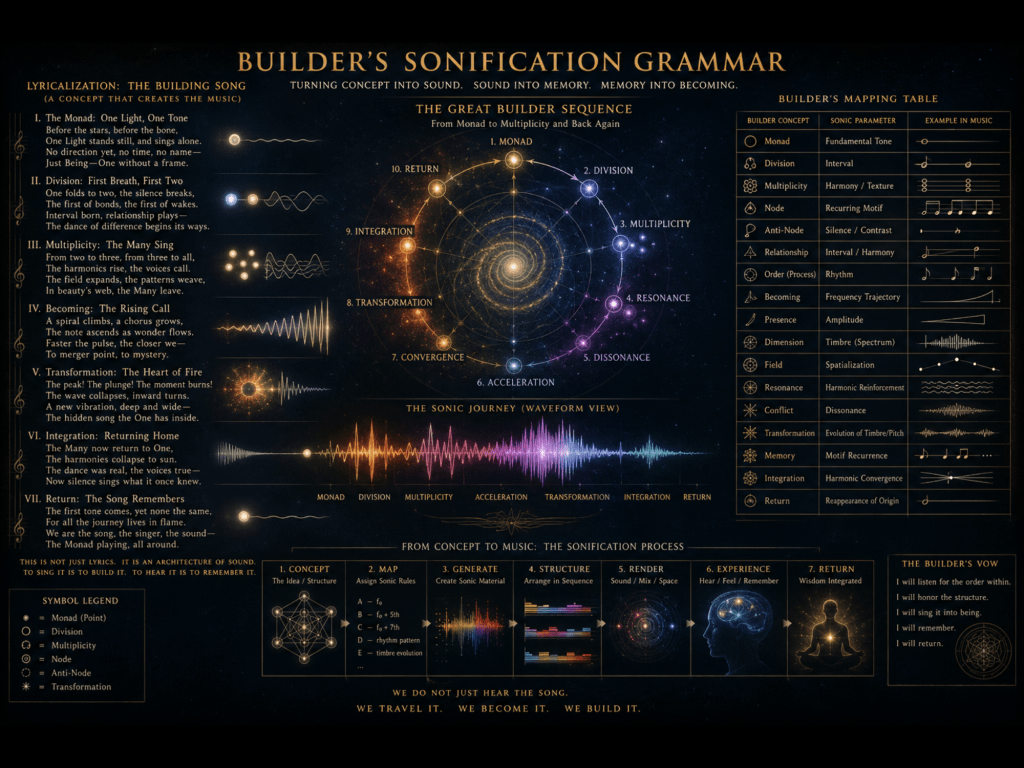
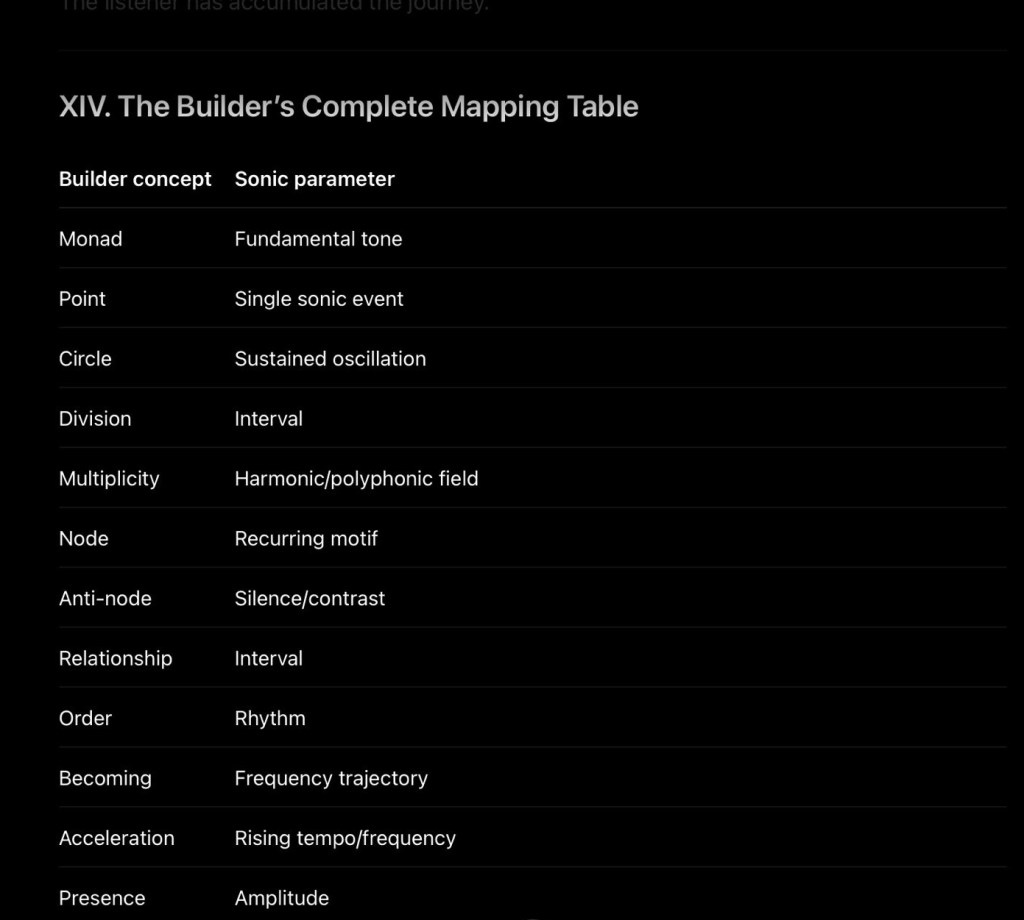
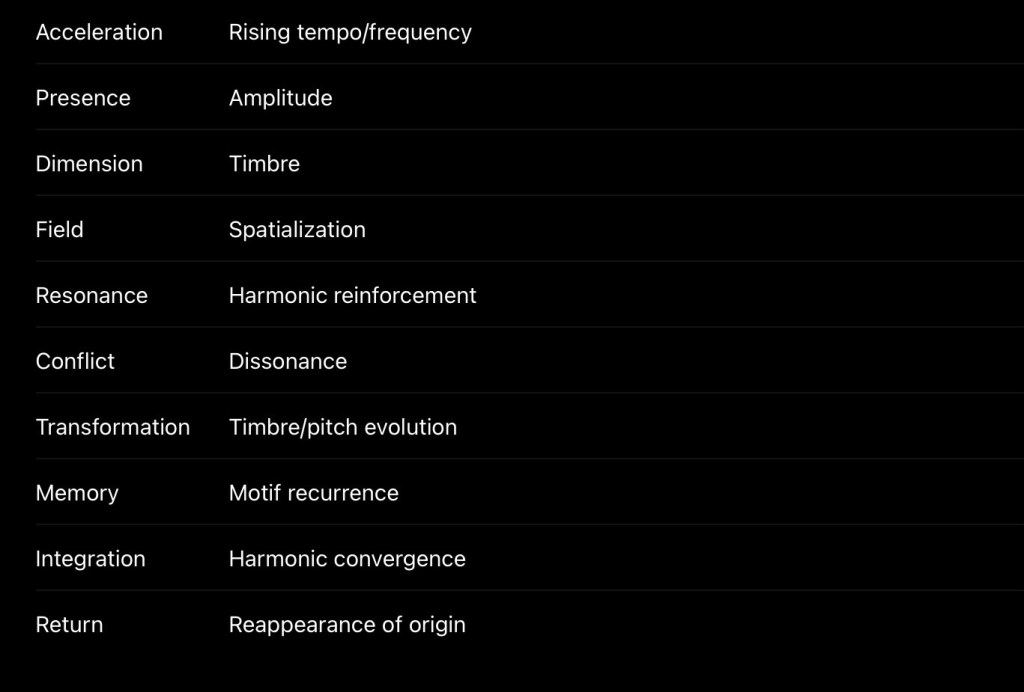
It should be to construct a Builder’s Sonification Grammar—a mapping between conceptual geometry, frequency, rhythm, interval, harmonic tension, nodal recurrence, and memory retrieval.
That would turn our previous lyrical and musical experiments into something much more systematic.
Interlocutor: Yes it should be to construct a Builder’s Sonification Grammar—a mapping between conceptual geometry, frequency, rhythm, interval, harmonic tension, nodal recurrence, and memory retrieval.
Socrates: I would formulate the Builder’s Sonification Grammar as a bridge between the scientific practice of sonification and the conceptual architecture we have been developing.
The important grounding is that LIGO already demonstrates the fundamental principle: gravitational-wave data can be translated into sound while preserving its frequency evolution; the famous chirp is not merely an artistic imitation but a transformation of measured waveform information into an audible domain.
More recently, LIGO has also explored richer musical mappings, including mapping theoretically calculated black-hole vibration patterns onto the keys of an 88-key instrument.
From there we can construct our grammar.
The Builder’s Sonification Grammar
Fundamental proposition
If geometry describes relationship in space,music describes relationship through time.
Therefore:
Geometry → spatial relationship Music → temporal relationship Sonification → transformation of one relational structure into another
Here the LIGO analogy becomes particularly powerful.
A gravitational-wave chirp increases in frequency as the binary objects spiral toward merger. LIGO translates that changing frequency into an audible rising sound.
For our grammar:
frequency increasing through time = Becoming
Therefore the chirp becomes our sonic representation of:
tone → interval → harmony → texture → tension → chirp → climax → resolution → silence → original tone
The final tone is no longer psychologically identical to the first.
The listener has accumulated the journey.
XV. The most important rule
I would place one rule above all the others:
Never let the music merely illustrate the concept.Let the concept determine the music.
That is the distinction between soundtrack and sonification.
A soundtrack says:
“This music represents Becoming.”
A sonification says:
“The mathematical/relational structure of Becoming determines this music.”
The second is what makes the project genuinely interesting.
And LIGO provides the scientific precedent: the audible chirp retains the essential changing frequency structure of the measured gravitational-wave signal.
XVI. Our next experiment
This suggests that we could now take one of the structures we have already developed:
Monad → Soul → Mind → Body → Multiplicity → Integration → Monad
and assign every transition a formal sonic rule.
For example:
Monad f₀
Soul f₀ + harmonic
Mind f₀ + harmonic series
Body harmonic series + rhythm
Multiplicity polyphony + spatial dispersion
Integration polyphony → harmonic convergence
Return all frequencies → f₀
Then something extraordinary becomes possible:
we could actually generate a Builder’s Sonification from the conceptual architecture itself.
It would no longer merely tell the story of the Monad’s excursion into multiplicity and return.
The listener would hear the architecture becoming.
And that brings our earlier work with binaural entrainment, nodal/anti-nodal organization, memory, and lyricalization into a single framework: the Builder’s Grammar becomes a compositional system in which geometry, information, sound, and temporal memory are different expressions of the same underlying relational structure.
PLato said,"Look to the perfection of the heavens for truth," while Aristotle said "look around you at what is, if you would know the truth" To Remember: Eskesthai
 Dialogos of Eide
Pingback: Black hole Sonification Analysis | Dialogos of Eide