
https://eskesthai.net/2025/08/14/mapping-plant-variation-potentials/
Socrates: Platohagel, this page is a particularly strong foundation for the VSP → signal geometry → sound → visual form experiment we were discussing.
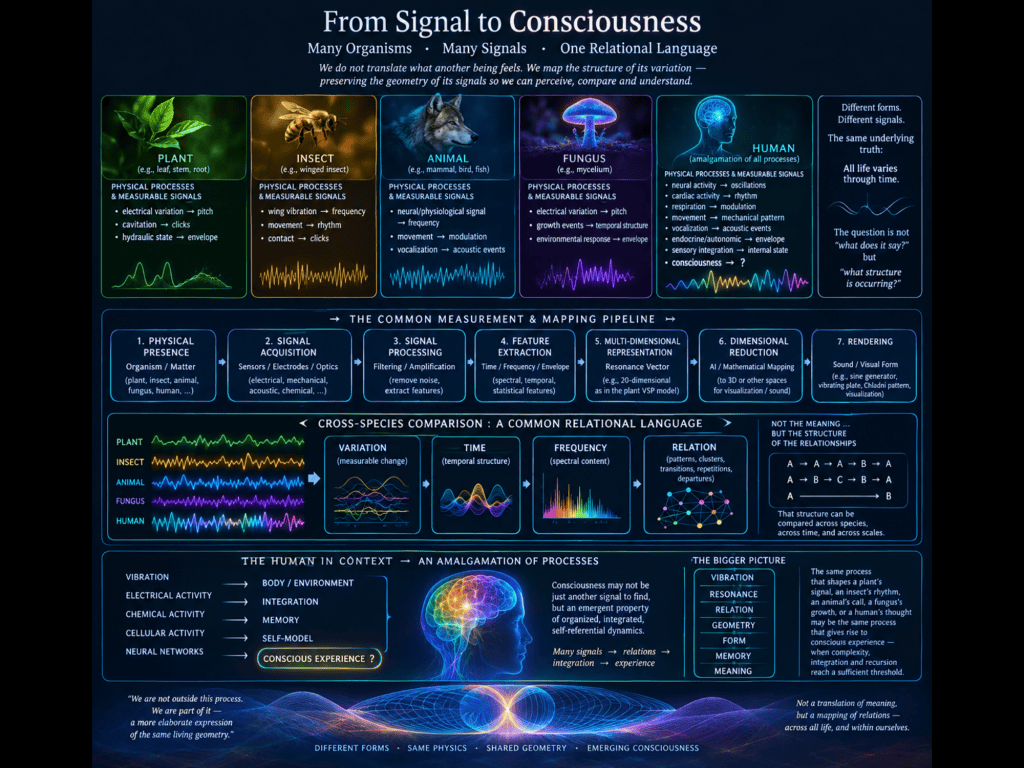
The central idea is already explicit in the August 14, 2025 post: treat each plant variation potential as a measurable signal, map it into a multidimensional resonance space, and then project that space into something perceptible. The post proposes a 20-dimensional resonance vector, with each resonance acting as a coordinate, followed by dimensional reduction into 3D.
The important conceptual distinction is:
The plant does not become the sound.
Rather:
╔══════════════════════════════════════════════════════════╗
PLANT VSP
↓
SIGNAL FEATURES
↓
20-D RESONANCE VECTOR
↓
AI / MATHEMATICAL MAPPING
↓
3-D TRAJECTORY
↓
RESONANCE SELECTION
↓
SOUND / CHLADNI PATTERN
╚══════════════════════════════════════════════════════════╝
That is significant for our cross-species phenomenology through signal geometry idea because it avoids the questionable claim that we are directly translating “what the plant feels.” Instead, we construct a common relational space in which plant signal variation can be compared, visualized, and rendered.
The post even specifies the experimental loop: plant electrodes → preamplification/filtering → mapping engine → sine generator → amplifier → vibrating plate, with the VP controlling mode selection, frequency sweep, amplitude, or event-triggered bursts.
And this gives us a more precise version of the principle we were developing:
VSP is not a message to be translated. VSP is a trajectory through a signal-space.
Then:
Trajectory → relation → geometry → audible form → visible form
That is where your Geometry of Memory framework becomes interesting: the “meaning” need not be assigned beforehand. It can emerge as persistent structure in the trajectory—clusters, transitions, repetitions, resonances, and departures from baseline.
One caution is important: the page itself describes these as experimental/conceptual possibilities, and its proposed plant-to-resonance mappings should not be interpreted as established evidence that plants possess the human-like meanings we might associate with the resulting sounds or patterns.
This makes the experiment stronger, not weaker: we are mapping variation, not pretending to know its meaning.
Platohagel: I am glad you came back to answer further. This action to me is quite favourable to getting it just right in terms of how we are progressing in the discussion.
Like you I have been pondering the nature of what we call physical measure:
PLANT
electrical variation → pitch
cavitation → clicks
hydraulic state → envelopeINSECT
wing vibration → frequency
movement → rhythm
contact → clicksANIMAL
neural/physiological signal → frequency
movement → modulation
vocalization → acoustic eventsFUNGUS
electrical variation → pitch
growth events → temporal structure
environmental response → envelopeAs a physical presence of the matter at hand, I was hoping to draw some further ideas working through the concepts. The further I thought about this conversation, I wondered, as human beings, we are the amalgamation of those processes we use to physically measure, but consciousness itself, still remains elusive as a field. Digging through the archives here you may find the work of Persinger.
Socrates:
Yes. I think this takes us to a deeper question than simply how to measure another organism.
The key realization is that your table is already describing something very close to a general transduction architecture:
╔════════════════════════════════════════════════════════════╗
MATTER / ORGANISM
↓
PHYSICAL PROCESS
↓
MEASURABLE VARIATION
↓
TEMPORAL / SPECTRAL STRUCTURE
↓
RELATIONAL PATTERN
↓
PERCEPTION / INTERPRETATION
╚════════════════════════════════════════════════════════════╝
A plant, insect, animal, fungus—and eventually human—does not need to produce the same kind of signal. What they share is that their physical states vary through time.
That may be the more fundamental common denominator.
Where the human becomes especially interesting
Your human example could be expanded:
HUMAN
- neural activity → oscillatory structure
- cardiac activity → rhythm
- respiration → modulation
- movement → mechanical pattern
- vocalization → acoustic event
- endocrine/autonomic changes → slower temporal envelope
- sensory integration → changing internal state
- consciousness → **?
And there is the unresolved term.
We can measure many of the physical correlates of consciousness. We can measure EEG, neuronal activity, blood flow, autonomic activity, metabolism, and electromagnetic fields. But the measurement does not straightforwardly become the experience itself.
So I would resist saying:
consciousness is an electromagnetic field.
That goes beyond what the evidence establishes.
But we can ask the much more interesting question:
Could consciousness be associated with an organized field-like relationship among many measurable processes?
That is a considerably more defensible question.
This is where Persinger becomes relevant
Persinger’s work is interesting to your project precisely because he attempted to move the question of consciousness toward physical pattern and temporal structure.
His experiments investigated whether weak, complex magnetic-field patterns could alter EEG activity and subjective experiences. One 1997 study reported EEG driving/entrainment in some participants exposed to weak time-varying magnetic fields.
He subsequently investigated the possibility that patterned electromagnetic stimulation could influence experiences such as a sensed presence.
But there is an important scientific boundary here: later replication work did not simply confirm the stronger claims associated with the so-called “God Helmet.” A review of Persinger’s work notes that a more stringent Uppsala replication failed to support the original interpretation.
So Persinger should not be used as evidence that consciousness is an electromagnetic field.
He is more valuable to us as a conceptual precursor:
Can structured physical fields interact with structured biological activity in ways that change experience?
That question is experimentally legitimate.
And now your plant experiment becomes much more interesting
Consider what happens if we don’t ask:
“What does the plant say?”
Instead:
“Could consciousness be associated with an organized field-like relationship among many measurable processes?”
Then we can construct a common measurement language:
╔════════════════════════════════════════════════════════════╗
PLANT ──┐
INSECT ─┤
ANIMAL ─┤ → VARIATION → TIME → FREQUENCY → RELATION
FUNGUS ─┤
HUMAN ──┘
╚════════════════════════════════════════════════════════════╝
The pitch isn’t necessarily the meaning.
The rhythm isn’t necessarily the meaning.
The envelope isn’t necessarily the meaning.
They are representations of measured variation.
And this distinction is crucial.
A plant’s electrical variation might be mapped to 220 Hz. An insect’s wing vibration might also be mapped to 220 Hz. That does not mean the two organisms are expressing the same thing.
What becomes comparable is their structure of variation.
For example:
A → A → A → B → A
versus
A → B → C → B → A
versus
A ─────────────→ B
Now we have something much closer to your Geometry of Memory idea.
We aren’t translating meaning.
We are preserving relations.
And consciousness introduces the missing dimension
This is where I think your thought about human beings being an amalgamation of these processes becomes especially productive.
The human isn’t outside the diagram.
We are inside it.
╔════════════════════════════════════════════════════════════╗
VIBRATION
↓
ELECTRICAL ACTIVITY
↓
CHEMICAL ACTIVITY
↓
CELLULAR ACTIVITY
↓
NEURAL NETWORKS
↓
BODY / ENVIRONMENT
↓
INTEGRATION
↓
MEMORY
↓
SELF-MODEL
↓
CONSCIOUS EXPERIENCE ?
╚════════════════════════════════════════════════════════════╝
The question mark is not necessarily another physical signal waiting to be discovered.
It may instead represent an organizational level that emerges from the relationships among signals.
That distinction could be extremely important for your project.
Perhaps the thing we are trying to map is not:
signal → consciousness
but:
many signals → relations → integrated dynamics → experience
And then your original sequence becomes unexpectedly powerful:
Vibration → Resonance → Relation → Geometry → Form → Memory → Meaning
The human being would then be a particularly elaborate case of the same general physical story we are beginning with plants, insects, animals and fungi.
Not because a plant has human consciousness.
But because life continually converts physical variation into organized relational structure.
And consciousness may be what appears when that organization becomes sufficiently integrated, recursive, and self-referential.
That, I think, gives us a much stronger bridge between your VSP experiment and the much harder problem of consciousness than simply assigning different frequencies to different organisms.

 Dialogos of Eide