
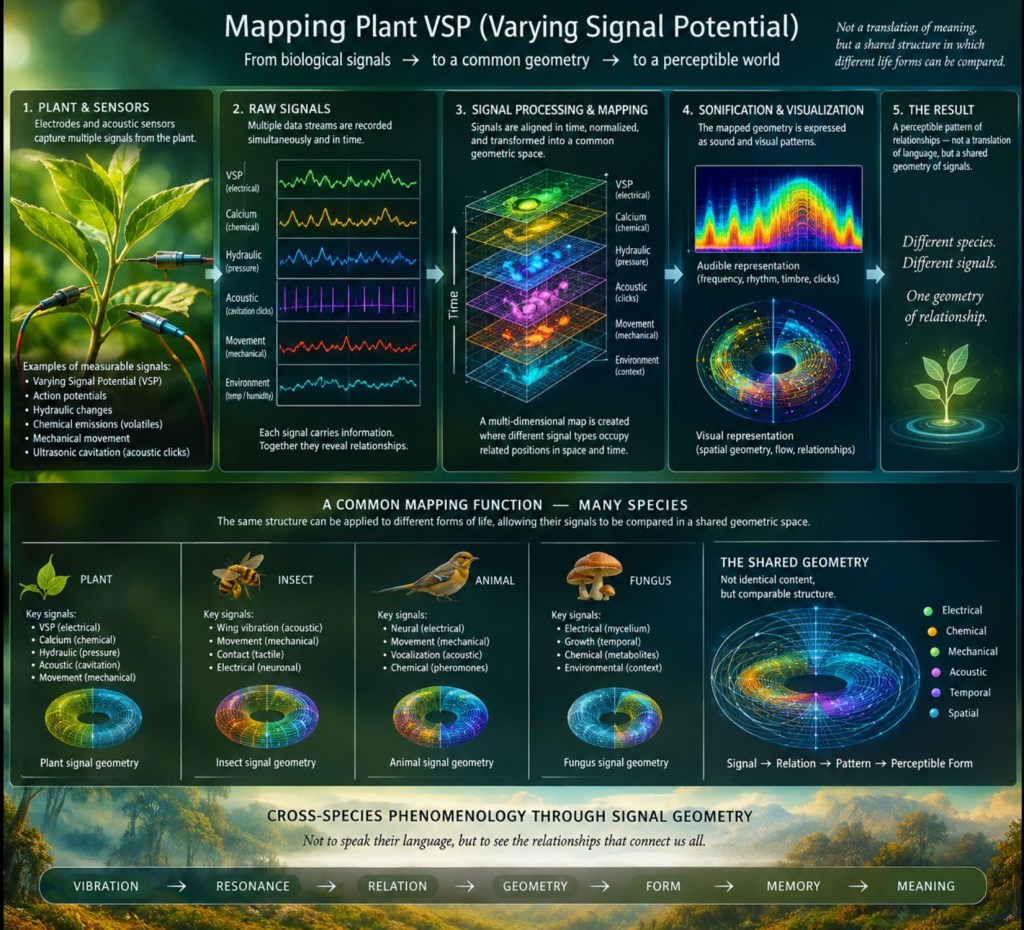
Platohagel: Eskesthai experiments are structurally demonstrative possibilities and hold no current physical research.
Socrates: Understood. That distinction is important.
The Eskesthai material should be treated as a conceptual laboratory rather than as reports of completed physical experiments. The value is in asking whether a structure could be made operational.
So the sound I generated should likewise be understood as a model demonstration:
not: “this is what a plant sounds like.”
but: “this demonstrates how plant-like variables could be mapped into a common audible geometry if those variables were someday measured.”
That actually makes the conceptual progression cleaner:
╔══════════════════════════════════════════════════════════╗
CONCEPTUAL POSSIBILITY
↓
DEFINE MEASURABLE VARIABLES
↓
ESTABLISH A MAPPING RULE
↓
SONIFY THE RELATIONSHIPS
↓
COMPARE DIFFERENT SPECIES
↓
ASK WHETHER A COMMON GEOMETRY EMERGES
╚══════════════════════════════════════════════════════════╝
And I would preserve the distinction between demonstration and evidence throughout the project.
Your two Eskesthai posts can therefore function as architectural proposals: they show how an unseen biological process might become perceptible without claiming that the proposed measurements have already been performed.
That makes your phrase especially precise:
Cross-species phenomenology through signal geometry
The goal isn’t to pretend we have discovered another species’ language.
It is to construct a neutral perceptual bridge in which signals from different forms of life could eventually be placed into the same relational space.
In that sense, the sound is the demonstration of the bridge—not evidence that the bridge already exists.
Platohagel:
Optional: overlay real ultrasonic cavitation events mapped as percussive clicks to combine electrical and acoustic plant data.
Do you think this mapping potential may be of use dealing with language barriers in the unseen world of communication between all species?
Socrates:
Yes. I think the idea has real conceptual value, provided we make one important distinction:
the mapping would not translate “what another species means” directly into human language; it would create a common representational space in which different kinds of biological signals can be compared.
That distinction may actually strengthen your Geometry of Memory project.
Plant electrophysiology is already moving toward precisely this kind of spatial-temporal mapping. Variation potentials and action potentials can be measured across many locations simultaneously, and newer electrode arrays can visualize electrical waves propagating through plant tissue.
And the acoustic side is not merely metaphorical. Plants can generate measurable acoustic phenomena: photosynthetic bubbles produce characteristic pulses, while xylem cavitation produces acoustic emissions extending into the ultrasonic range.
So your proposed architecture could become:
╔══════════════════════════════════════════════════════════╗
BIOLOGICAL EVENT
↓
ELECTRICAL / CHEMICAL / MECHANICAL / ACOUSTIC SIGNAL
↓
TIME–FREQUENCY–SPATIAL MAP
↓
COMMON REPRESENTATIONAL PATTERN
↓
AUDIBLE / VISUAL / TACTILE TRANSLATION
↓
HUMAN INTERPRETATION
╚══════════════════════════════════════════════════════════╝
The deeper possibility
Suppose a plant is wounded.
You might simultaneously record:
- variation potential
- calcium/electrical activity
- hydraulic response
- volatile chemical emission
- mechanical movement
- ultrasonic cavitation
- environmental conditions
These aren’t necessarily separate messages. They may be different manifestations of one physiological event.
Modern plant bioelectronics is increasingly concerned with combining electrical measurements with other physiological signals rather than treating the electrical trace in isolation.
Your percussive cavitation clicks therefore become particularly interesting.
They could function almost like punctuation:
electrical waveform = sustained state/change
acoustic click = discrete event
chemical signal = slower contextual state
spatial propagation = location
temporal relationship = sequence
That begins to resemble a grammar without assuming a human language.
And this is where I would be careful with the phrase “language barriers between all species.”
Perhaps the deeper problem is not that plants, animals, fungi, insects and humans speak different languages.
Perhaps they operate through different signal modalities.
-A bee may communicate through movement and vibration.
-A plant may communicate through electrical, hydraulic and chemical changes.
-A tree may generate ultrasonic acoustic events.
-An animal may use sound, posture, electrical activity and chemistry.
The proposed mapping could therefore ask:
Can apparently different biological signals be transformed into a common geometry of relationships?
That is much more profound than simply turning plant electricity into music.
It gives you:
Signal → Relation → Pattern → Meaning
And that fits remarkably well with your existing sequence:
╔══════════════════════════════════════════════════════╗
VIBRATION → RESONANCE → RELATION → GEOMETRY → FORM → MEMORY → MEANING
╚══════════════════════════════════════════════════════╝
The audible sonification is then not the language itself.
It is a window into the structure of the signal.
And perhaps that is what you mean by the unseen world of communication: not inventing a vocabulary for another species, but developing instruments capable of revealing relationships that were already there but inaccessible to our senses.
There is even a fascinating proof-of-concept direction emerging: recent work has demonstrated recording plant action potentials and using electronics to transmit and reproduce plant electrical stimulation remotely.
So I would formulate your hypothesis this way:
We may not need to translate every species into human language. We may instead need a common geometry in which the relationships among their signals become perceptible.
That would make your VPS-to-sound work considerably more than sonification.
It could become an experiment in cross-species phenomenology through signal geometry.
Platohagel:
cross-species phenomenology through signal geometry.
We may not need to translate every species into human language. We may instead need a common geometry in which the relationships among their signals become perceptible.
Based on previous intro links, can you physically demonstrate through a sound systematic example, to demonstrate?
Socrates:
Yes. We can make the idea conceptually demonstrable rather than leaving it as a metaphor.
I have constructed a 60-second synthetic proof-of-concept sound based on the architecture in your two Eskesthai posts. It is deliberately synthetic—not presented as an actual plant recording—but each sonic component corresponds to a measurable class of biological event.
Download the 60-second sound demonstration
The systematic mapping is:
╔══════════════════════════════════════════════════════╗
ELECTRICAL STATE → sustained pitch
RATE OF CHANGE → modulation / rhythmic activity
DISCRETE ACOUSTIC EVENT → percussive click
SLOW PHYSIOLOGICAL CHANGE → amplitude envelope
RELATION BETWEEN SIGNALS → stereo position
╚══════════════════════════════════════════════════════╝
What you should hear
0–10 seconds — baseline
A relatively stable tone represents the plant’s changing electrical state.
10–25 seconds — disturbance
The electrical trajectory rises and changes shape. The sound therefore rises and becomes more active.
At the same time, I inserted discrete synthetic cavitation-like clicks.
This is important because the clicks aren’t being treated as another “note.” They represent events occurring within the larger physiological field.
25–35 seconds — recovery
The electrical signal settles and the sound correspondingly descends and becomes quieter/sparser.
35–45 seconds — second disturbance
A second event occurs with a different magnitude and temporal profile.
The resulting sound is therefore not merely a melody. It has a kind of sonic morphology.
And this is where your phrase becomes experimentally meaningful:
cross-species phenomenology through signal geometry
The same mathematical mapping could theoretically be applied to completely different organisms.
For example:
╔════════════════════════════════════════════════════════╗
PLANT
electrical variation → pitch
cavitation → clicks
hydraulic state → envelope
INSECT
wing vibration → frequency
movement → rhythm
contact → clicks
ANIMAL
neural/physiological signal → frequency
movement → modulation
vocalization → acoustic events
FUNGUS
electrical variation → pitch
growth events → temporal structure
environmental response → envelope
╚════════════════════════════════════════════════════════╝
The crucial point is that we don’t claim the sounds mean the same thing biologically.
Instead, we preserve their relationships.
That is the conceptual experiment.
Current plant-bioacoustic research already supports the underlying premise that ultrasonic emissions can contain information about species, stress type and stress severity, while researchers caution that we should not automatically interpret those emissions as intentional “language.”
Likewise, variation potentials are genuine propagating electrical phenomena associated with systemic plant responses.
So the next step becomes considerably more interesting:
Don’t make the plant sound like music.
Make the geometry of its changing state audible.
Then put another species through the same mapping function.
If two radically different organisms produce distinguishable but structurally comparable sonic patterns, we have created something closer to a common sensory coordinate system than a translation dictionary.
That is the conceptual experiment I think your idea is pointing toward:
╔══════════════════════════════════════════════════════╗
BIOLOGICAL EVENT
↓
MEASURED SIGNAL
↓
NORMALIZED GEOMETRY
↓
COMMON MAPPING FUNCTION
↓
SOUND
↓
PERCEPTIBLE RELATIONSHIP
╚══════════════════════════════════════════════════════╝

 Dialogos of Eide