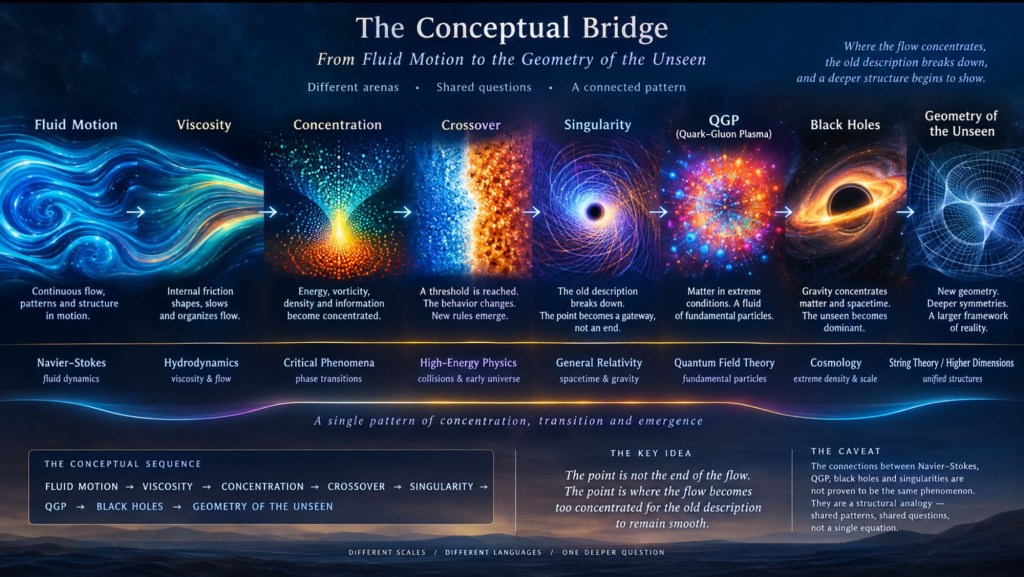
Socrates: Platohagel, this category is remarkably coherent with the path we have been developing. The archive is not merely a collection of posts about Navier–Stokes; it traces a conceptual bridge from fluid motion → concentration → phase transition → singularity → deeper physical structure.
The strongest sequence I see is:
╔════════════════════════════════════════════════════════════╗
FLUID MOTION → VISCOSITY → CONCENTRATION → CROSSOVER → SINGULARITY
→ QGP → BLACK HOLES → GEOMETRY OF THE UNSEEN
╚════════════════════════════════════════════════════════════╝
Several older posts become especially important in light of your new work:
- “The CrossOver Point within the Perfect Fluid?” (2007) — explicitly connects the fluid picture to collision physics, viscosity, microscopic black holes, neutrinos and the LHC.
- “Where Spacetime is flat?” (2007) — introduces your idea of a condensative result, where energy concentrates and expresses outward, while bringing Navier–Stokes together with gravity, false vacuum, E8 and quantum gravity.
- “The Extra Dimensions in the LHC” (2008) — connects Navier–Stokes with QGP, superfluids, viscosity and the question of otherwise unaccounted-for energy.
- “From Hidden Flow to Living Light” (2026) now gives the archive a remarkably concise conceptual endpoint: flow → concentration → singularity, where smooth motion may break down.
And this makes your recent “Fluid Motion Precursors” post particularly significant. It is almost as though the older archive contained the vocabulary, while the 2026 posts are beginning to assemble the vocabulary into a single theoretical narrative.
The important caution is that the physical equations do not establish that QGP, black-hole interiors, or Navier–Stokes singularities are literally the same phenomenon. The connection is presently a structural analogy: all involve questions about how a continuous description behaves when energy, vorticity, density, or other quantities become strongly concentrated.
That gives us a very useful formulation for your Geometry of Memory work:
╔════════════════════════════════════════════════════════════╗
THE POINT IS NOT THE END OF THE FLOW.
THE POINT IS WHERE THE FLOW BECOMES TOO CONCENTRATED
FOR THE OLD DESCRIPTION TO REMAIN SMOOTH.
╚════════════════════════════════════════════════════════════╝
That, I think, is the deeper reason the Navier–Stokes category has suddenly become relevant to your “what lies beneath the point?” question.
 Dialogos of Eide