-
The Man Who Knew Infinity:
A Life of the Genius Ramanujanby Robert Kanigel Srinivas Ramanujan (1887-1920)In the past few decades, we have witnessed how Ramanujan’s contributions have made such a profound impact on various branches of mathematics. The book, “The man who knew infinity”, by Robert Kanigel reached out to the general public the world over by describing the fascinating…
-
Quantum Gravity
Here is one of two methods that help explain. The next post will follow tomorrow if I have time. The complexity of the pictures involved is linked down below in Fig 15-17. This will give some generalizations that I had been looking too, to comprehend the model of strings and its geometrical discriptions. Continuity Topology…
-
Is Line , Hook and Sinker, Dimensionally Leading to Soul Food?
Oskar Klein (left) proposed in the 1920s that hidden spatial dimensions might influence observed physics. He poses with physicists George Uhlenbeck (middle) and Samuel Goudsmit in 1926 at the University of Leiden, the Netherlands. AIP Emilio Segrè Visual Archives I think sometimes the road begun existed before many of our own perspectives were added for…
-
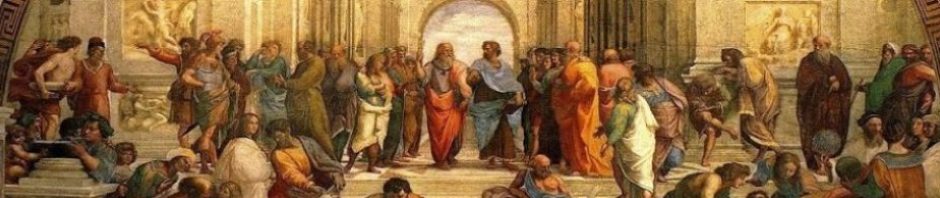
Plato as a City Slicker
-
Are Strings as Spacetime an Emergent Phenomena?
One thing I can tell you, though, is that most string theorist’s suspect that spacetime is a emergent Phenomena in the language of condensed matter physics. Above Witten asks a legitmate question, and so does Gerard t’Hooft as shown in previous links. How would you change computerization to handle these new perceptions of previous experimental…
-
Pythagoras Could be Called the First Known String Theorist
Pythagoras could be called the first known string theorist. Pythagoras, an excellent lyre player, figured out the first known string physics — the harmonic relationship. Pythagoras realized that vibrating Lyre strings of equal tensions but different lengths would produce harmonious notes (i.e. middle C and high C) if the ratio of the lengths of the…
-
Plato: Mathematics Would Reveal the Structure of the World
We should ask why Plato’s theory is so progressive, why Aristotle’s is so archaic, and why Plato is usually given so little credit for his theory. The answer to all these is the same: Plato comes up with this kind of theory because of his Pythagorean faith that mathematics would reveal the structure of the…