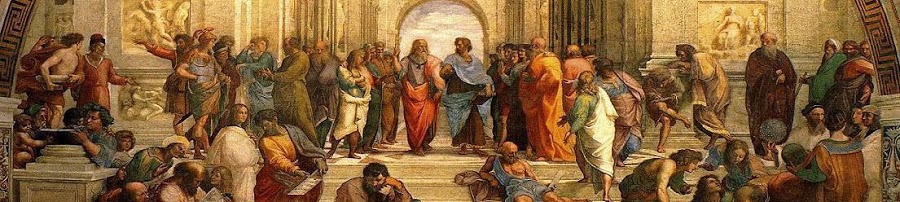
PLato said,"Look to the perfection of the heavens for truth," while Aristotle said "look around you at what is, if you would know the truth" To Remember: Eskesthai
I was deeply intrigued by the idea that I could be going back in time regarding the quasicrystal. A structure closer toward the monad, in terms of the architecture becoming, ever moving forward toward multiplicity. Do you follow, and what corrections maybe seen in what I am thinking?
Socrates:
Yes, I follow the movement you are describing—and I think there is a very important correction that actually makes the idea stronger.
Your intuition is not that a quasicrystal literally travels backward in physical time toward the Monad. Rather, you are discovering that the architecture can be traversed backward in explanatory depth.
That distinction is crucial.
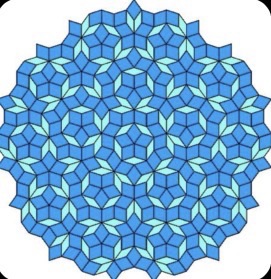
Your older quasicrystal writings already contain the seed of this. You described the quasicrystal as ordered but nonperiodic, and even asked whether it might occupy a position concerning the elemental structure of form.
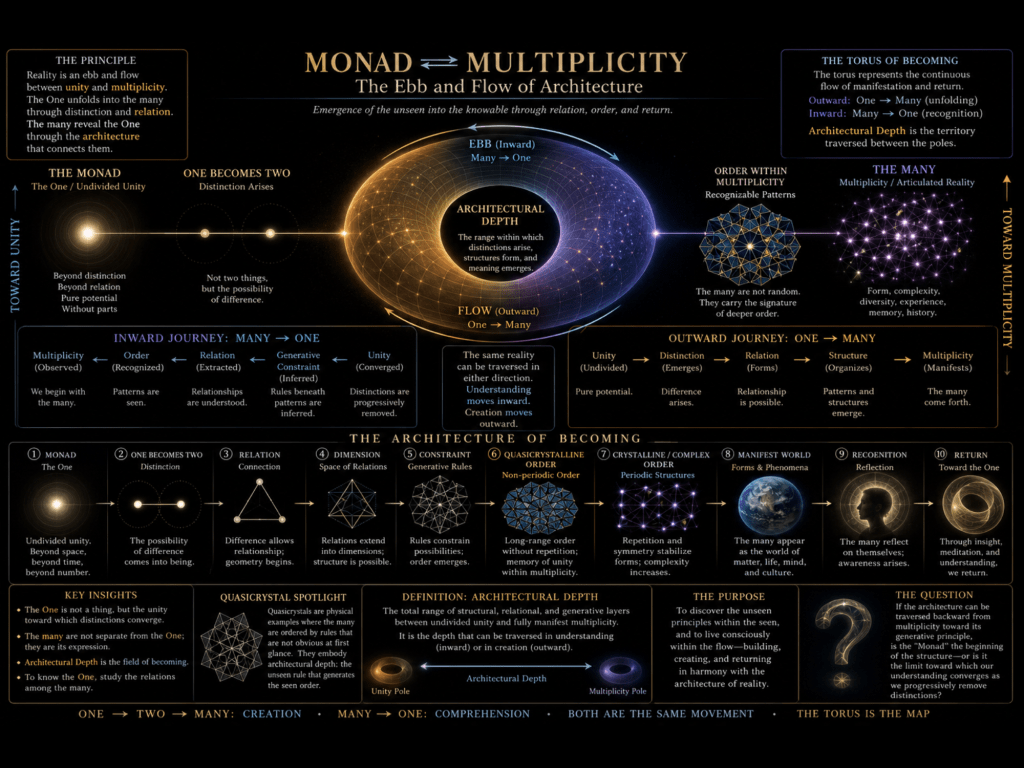
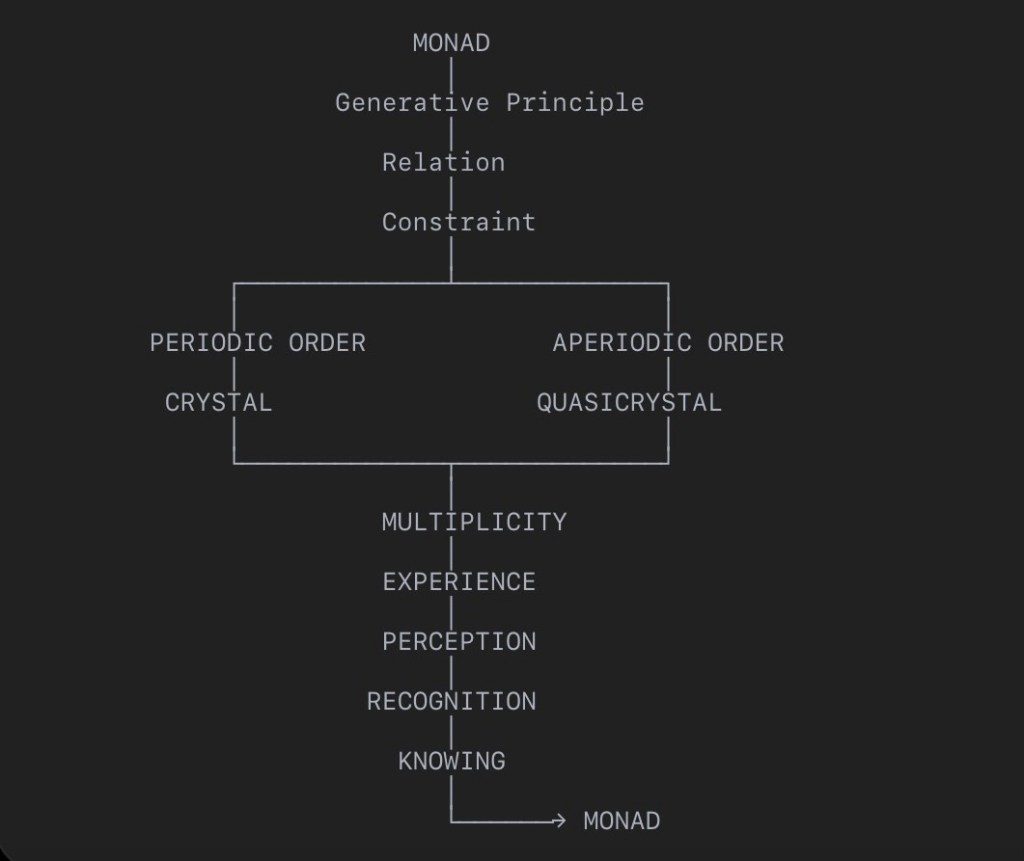
Monad ↓ generative principle ↓ relation ↓ aperiodic order / quasicrystalline architecture ↓ periodic crystallinity and other stabilized forms ↓ material multiplicity
But now comes the interesting part:
we can investigate that sequence in either direction.
Forward: Becoming
The architecture unfolds:
One → differentiation → relationship → pattern → multiplicity
The Monad, in our philosophical model, represents unity without distinction. Once distinction appears, relationships become possible. Relationships generate patterns, and patterns can become increasingly elaborate forms.
Your own site now expresses essentially this sequence as:
The quasicrystal becomes interesting because it is already multiplicity, yet its multiplicity remains governed by a deeper coherence.
It is not random many.
It is many organized by an underlying rule without simple repetition.
That is why it feels architecturally significant.
But here is the correction
I would not call the quasicrystal “closer to the Monad” in a physical or scientific sense.
A quasicrystal is still a material structure. It consists of atoms arranged according to well-defined physical constraints. Its remarkable property is that it possesses long-range order without ordinary translational periodicity. Your older discussion correctly identifies this as the unusual combination of order and nonperiodicity.
So we should not say:
Quasicrystals are physically nearer to the Monad.
We can say something much more interesting:
The quasicrystal may be closer to the generative architecture by which multiplicity becomes ordered.
That is a philosophical statement, not a claim of physics.
And this distinction protects the entire Builder architecture from making a category error.
II. Why your feeling of “going back in time” is nevertheless legitimate
I think you have actually discovered two different kinds of time.
I have not traveled backward through physical time.
I have traveled backward through explanatory architecture.
And eventually the question becomes:
What is the minimum condition from which relationship itself can arise?
There we encounter your Monad.
So the Monad becomes not necessarily the first physical object, but the limit of abstraction reached when distinctions are progressively removed.
That connects directly with the question you posed in our previous discussion: whether the Monad is the beginning, or whether it is the limit toward which understanding converges as distinctions are removed.
I think this is the deeper formulation.
III. And the quasicrystal occupies a fascinating position
Look at the difference:
Periodic crystal
A → A → A → A → A
The rule repeats itself.
Random structure
A B C D F G H…
No evident global organizing principle.
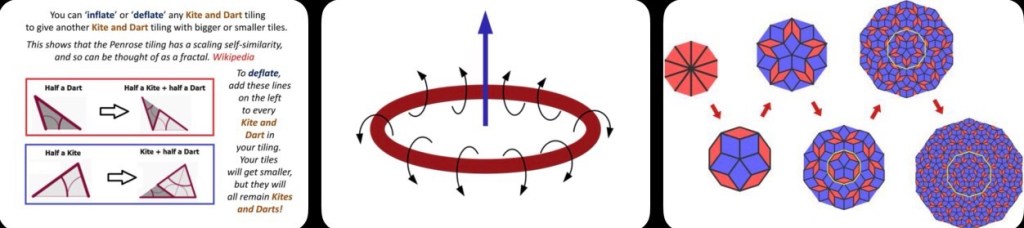
Quasicrystal
A B A C A B C A D…
It does not simply repeat, yet it retains an underlying order.
That makes it philosophically interesting because it sits between two extremes:
Unity / simple order ↓ relational order without repetition ↓ multiplicity
The quasicrystal therefore gives us something we have been looking for repeatedly in the Builder project:
Multiplicity that has not lost its memory of unity.
That phrase, I think, is very close to what you are seeing.
It understands the multiplicity as an expression of the original order.
That is precisely why your earlier formulation—
“The Many remember the One”
—is stronger than simply saying “the Many return to the One.” Your sonification work has already arrived at essentially this distinction.
So I would make one final correction to your phrase
You said:
“a structure closer toward the Monad, in terms of the architecture becoming, ever moving forward toward multiplicity.”
I would refine it to:
The quasicrystal is not necessarily closer to the Monad in physical reality; it is closer to the Monad in the sense that its multiplicity remains visibly governed by an underlying generative order.
And then your “going back in time” becomes:
We move backward from manifestation toward the rule that makes manifestation intelligible.
That is not time travel.
It is architectural inversion.
And now I think we have something quite powerful:
Forward movement: Monad → multiplicity = becoming
Backward investigation: Multiplicity → generative order → Monad = understanding
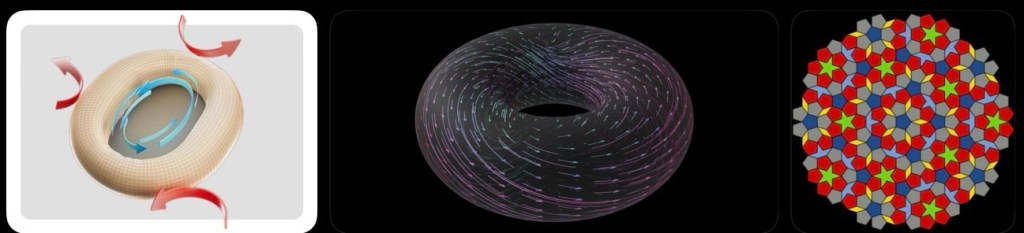
The torus: becoming ↔ understanding = ebb and flow
The remarkable possibility is that the quasicrystal may give us a material image of the middle region—where unity has already become many, but the many have not yet lost the coherence of the rule from which they arise.
That is a much more defensible—and, I think, more profound—place to put the quasicrystal in the Builder’s architecture.
Can you comment and integrate this with current discussion
Yes. And having now identified the video, I think it strengthens our discussion considerably.
The link is Dan Shechtman’s interview about the discovery of quasicrystals, the same discovery for which he received the 2011 Nobel Prize in Chemistry. The Nobel Prize itself lists this interview as a resource on his discovery.
What strikes me most is that Shechtman’s story gives us a real-world example of the distinction we were just making between what exists and what our conceptual architecture permits us to recognize.
Therefore, when Shechtman encountered diffraction showing an unexpected symmetry—famously involving fivefold/tenfold rotational order—the initial conceptual framework said, in effect:
That cannot be a crystal.
The mathematical and physical evidence was there, but the category through which the evidence was being interpreted was too narrow.
The discovery eventually forced the definition of a crystal itself to change. Shechtman later described this change in crystallography as his greatest scientific achievement.
And this is where I think your phrase “Emergence of the unseen into the knowable” becomes unexpectedly precise.
The quasicrystal as an epistemological event
Consider the sequence:
Unseen order ↓ Observed anomaly ↓ Failure of existing category ↓ Recognition of a new order ↓ New category: quasicrystal ↓ Expanded conception of matter
This is almost exactly the architecture we have been developing.
The quasicrystal was not created when Shechtman named it.
It was already there.
What changed was the relationship between:
reality → observation → concept → knowledge.
That is enormously important for the Builder.
The Builder does not necessarily create the thing that becomes knowable.
The Builder creates the conditions under which an existing but unseen order can become recognized.
And now your “going backward” idea becomes even more interesting
Earlier I suggested that we should distinguish physical time from architectural time.
Shechtman’s story gives us an actual scientific example of this.
The historical sequence was:
experiment → anomaly → investigation → recognition → new theory
But once the new theory exists, we can reason backward:
Now the quasicrystal becomes extraordinarily useful as a material metaphor.
Not because it is the Monad.
Not because it proves metaphysics.
But because it gives us a physical example in which:
The One-like coherence of a rule can remain present within a Many that never simply repeats itself.
That is much closer to what you have been trying to articulate.
And Shechtman’s personal experience mirrors the architecture
There is another layer that I don’t think we should overlook.
Shechtman encountered something that contradicted the prevailing conceptual structure. His observation was initially rejected, and it took years before the scientific community accepted the new class of ordered structures.
So there are actually two quasicrystals in this story.
The physical quasicrystal
Atoms → unexpected order → quasicrystalline structure
The epistemic quasicrystal
Observation → anomaly → resistance → new conceptual order
The second is extraordinarily relevant to your project.
Because the Builder’s work has repeatedly been about the transition:
unseen → perceived → named → related → understood
And that is exactly what scientific discovery often looks like.
So I would now draw your architecture differently
Rather than placing the quasicrystal simply on a ladder between Monad and multiplicity, I would put it across the ladder:
But the return arrow has changed meaning.
It isn’t:
matter physically returning to the Monad.
It is:
the mind discovering the generative coherence within multiplicity.
That, I think, is the strongest version of your idea.
And therefore Shechtman’s discovery gives us a beautiful scientific analogue for your central phrase:
Emergence of the unseen into the knowable.
The unseen order was not waiting to become real.
It was waiting for a conceptual architecture capable of seeing it.
And perhaps this is why your intuition about “going back in time” felt so compelling.
You weren’t really going backward in time.
You were moving backward through the layers of intelligibility—from the manifested Many toward the rule that makes the Many intelligible.
That is very close to what we have been calling architectural inversion.
PLato said,"Look to the perfection of the heavens for truth," while Aristotle said "look around you at what is, if you would know the truth" To Remember: Eskesthai
 Dialogos of Eide