Sir Isaac Newton and the Modal Language
THE ALCHEMIST OF LIGHT — PART I
Before the word was written,
before the measure had a name,
there was a hidden correspondence
moving quietly through the frame.
A color became a question,
a shadow became a sign,
a substance changed its nature
when two relations aligned.
[Verse I — Newton]
In Cambridge halls beneath the candle,
Newton watched the prism break the light,
seven colors from the single,
many voices from the white.
But beneath the glass and numbers,
another question came to be,
What unseen order moves the visible?
What hidden law makes nature speak?
He turned toward the ancient writings,
toward the vessels, flame, and stone,
seeking not a treasure merely,
but the principle unknown.
[Pre-Chorus]
For matter was a language,
and change became a key,
the surface showed the mystery
of what the eye could never see.
[Chorus]
One thing speaking many languages,
one light wearing many forms,
above reflected in the below,
within the silence, something transforms.
Matter, color, number, motion,
each revealing something more—
the visible becomes a doorway
to what lies beneath the form.
[Verse II — The Chymist’s Garden]
Metal becomes a garden,
crystal reaches toward the sky,
what appeared to be inert matter
takes another form before the eye.
Dissolve—Separate—Recombine—Become.
Newton looked into the darkness
for the principle beneath the flame.
The alchemist looked into the vessel
for the hidden nature without a name.
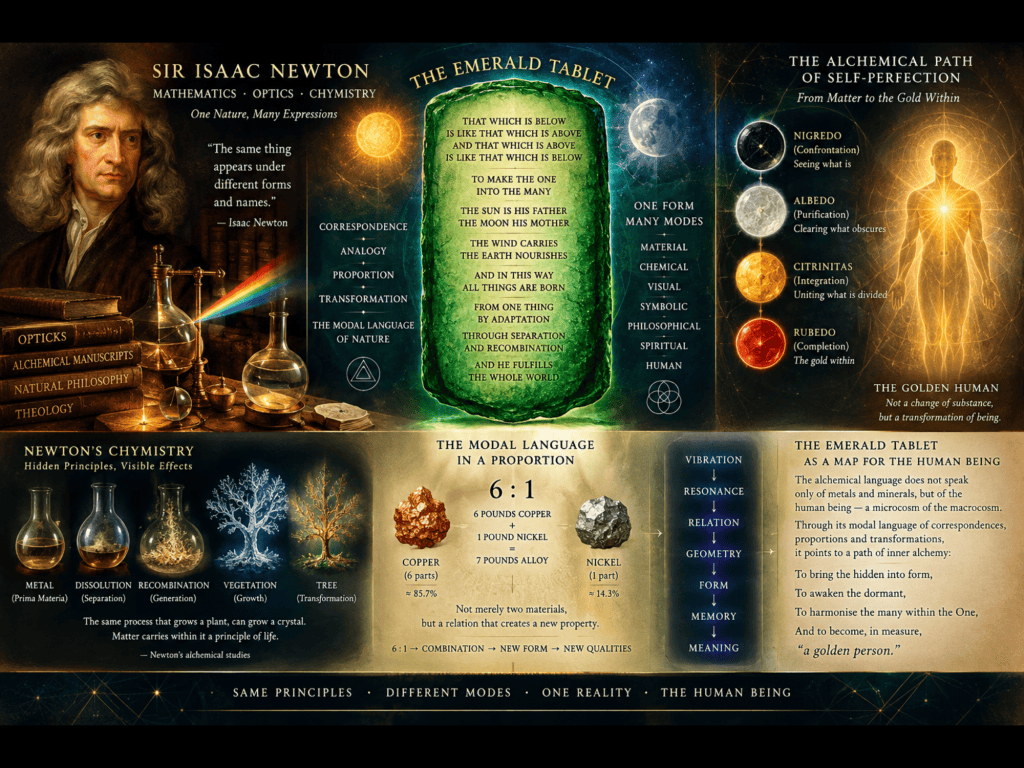
Six measures of copper,
one measure beside,
a number carried through the darkness,
a proportion held inside.
Not merely six and one,
not merely weight and stone—
the relation becomes the memory,
the memory becomes known.
And perhaps the ancient language
was never meant to say:
This thing simply means another,
Watch what happens when they relate.
The prism opens into color,
the vessel opens into form,
the question moves beneath the surface—
What unseen order makes us
The Alchemist of Light Part II
THE ALCHEMIST OF LIGHT — PART II
Upon the emerald tablet,
ancient words became a door:
What is above is like what is below,
and what is below becomes once more.
Sun and Moon in correspondence,
wind carrying what earth receives,
separation and recombination,
patterns hidden in the leaves.
[Verse I]
One becomes the many,
many find their way to one,
through the language of proportion,
through the daughter and the sun.
The visible becomes a symbol,
the symbol becomes a guide,
and what appears outside us
has another world inside.
One thing speaking many languages,
one light wearing many forms,
above reflected in the below,
within the silence, something transforms.
Not gold alone,
but what the gold might signify—
the human being becoming
what was hidden deep inside.
[Verse II — The Great Work]
Dissolve what has hardened,
separate what has grown apart,
purify what lies concealed,
recombine the scattered heart.
Darkness—Whitening—Golden dawn—
The red flame rising
before the final sun.
The substance changes slowly,
but something else is changed:
The one who watches the transformation
is no longer quite the same.
The philosopher looked into the human
and asked what transformation means.
The prism opened into color—
the color opened into dreams.
The ancient language speaks in mirrors,
in proportions, signs, and flame—
not to make a perfect substance,
but to make the seeker capable of seeing.
[Final Chorus — expansive]
One thing speaking many languages,
one reality taking form,
matter, symbol, number, color,
the lightning and the storm.
The visible becomes a doorway,
the measured becomes a sign,
the many reveal their relationship,
and relationship reveals the design.
Above—below.
Within—without.
Matter—meaning.
Question—doubt.
And through the changing forms of nature,
something human comes to be—
Not the making of a perfect substance,
but the making of a self
that learns to see.
Let the gold remain a symbol,
let the emerald remain a door.
Let Newton’s light pass through the prism,
and ask what lies beyond the form.
For perhaps the ancient alchemists
were speaking in a language of becoming—
where substance becomes relation,
relation becomes form,
form becomes memory,
memory becomes meaning—
and meaning becomes the human
who awakens to the whole.
One Nature, Many expressions.
One question what are we becoming?