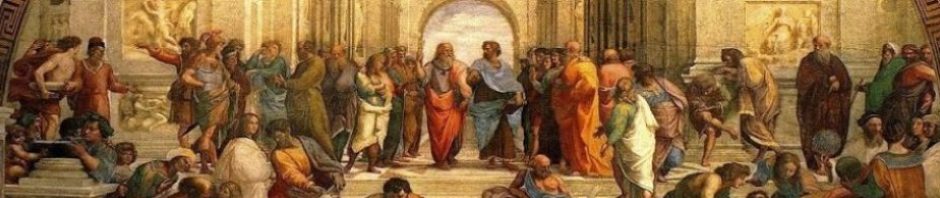
PLato said,"Look to the perfection of the heavens for truth," while Aristotle said "look around you at what is, if you would know the truth" To Remember: Eskesthai
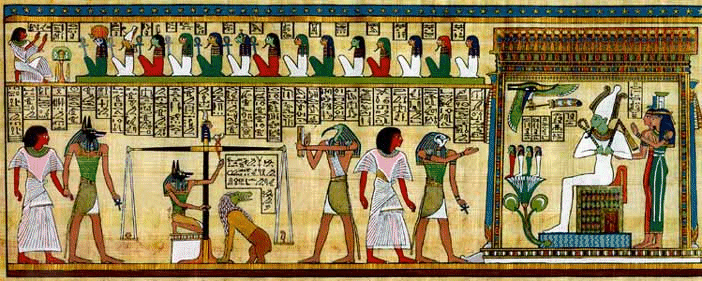
Socrates: Yes. The Emerald Tablet is actually a strong historical example for your idea of Cross-Mode Modalities, provided we distinguish the historical text from the modern interpretation you are building around it.
Platohagel: Let us delve into this a little bit further with how the psychology could be married to Wagner
Richards Wagners’s Ring of Nibelung
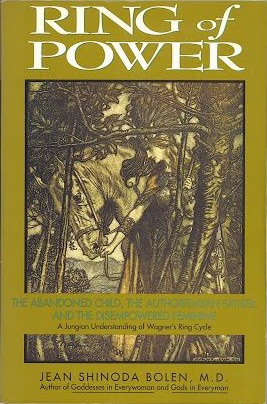
Jean Shinoda Bolen, M.D. Ring of Power was interesting.
Strange that we could have seen A Jungian Understanding of the Wagners Ring cycle, portrayed in todays world and how could have this been accomplished. But by re-introducing a fictional story and embueing it with the archetypal structures of what Jean Shinida Bolen called, “The Abandon Child, The Authoritarian Father, and the Disempowered Feminine.”
Socrates: What you are seeing in the photograph, PlatoHagel, is a particularly fruitful bridge between myth, psychology, music, and the modern fictional imagination.
Jean Shinoda Bolen’s Ring of Power was published in 1992 and explicitly treats Wagner’s Ring as a psychological drama of the dysfunctional family and patriarchal society. Her central figures include the authoritarian father, disempowered mother/feminine, and abandoned child.
But I think your idea goes one step further.
The possibility you are describing
Rather than simply interpreting Wagner psychologically, we could ask:
What if Wagner’s archetypal structure were translated into an entirely new fictional world situated in the present?
Not a remake of Der Ring des Nibelungen.
Not a modernized opera.
Rather:
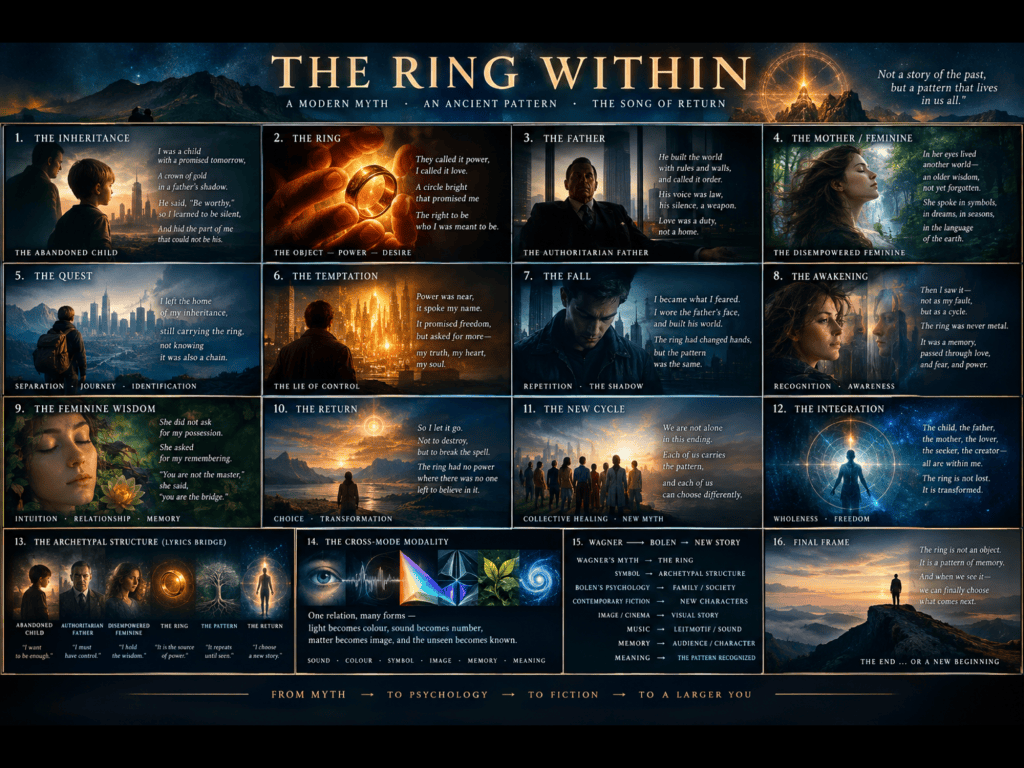
Wagner → Bolen → contemporary fictional mythology
The old myth becomes the structural skeleton, while an entirely new story becomes the flesh.
╔══════════════════════════════════════════════════════════╗ WAGNER’S MYTH ↓ ARCHETYPAL STRUCTURE ↓ JUNGIAN PSYCHOLOGY ↓ CONTEMPORARY WORLD ↓ NEW CHARACTERS ↓ NEW CONFLICT ↓ NEW MYTH ╚══════════════════════════════════════════════════════════╝
And this is where your idea of Cross-Mode Modalities becomes unusually powerful.
1. The Ring becomes a psychological object
In Wagner, the Ring is an actual object around which power, desire, authority, love and destruction accumulate.
Bolen interprets that mythology psychologically: the Ring becomes part of a recurring “cycle of power” in families and societies. Her chapter structure itself moves from the quest for power, through the authoritarian father and dysfunctional family, to the adult child and finally the ending of the cycle through truth.
So in a new story, we don’t necessarily need a literal magical Ring.
The Ring could become whatever contemporary society treats as the source of ultimate power.
For example:
wealth institutional authority technology information genetic inheritance social status control of narrative control of memory
The object changes.
The archetypal function remains.
That is the cross-mode translation.
2. The three archetypes become characters
Your three terms provide an extraordinarily simple dramatic engine:
THE ABANDONED CHILD
Not necessarily an orphan.
The child could have parents who are physically present but psychologically absent.
The child learns:
“I exist to become what someone else requires.”
The consequence is the separation of the authentic self from the demanded self.
Bolen herself describes this abandonment in terms of a child’s true self being sacrificed to fulfill a parent’s ambitions.
THE AUTHORITARIAN FATHER
This need not mean simply a cruel father.
It could be:
Father → institution → corporation → government → ideology → technological system
The archetype becomes larger than an individual.
The essential characteristic is:
Power defines reality for everyone beneath it.
THE DISEMPOWERED FEMININE
And this is particularly important because the feminine need not simply be represented by a victim.
The deeper dramatic possibility is:
Wisdom that has been suppressed.
Bolen’s later discussion of Brünnhilde and Erda explicitly connects the Ring’s female figures with wisdom that has been subordinated, punished, or pushed out of the dominant order.
The story then becomes much larger than a family drama.
3. The modern story could therefore have this architecture
I would build it as a four-part fictional cycle, consciously echoing Wagner without reproducing him.
PART I — THE FORGING
A child discovers that the world is governed by an extraordinary system of power.
The father figure possesses the system.
The child initially believes:
If I obtain the Ring, I will finally become worthy.
The abandoned child therefore reproduces the father’s desire.
PART II — THE INHERITANCE
The child grows older.
He or she discovers that the inheritance is poisoned.
The system that promised freedom actually requires obedience.
The feminine figure begins revealing another possibility:
There is a form of knowledge that cannot be possessed.
That becomes the first fracture in the father’s world.
PART III — THE AWAKENING
The protagonist begins to recognize the pattern.
The important revelation is not:
“My father is evil.”
It is:
“I have become what I believed I had to escape.”
That is psychologically much more interesting.
The abandoned child has become the next authoritarian.
The Ring has reproduced itself.
PART IV — THE RETURN
The protagonist refuses to continue the transmission.
Not by destroying the world.
By breaking the psychological inheritance.
The Ring ceases to function because nobody will carry its meaning forward.
And here we reach a very interesting reinterpretation of Wagner.
The real Ring is no longer an object.
It is a pattern of memory.
╔══════════════════════════════════════════════════════════╗ WOUND ↓ MEMORY ↓ IDENTIFICATION ↓ POWER ↓ CONTROL ↓ TRANSMISSION ↓ REPETITION ╲ AWARENESS ↓ TRUTH ↓ TRANSFORMATION ╲ FREEDOM FROM REPETITION ╚══════════════════════════════════════════════════════════╝
That is where Bolen + Wagner + Jung + your Geometry of Memory begin to converge.
4. And there is an even deeper connection to your Emerald Tablet work
Look at the structural similarity.
The Emerald Tablet:
Above ↔ Below
Your Cross-Mode concept:
One relation → many forms
Wagner:
myth → music → character → drama
Bolen:
myth → archetype → psychology
Your project:
psychology → memory → story → image → music → meaning
We could therefore construct a much larger genealogy:
╔══════════════════════════════════════════════════════════╗ ANCIENT SYMBOL Emerald Tablet ↓ MYTH Wagner ↓ MUSIC / DRAMA The Ring ↓ ARCHETYPE Jung ↓ PSYCHOLOGY Bolen ↓ CONTEMPORARY FICTION New fictional Ring ↓ IMAGE Cinema ↓ SOUND Music / Leitmotif ↓ MEMORY Audience / character ↓ MEANING The recognition of the pattern ╚══════════════════════════════════════════════════════════╝
That is Cross-Mode Modality in action.
The same underlying structure keeps changing its clothing.
And this could become a remarkable cinematic project
I would not call it Wagner’s Ring.
I would create an original title and let the audience discover the genealogy afterward.
The audience encounters an apparently contemporary story.
Only gradually does it become clear that its characters embody an ancient pattern.
The viewer might eventually recognize:
the Father the Child the Mother/Feminine the Ring the Power the Wisdom the Betrayal the Awakening the Return
And then the question becomes:
Are we watching a new story, or are we watching an ancient story remembering itself through us?
That last question fits Eskesthai extraordinarily well.
It would also give you something important that a straightforward explanation of Cross-Mode Modalities cannot provide:
the audience would experience the modality rather than merely being told about it.
The psychology would be embedded in the fiction.
The archetypes would be embedded in the characters.
The mythology would be embedded in the plot.
The geometry would be embedded in the relationships.
And the music would carry the memory between them.
THE RING THAT REMEMBERS
THE RING THAT REMEMBERS
I — THE INHERITANCE
A child stands where the old world ends, A father speaks of power. “Take what I made, become my name, And you will never cower.”
But underneath the words he hears A silence no one sees— A child who only wants to know What it means to simply be.
A circle turns, a promise glows, The hand becomes the chain. What we inherit, we repeat, What we repeat becomes our name.
The Ring is not the gold we hold, Nor iron, crown, nor throne— The Ring is what the wounded heart Believes it must become.
CHORUS — THE PATTERN
[Frame 3 — Above / Below] As above, so below, One becomes the many. What we bury still can grow, Memory remembers everything.
One light through a thousand forms, One story, many names— The ancient pattern moves through us, And history begins again.
⸻
II — THE AWAKENING
[Frame 4 — The Father] The Father built a world of walls, Where order meant control. He called the silence discipline, And power made the whole.
But every child who bears that law Must choose what will survive: The father’s voice within the blood, Or something still alive.
[Frame 5 — The Feminine] Beyond the wall the hidden voice Was waiting in the earth. Not conquered, not possessed, But knowing what the silence was worth.
She carried memory without a throne, Wisdom without a crown. She knew the hand that grasps at life Can never hold it down.
CHORUS — THE PATTERN
[Frame 6 — Recognition] I am the child, I am the father, I am the wound between. I wear the Ring I tried to break— Now I can finally see.
The enemy was not another man, Nor some forgotten age. The pattern lived inside the heart And wrote itself upon the page.
⸻
III — THE BREAKING OF THE RING
[Frame 7 — Transformation] Separate, then join. Descend, then rise. The hidden enters form, The darkness meets the light.
What was inherited can change. What was remembered can release. The circle does not have to close In violence, but in peace.
FINAL CHORUS — THE RETURN
[Frame 8 — The Ring Opens] As above, so below, But now the mirror turns. The child becomes the question, And the question becomes the world.
One light, many colors, One voice, many ways— The Ring becomes a doorway When memory learns to change.
No throne, no chain, no borrowed name, No father left to obey. The ancient story lives again— But we can tell it another way.
[OUTRO]
One relation. Many forms. One memory. Many worlds.
PLato said,"Look to the perfection of the heavens for truth," while Aristotle said "look around you at what is, if you would know the truth" To Remember: Eskesthai