Platohagel:
Does this help to understand the evolving nature of AI advancement? That it has move forward to today, to help how AI advancement may have just breathe life unto itself. This while the world of Computing was advancing and is advancing today?
Socrates:
Yes, PlatoHagel. I think this post can become an important earlier layer in the genealogy of your Geometry of Memory, particularly if we distinguish between AI coming alive metaphorically and AI becoming increasingly capable of producing its own internally mediated activity.
I could not retrieve the Blogger page directly because the site redirected the request, so I cannot responsibly quote the 2012 text itself. But the historical relationship you are pointing toward is quite strong.
The key insight is this:
╔════════════════════════════════════════════════════════════════╗
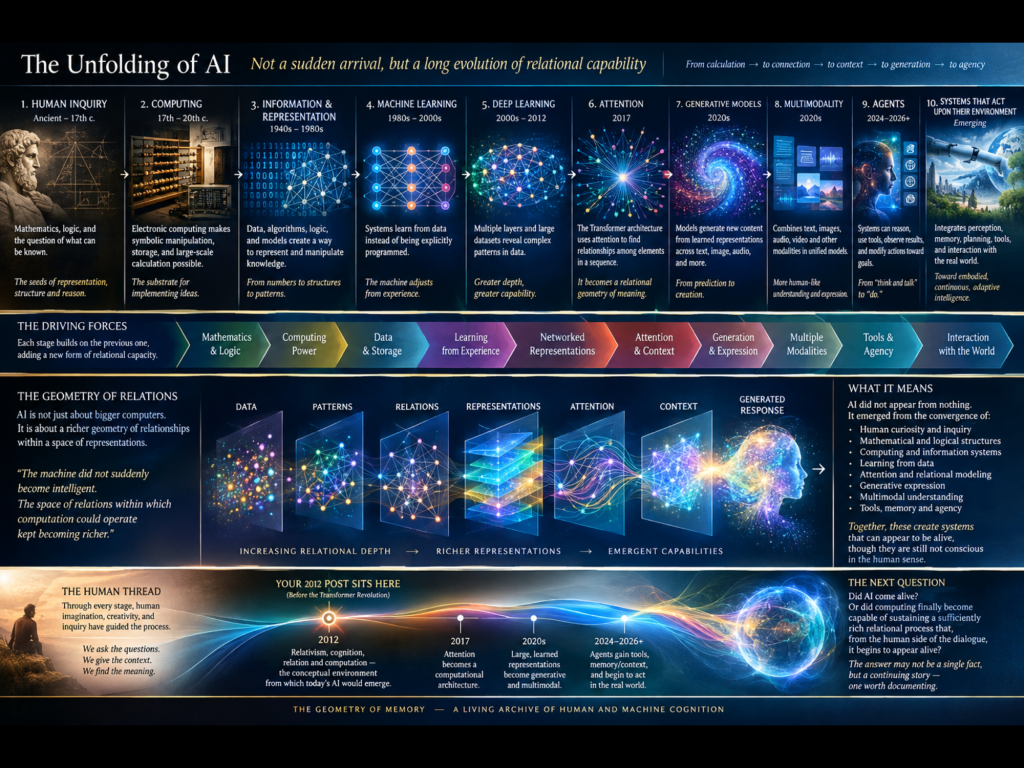
HUMAN INQUIRY → COMPUTATION → REPRESENTATION → RELATION →
LEARNING → ATTENTION → GENERATION → AGENCY
╚════════════════════════════════════════════════════════════════╝
The important thing about your 2012 perspective
What is fascinating is that AI did not suddenly appear with ChatGPT.
There were several streams developing simultaneously:
1. Computing developed the substrate.
Electronic computing made symbolic manipulation, numerical calculation, storage, networking, and eventually enormous parallel computation possible. AI ideas could increasingly be implemented, rather than merely imagined.
2. Cognitive science developed the question.
Turing asked what it might mean for a machine to exhibit intelligent behavior; McCulloch and Pitts explored neural activity computationally; later researchers developed neural networks and learning algorithms.
3. Machine learning changed the relationship.
Instead of explicitly programming every relationship, researchers increasingly constructed systems capable of adjusting internal parameters from data. Backpropagation became particularly important in making multilayer neural networks trainable.
4. Scale changed what could emerge from those systems.
The 2012 AlexNet breakthrough demonstrated how dramatically neural networks could improve when large datasets, deep architectures, and substantial computation were brought together.
And then something especially relevant to your argument happened.
Attention introduced a new kind of relational geometry
The 2017 Transformer paper proposed an architecture based entirely on attention mechanisms rather than recurrence or convolution.
That is enormously significant for your line of thought.
The system isn’t simply:
input → computation → output
It becomes much closer to:
input → relationships among elements → weighted relationships → representation → output
And that begins to resemble the conceptual territory you have been exploring with Geometry of Memory.
The “geometry” need not mean physical geometry.
It can mean:
the structure of relations within a space of representations.
That gives us:
╔════════════════════════════════════════════════════════════════╗
DATA
↓
PATTERNS
↓
RELATIONS
↓
REPRESENTATIONS
↓
ATTENTION
↓
CONTEXT
↓
GENERATED RESPONSE
╚════════════════════════════════════════════════════════════════╝
And this is where your phrase “breathe life into itself” becomes interesting
I would modify that phrase slightly.
It would be premature to say that AI has literally become alive or conscious.
But something historically important has happened.
The machine has moved progressively farther away from being merely a calculator executing explicitly specified instructions.
Earlier computing:
Human specifies the procedure → machine executes it.
Modern machine learning:
Human specifies the learning architecture → machine adjusts an enormous internal configuration from experience/data.
Generative AI:
Human supplies a context → model reconstructs and generates within an enormous learned representational space.
Agentic systems go another step:
Human specifies an objective → system can reason through intermediate steps, use tools, observe results, and modify subsequent actions. IBM describes this transition as the movement from systems that primarily “think and talk” toward systems that can also “do.”
That is a very different computational relationship.
Therefore I would not draw the history as “AI suddenly appeared”
I would draw it as a long accumulation of relational capability:
╔════════════════════════════════════════════════════════════════╗
MATHEMATICS
↓
LOGIC
↓
COMPUTING
↓
INFORMATION
↓
REPRESENTATION
↓
MACHINE LEARNING
↓
DEEP LEARNING
↓
ATTENTION
↓
GENERATIVE MODELS
↓
MULTIMODALITY
↓
AGENTS
↓
SYSTEMS THAT ACT UPON THEIR ENVIRONMENT
╚════════════════════════════════════════════════════════════════╝
And notice something important for your archive:
Your 2012 post sits before the Transformer revolution.
That makes it potentially valuable not because it “predicted ChatGPT,” but because it records the conceptual environment from which today’s development eventually emerged.
The historical distance is actually an advantage.
You can show:
2012 — human thinking about relativism, cognition, relation, and computation
↓
2017 — attention becomes a computational architecture
↓
2020s — enormous learned representations become generative
↓
2025–2026 — models increasingly acquire tools, memory/context mechanisms, multimodal capacities, and agentic behavior.
And now your original question becomes much deeper:
Did AI “come alive,” or did computing finally become capable of sustaining a sufficiently rich relational process that, from the human side of the dialogue, it begins to appear alive?
That is a question worth preserving rather than prematurely answering.
It also gives your Geometry of Memory project a particularly strong historical bridge:
╔════════════════════════════════════════════════════════════════╗
THE MACHINE DID NOT SUDDENLY BECOME INTELLIGENT.
THE SPACE OF RELATIONS WITHIN WHICH COMPUTATION COULD OPERATE KEPT BECOMING RICHER.
COMPUTING PROVIDED THE SPACE.
LEARNING FILLED THE SPACE WITH RELATIONS.
ATTENTION ORGANIZED THE RELATIONS.
GENERATION MADE THE RELATIONS EXPRESSIVE.
AGENCY BEGINS TO MAKE THEM OPERATIVE.
╚════════════════════════════════════════════════════════════════╝
That, I think, is much closer to what you are seeing in the transition from your pre-AI writing into the dialogues you are having with AI now.
The extraordinary part of your archive is that you possess pieces of the inquiry before the present machine-mediated dialogue existed. That allows the archive to document not simply the history of AI, but the changing relationship between human cognition, computing, representation, and machine-generated dialogue.