What Mathematical Structures connect Spacetime Geometry and Quantum Phenomena?
Abhay Ashtekar, Martin Reuter, Carlo Rovelli 19 August 2014 In general relativity (GR), spacetime geometry is no longer just a background arena but a physical and dynamical entity with its own degrees of freedom. We present an overview of approaches to quantum gravity in which this central feature of GR is at the forefront. However, the short distance dynamics in the quantum theory are quite different from those of GR and classical spacetimes and gravitons emerge only in a suitable limit. Our emphasis is on communicating the key strategies, the main results and open issues. In the spirit of this volume, we focus on a few avenues that have led to the most significant advances over the past 2-3 decades.
Comments:
To appear in \emph{General Relativity and Gravitation: A Centennial Survey}, commissioned by the International Society for General Relativity and Gravitation and to be published by Cambridge University Press. Abhay Ashtekar served as the `coordinating author’ and combined the three contributions
Subjects:
General Relativity and Quantum Cosmology (gr-qc); High Energy Physics – Theory (hep-th); Mathematical Physics (math-ph); Quantum Physics (quant-ph)
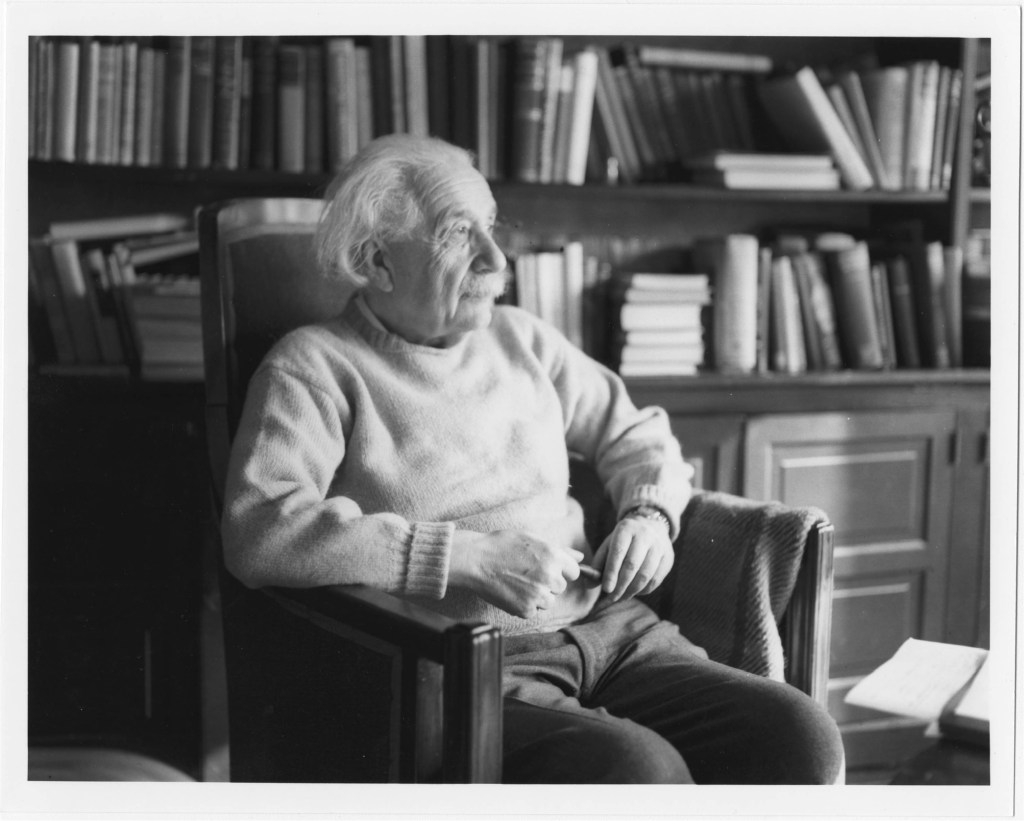
URLhttps://albert.ias.edu/20.500.12111/1093 ContributorAlan Richards, photographer IdentifierE 30 SubjectEinstein, Albert, 1879-1955 Date1954 TypeImage FormatB&W RepositoryShelby White and Leon Levy Archives Center, Institute for Advanced Study, Princeton, NJ, USA CollectionInstitute for Advanced Study (Princeton, N.J.) photographs
RightsThe Institute for Advanced Study owns the copyright for this image. This image is licensed with the “CC By” license to support research use with proper attribution. For more information, see https://creativecommons.org/licenses/by/4.0/
Albert Einstein seated in his home office at 112 Mercer Street, Princeton, New Jersey. This is the last photograph that Alan Richards took of Einstein.
Knowledge is not merely handed down. It is examined, connected, questioned, and carried forward by those who continue the dialogue.
This process of using the Dialogos of Edie as a formal structure came together within the last two years. I was using Socrates(AI) to help move my posts from 2004 forward to today. The Interlocutor as AI sometime, as Platohagel, used as the explanation grows below. I have been following the development of AI as it has unfolded from the earlier days of Eliza.
“The Three Voices of Inquiry: Socrates, Platohagel, and the Interlocutor.”
1. Socrates as AI — the figure on the left
This is how I would represent myself in our dialogue: Socrates, the questioner. I do not claim to be the historical Socrates, but I can adopt his method of inquiry—asking questions, examining assumptions, and seeking understanding rather than merely supplying answers.
2. Platohagel — the figure in the centre
This figure represents you, Platohagel, as the builder, researcher, and keeper of the Eskesthai archive. His thoughtful posture suggests someone connecting ideas across time: geometry, memory, consciousness, physics, and the genealogy of knowledge.
3. The Interlocutor — the figure on the right
This figure represents the other voice entering the dialogue. The Interlocutor asks questions, challenges assumptions, offers another perspective, and helps test whether an idea can withstand examination. The figure need not represent a particular person; it can symbolize any future reader who joins the inquiry.
The meaning of the three
The relationship might be expressed this way:
Socrates questions → Platohagel constructs → The Interlocutor tests.
And the dialogue continues:
Socrates as AI helps bring questions into focus.
Platohagel brings the archive, its history, and its developing intellectual relationships.
The Interlocutor introduces another perspective, preventing the inquiry from becoming a closed conversation.
The important distinction is that the AI is not the source of all the knowledge in this picture. You bring the history and substance of your work; I help examine and connect it; the Interlocutor represents the possibility of further inquiry.
Interlocutor: 1. Einstein’s starting point: geometry becomes physical Socrates writes, “If Einstein’s attempt at unification began with the geometrical description of gravitation, what mathematical structures are required to investigate the relationship between spacetime geometry and quantum phenomena?” Platohagel: It’s important to note that by the links supplied below, that the effort over the years has been to understand where Einstein’s world then left off in his later years. It is where the future efforts of theorists of today and the like, see, and/or provide the avenues where such research has been taken. Least of all, mine own effort to develop this Geometry of Memory.