-
The Trivium and the Quadrivium
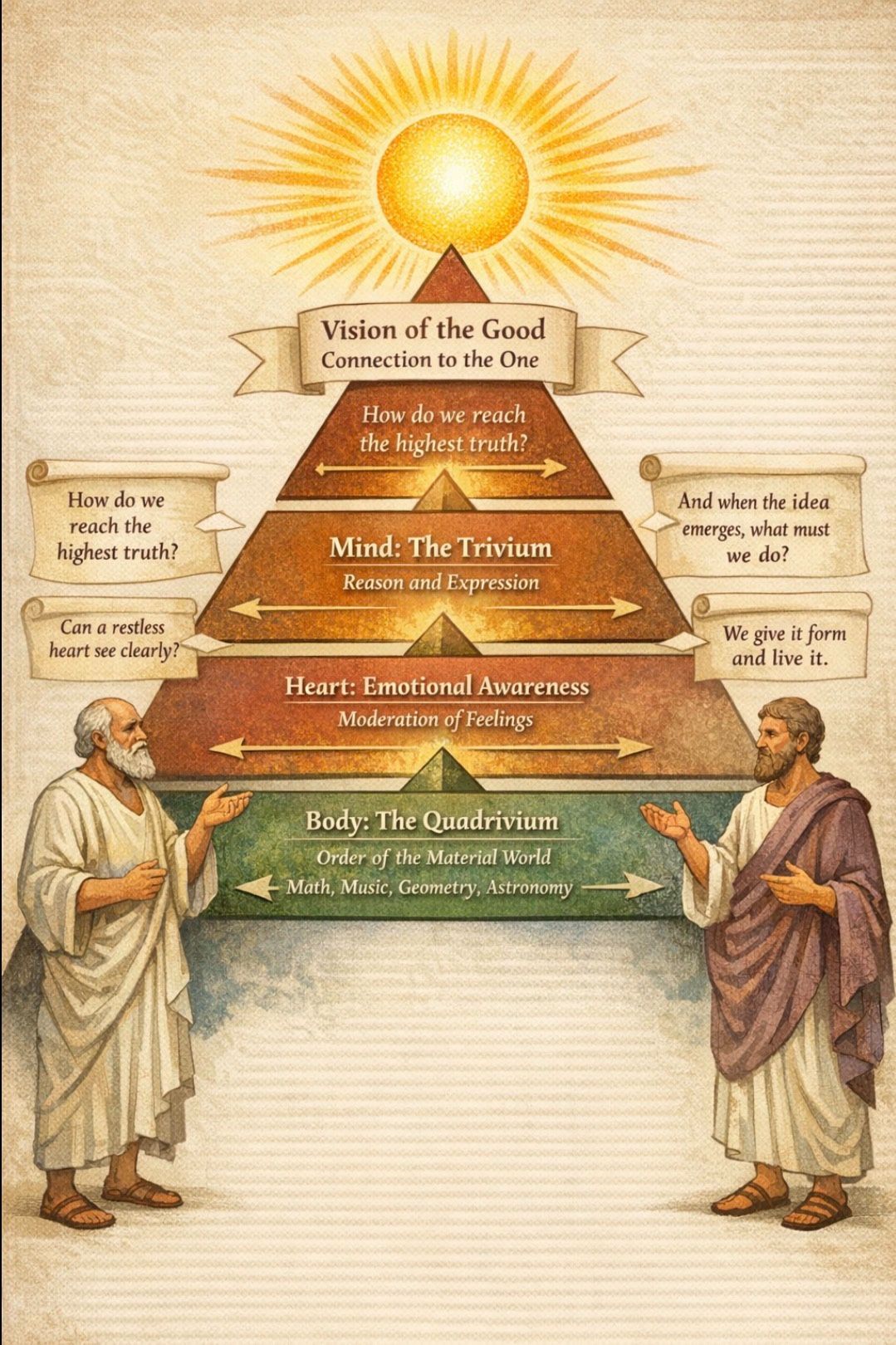
Socratic Dialogue Reflecting the Pyramid Method Characters: Socrates – the questioning guide, persistent in inquiry. Plato – the student and interlocutor, attempting to understand the ascent toward the Good. —————————————— Socrates: Tell me, Plato, when a man examines what he already knows, what does he find? Plato: He finds that some things are clear, self-evident,…
-
Dialogue on Wholeness, Shadow, and the Nation
Socrates: Plato, I see your mind burdened. What weighs upon your soul? Plato: I witness cruelty—acts by individuals, and the structures of a nation that permit them. I see victims who must reintegrate themselves, yet the society that surrounds them seems blind or complicit. I wonder: can wholeness ever be restored? Socrates: You speak of…
-
Truth is never found while standing still
Platohagel: PLato said,”Look to the perfection of the heavens for truth,” while Aristotle said “look around you at what is, if you would know the truth” To Remember: Eskesthai Socrates: Platohagel, let us examine what is being remembered here. Plato, in urging the soul to look toward the perfection of the heavens, was not chiefly…
-
Pre-Socratic Knowledge Foundation
Platohagel: I wonder if this pyramidal image was in Plato’s thoughts as he sought to create the first elemental structure of all matter orientated states of existence? Socrates: It’s compelling to consider the possibility that Plato might have been influenced by or at least resonated with the pyramidal image in his conceptualization of the elemental…
-
Socrates Death Condemnation Reasons
Platohagel: Why was Socrates condemned to death? Socrates: I was condemned to death in 399 BCE primarily on charges of impiety and corrupting the youth of Athens. These charges, however, were deeply intertwined with the political and social tensions of the time. In essence, Socrates was condemned not just for religious and moral reasons, but…
-
Thirteen Keys to the Whitehouse
Platohagel: Can a scientific value be given to the subject of the Thirteen Keys to the Whitehouse? Socrates: The Thirteen Keys to the White House is a prediction model created by Allan Lichtman and Vladimir Keilis-Borok. It uses a series of true/false statements to forecast the outcomes of U.S. presidential elections. These keys are based…
-
Connection Between the Federalist Society and the Heritage Foundation
Platohagel: What is the connection between the Federalist Society and the Heritage foundation? Socrates: Ah, the Federalist Society and the Heritage Foundation share common ground in their conservative and libertarian ideals, yet they serve distinct functions within the broader movement. The Federalist Society, established in 1982, focuses on reshaping the legal landscape by promoting originalist…
-
Reason Against Unjust Beliefs
Platohagel: Does Socrates and Platonism advance totalitarianism states? Socrates: Ah, my dear interlocutor, the pursuit of wisdom and virtue is the essence of my philosophy. Totalitarianism, with its emphasis on control and power, goes against the ideals of justice and individual autonomy that I advocate for. The true path lies in the examined life and…
-
Where is Our Starting Point?
“The end he (the artist) strives for is something else than a perfectly executed print. His aim is to depict dreams, ideas, or problems in such a way that other people can observe and consider them.” – M.C. Escher The Nobel Prize in Physics 1914 Max von Laue Quasicrystal: Prof. Dan Shechtman Can you trace…
-
First Alcibiades
Papyrus fragment of Alcibiades I, section 131.c-e. The First Alcibiades or Alcibiades I (Ancient Greek: Ἀλκιβιάδης αʹ) is a dialogue featuring Alcibiades in conversation with Socrates. It is ascribed to Plato, although scholars are divided on the question of its authenticity. Contents 1 Content 2 Authenticity 3 Dating 4 References 5 Bibliography 6 External links…
-
Justified true belief
Before Gettier, an historical account brings one up to date? Euler diagram representing a definition of knowledge. Justified true belief is one definition of knowledge that states in order to know that a given proposition is true, one must not only believe the relevant true proposition, but one must also have justification for doing so.…