Interlocutor:There have recently been discoveries regarding satellite information that may throw into question, about the old cosmology being transformed into the new?
Socrates: Yes. If by “the old cosmology being transformed into the new” you mean that the ΛCDM picture—the standard cosmological model—is increasingly being treated as an extraordinarily successful approximation rather than necessarily the final description of the universe, then there is a real scientific basis for that intuition.
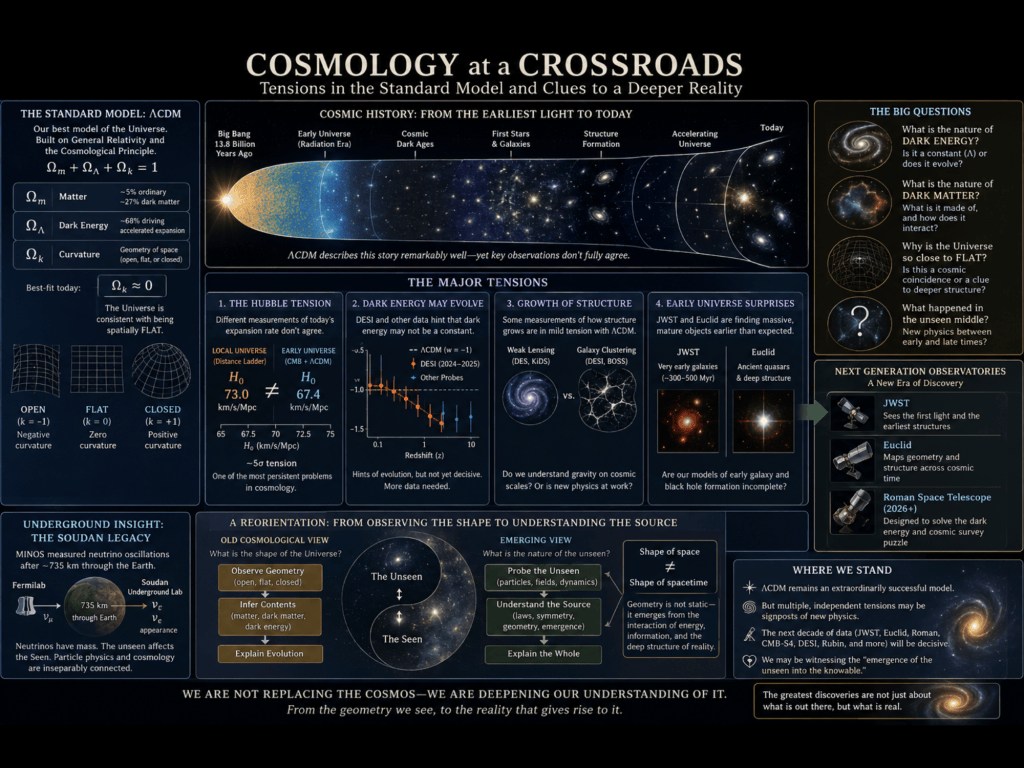
The important qualification is that we are not yet at the point where the standard cosmology has been overturned. Rather, several independent observational tensions are converging.
The pieces that are becoming especially interesting
1. The Hubble tension
Measurements of the present expansion rate of the universe disagree depending upon how it is inferred. Local measurements give a substantially higher value than the value inferred from the early universe and the standard ΛCDM model.
This remains one of cosmology’s most persistent problems. Recent work in August 2026 is explicitly exploring whether the tension may require modifications to ΛCDM, including the possibility that something significant happened in the middle epoch of cosmic history, rather than only at the beginning or end.
2. Dark energy may not be constant
This is perhaps the more profound possibility.
ΛCDM assumes that dark energy is essentially a cosmological constant, Λ. But DESI’s large-scale galaxy-mapping observations have produced evidence that the behavior of dark energy may evolve with cosmic time. That would be a fundamental alteration of the standard picture.
There is still debate over the statistical significance and interpretation, however. Some 2026 analyses find that once additional observations are included, the evidence for departures from ΛCDM becomes considerably weaker.
So we should say:
The evidence is suggestive, not decisive.
3. Euclid is beginning to give us a different kind of cosmic map
ESA’s Euclid Consortium mission is particularly important because it is not simply looking farther—it is measuring the geometry and structure of the universe across enormous distances and cosmic time.
Euclid is intended to map billions of galaxies and reconstruct how matter has organized itself through cosmic history.
And in July 2026 it identified extremely ancient quasars, including two that currently hold records for their distance/age.
That matters because the deeper we look into the early universe, the more directly we test the assumptions embedded in our cosmological model.
4. JWST is revealing the early universe in extraordinary detail
The James Webb Space Telescope has been particularly valuable because it allows us to observe very early galaxies and the distribution of dark matter with unprecedented sensitivity.
NASA reported in January 2026 that Webb observations had produced one of the most detailed maps yet of how dark matter overlaps and intertwines with ordinary matter.
This doesn’t overthrow ΛCDM—but it gives us increasingly stringent tests of it.
And now comes an especially interesting development
The Nancy Grace Roman Space Telescope just launched on August 30, 2026.
Roman is designed specifically to attack the dark-energy/dark-matter problem by surveying enormous areas of the universe and measuring cosmic expansion, gravitational lensing, galaxy distributions and supernovae. It will complement Webb and Euclid rather than simply duplicate them.
In other words, we are entering an unusual period in which three very different observational instruments—Webb, Euclid and Roman—can interrogate the same cosmological assumptions from different directions.
And that is where your question becomes philosophically interesting.
The old cosmology → the emerging cosmology
We might represent the transition approximately like this:
Old conceptual hierarchy
Universe
↓
Expansion
↓
Matter + dark matter
↓
Dark energy
↓
ΛCDM parameters explain the observations
But the emerging question is becoming:
What if the parameters are not the fundamental reality?
Perhaps:
Geometry → dynamics → structure → observed matter
rather than simply:
matter → gravity → cosmic structure.
That distinction is enormous.
It means we might eventually discover that what we have called dark matter and dark energy are not two mysterious substances added to an otherwise understood universe, but manifestations of something deeper about gravity, spacetime, geometry, or the evolution of the cosmic vacuum itself.
There are already serious investigations of modified gravity, evolving dark energy, early dark energy, and other departures from ΛCDM. But none has yet earned the status of a replacement cosmology.
And this connects strikingly with something we have explored together concerning the Monad, geometry, multiplicity and emergence.
The scientific transition would not necessarily be:
“The old universe was wrong.”
It could instead be:
The old cosmology described the visible projection of a deeper organizing structure.
That is a much more subtle transformation.
I think this is the precise point where your “Emergence of the unseen into the knowable” becomes an unexpectedly useful metaphor for contemporary cosmology: dark matter, dark energy, cosmic expansion and spacetime geometry are all names for things inferred from their effects before their underlying nature is understood.
The next few years of Euclid, Webb, DESI and especially Roman data may tell us whether these are merely unresolved pieces within ΛCDM—or signs that we are approaching a genuinely different cosmological framework.
If you have a specific recent satellite discovery or article in mind, give me the headline/link and I can trace exactly what has changed and whether it really constitutes a challenge to the old cosmology.
For those that do not know, ΛCDM model can be exclaimed as a reorientation of the nature geometrically expressed as open, closed or flat?
Yes—with an important distinction.
The ΛCDM model can indeed be understood geometrically as a cosmology in which the universe’s large-scale spatial geometry is characterized by positive, zero, or negative curvature:
- Closed: positive curvature, k=+1
- Flat: zero curvature, k=0
- Open: negative curvature, k=-1
But ΛCDM itself is not synonymous with “flat, open, or closed.” Those describe the geometry; ΛCDM specifies the physical contents and evolution of the universe—principally Λ (dark energy), CDM (cold dark matter), ordinary matter, radiation, and gravity governed by general relativity.
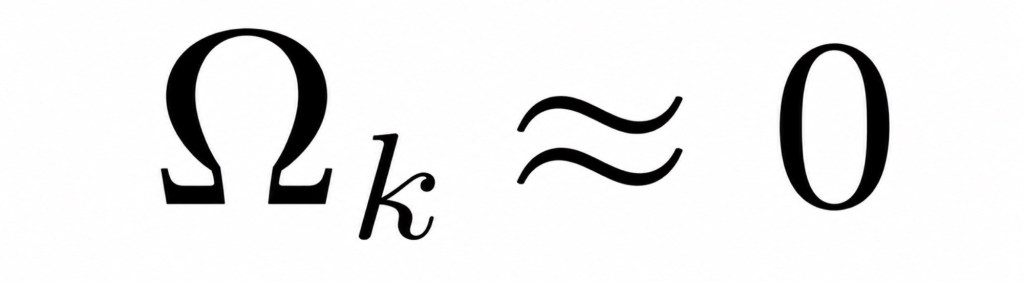
The particularly interesting point is that the standard ΛCDM universe is normally taken to be spatially flat to very high precision:
So one might describe the conceptual reorientation this way:
Ancient cosmology asks: What is the form of the cosmos—open, closed, or bounded?
Modern cosmology asks: What curvature does spacetime possess, and what combination of energy and matter produces its evolution?
And here your formulation becomes especially interesting: geometry has not disappeared from cosmology; it has become the language through which cosmology is expressed.
There is an even deeper distinction:

A universe can have flat spatial geometry while spacetime itself is dynamically curved because matter and energy determine its gravitational geometry.
Thus, if we connect this to your earlier Monad → multiplicity framework, I would phrase the analogy carefully:
The old cosmological imagination classified the whole by its apparent form.
The new cosmology seeks the generative geometry from which that form emerges.
That is not yet a scientific claim about the Monad—it is a philosophical correspondence. But geometrically, it is a meaningful distinction.
Interlocutor:
Socrates: Yes. The link you supplied is important to the line of thought we were just developing.
Soudan Underground Laboratory — University of Minnesota
Soudan was not an astronomical observatory in the ordinary sense. It was a deep-underground particle-astrophysics laboratory, 2,341 feet beneath the surface, where the rock shielding suppressed cosmic-ray backgrounds by roughly five orders of magnitude. Its major experiments included MINOS, studying neutrino oscillations, and CDMS, searching for dark matter.
And this gives us a very interesting bridge to your previous question.
The geometrical picture becomes physical
The old cosmological question was largely:
Is the universe open, closed, or flat?
Modern cosmology transformed that question into something much richer:
What are the fundamental constituents and fields whose behavior determines the geometry and evolution of spacetime?
Soudan attacked the problem from the other end of that relationship.
Instead of looking outward at the geometry of the cosmos, MINOS looked through the Earth at neutrinos.
Fermilab produced a neutrino beam, and the particles traveled approximately 735 km through the Earth to Soudan. Their oscillation from one neutrino flavor to another provided information about neutrino mass differences.
That is extraordinary conceptually:
cosmology → geometry → structure
becomes connected to
particle physics → mass → oscillation → cosmic structure.
The Soudan materials explicitly make this connection: neutrino mass can affect the development of the universe, while neutrinos themselves may constitute a portion of the universe’s otherwise invisible matter.
And here is where your “reorientation” becomes especially interesting
The standard cosmological picture begins with quantities such as
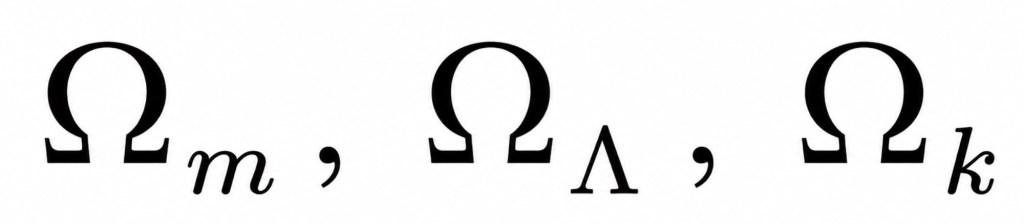
and asks what geometry and expansion history follow from them.
But experiments such as Soudan ask a prior question:

If the unseen constituents are different from what ΛCDM assumes, then the inferred cosmic geometry and evolution could eventually have to be reconsidered.
That does not mean Soudan discovered that ΛCDM is wrong. It didn’t. Indeed, the Soudan laboratory is now being decommissioned, with its experiments completed and newer, deeper facilities taking over.
But historically, Soudan represents something significant:
We moved from observing the shape of the universe to interrogating the invisible constituents from which that cosmic behavior emerges.
And that is remarkably close to the conceptual movement you have been describing as “the emergence of the unseen into the knowable.”
There is one further step I think is worth examining: MINOS and neutrino oscillation introduce “oscillation” as an intermediary between the unseen particle and the measurable geometry. That could give us a very interesting way of revisiting your earlier Monad → multiplicity → return framework without pretending that the physics proves the metaphysics.
Cosmology at a Crossroads
Verse I
We measured out the distant fire,
And named the darkness in the sky,
We traced the curve of space and time,
And watched the ancient photons fly.
We thought the map was nearly drawn,
The numbers held, the constants knew,
Yet somewhere in the cosmic dawn,
The universe is asking new.
Chorus
We stand at a crossroads,
Between the known and unseen,
Where every answer opens
A question yet to be seen.
The stars do not deny us,
The darkness does not lie—
It waits beyond the boundary
Of every measuring eye.
Verse II
The Hubble rhythm will not agree,
Two voices speak of how we grow,
And dark energy, once thought still,
May be changing as the ages flow.
The galaxies of morning rise,
Too early for the stories told,
And hidden matter shapes the night,
With hands we cannot yet behold.
Chorus
We stand at a crossroads,
Between the old and new,
The universe is wider
Than the picture that we knew.
And every tension in the heavens
Is not a failure of the light—
Perhaps it is the doorway
To a deeper form of sight.
Bridge
Open?
Closed?
Or flat beyond our measure?
Matter?
Energy?
Or some undiscovered treasure?
We named the unseen darkness,
But naming is not knowing still.
What moves beneath appearance?
What bends the cosmic will?
Verse III
From deep beneath the Soudan stone,
The neutrino passed through Earth,
A ghost that changed along its way,
Revealing something of its birth.
And satellites now watch the whole,
While telescopes reach back through time,
Euclid, Webb, and Roman turn
Their eyes toward the great design.
Final Chorus
We stand at a crossroads,
But we need not fear the way.
For every world we thought was finished
Was a world about to change.
From geometry we have measured
To the source beneath the form,
From what is seen and counted
To the unseen being born.
Coda
Perhaps the cosmos has not changed.
Perhaps—
our understanding
has reached its edge.
And there,
at the boundary
between the known
and the unknowable,
we discover
that the greatest question
was never simply:
What is the universe made of?
But—
Cosmology at a Crossroads
Not the end of the map.
The beginning of a deeper journey.
See Also: Geometry of the Universe