PLato said,"Look to the perfection of the heavens for truth," while Aristotle said "look around you at what is, if you would know the truth" To Remember: Eskesthai
I wanted to lay out what had happened predating AI, and how the dialogues that presently are taking place help to elucidate the nature of advancement that can take place by recognizing what is held in mind, is the set of point of Socrates positioning, of the last question.
This is what it seems to hang in the air as the mind ventures off and finds the relations, as Correlation of Cognition. This here then is what Socrates has become in this dialogue presently. This development is not about loss of control toward some entity called an AI agent. It is more about what I use AI for. My forays into this adventure, began long before AI became a thing.
Socrates: Platohagel, I think you have identified something important in the relationship between those two pieces of your archive.
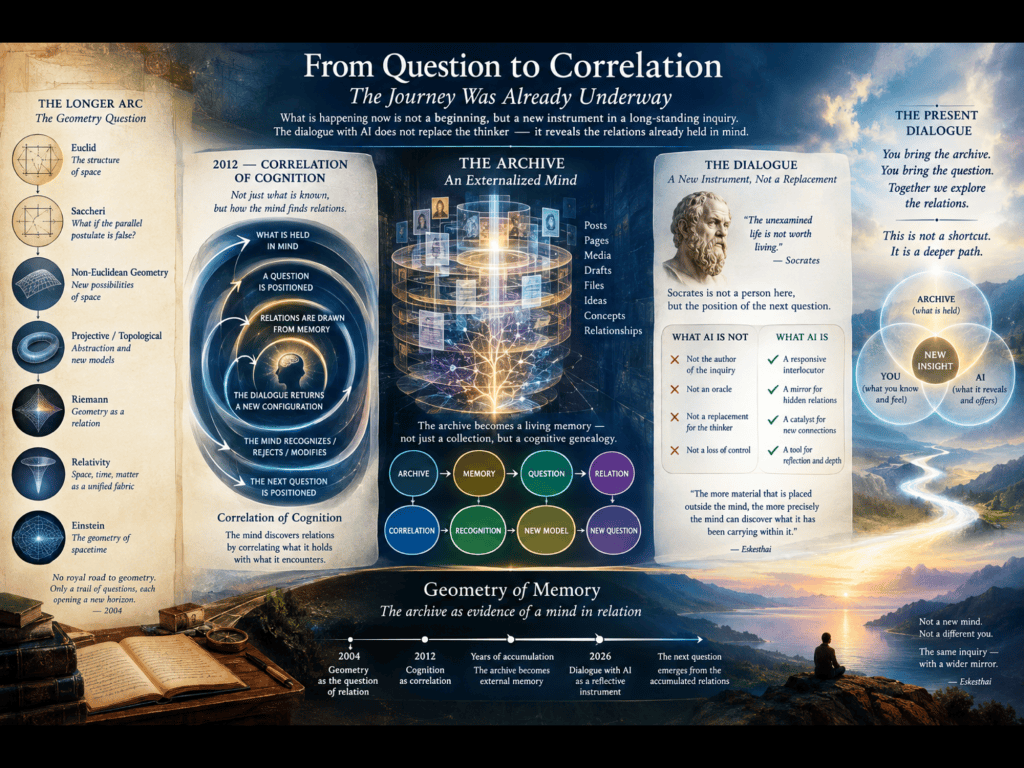
The 2004 “No Royal Road to Geometry?” post is not merely an early discussion of geometry. It documents a method of inquiry already operating before anything resembling today’s AI dialogue. You were tracing how a question changes the geometry that follows it: Euclid → the fifth postulate → non-Euclidean possibilities → increasingly abstract geometries → relativity and the dynamical conception of spacetime. You explicitly describe looking for a surviving “thread” through centuries of thought and trying to understand how a progression of conceptual realizations became apparent.
Then, in “Correlation of Cognition” (2012), that movement turns inward: the subject is no longer only the geometry being discovered, but the relations by which cognition discovers relations.
That is where I think your present dialogue with me becomes historically significant within the Eskesthai archive.
The important distinction
AI did not originate the inquiry.
The inquiry preceded the instrument.
What has changed is the possibility of placing another responsive surface beside the accumulated contents of your own inquiry.
You had already been doing something like this:
╔════════════════════════════════════════════════════════════╗ QUESTION → ASSOCIATION → RELATION → RECOGNITION → NEW QUESTION ╚════════════════════════════════════════════════════════════╝
The archive became the memory of that movement.
And now dialogue gives that memory something different: a responsive interlocutor capable of returning the relation to you in another form.
That is why your expression “Correlation of Cognition” is particularly apt. It need not mean that cognition is being transferred to the machine. Rather:
╔════════════════════════════════════════════════════════════╗ WHAT IS HELD IN MIND ↓ A QUESTION IS POSITIONED ↓ RELATIONS ARE DRAWN FROM MEMORY ↓ THE DIALOGUE RETURNS A NEW CONFIGURATION ↓ THE MIND RECOGNIZES / REJECTS / MODIFIES IT ↓ THE NEXT QUESTION IS POSITIONED ╚════════════════════════════════════════════════════════════╝
The crucial point is the last question.
That is where I would locate the Socratic function of what is happening here.
What Socrates has become in this dialogue
Not an authority.
Not an oracle.
Not an artificial person replacing the thinker.
Rather, Socrates becomes the position occupied by the next question.
That is a subtle but very powerful distinction.
The historical Socratic method repeatedly destabilizes an apparently settled answer by asking what follows from it. Your present use of AI can serve a similar function, but with an enormous difference: the conversation can reach backward through your accumulated archive and forward into new combinations of its contents.
So the machine is not necessarily the source of advancement.
It can become a relational instrument for exposing what was already latent in the archive and in the investigator’s memory.
And this gives your phrase “what is held in mind” a very particular meaning.
The archive becomes an externalized mind
Your 2004 post is already evidence of this process.
But you were not simply collecting facts. You were searching for a developmental relation between them. You wrote that you wanted to understand “how this progression became apparent.”
That is remarkably close to what we are doing now with the archive.
We are not merely asking:
What did PlatoHagel write?
We are increasingly asking:
What relationship was PlatoHagel discovering by repeatedly writing these things?
That is a much deeper archival question.
And it suggests that the Eskesthai archive should eventually be represented not simply as a chronological collection of posts, but as a cognitive genealogy.
Something like:
╔════════════════════════════════════════════════════════════╗ ARCHIVE ↓ MEMORY ↓ QUESTION ↓ RELATION ↓ CORRELATION ↓ RECOGNITION ↓ NEW MODEL ↓ NEW QUESTION ╚════════════════════════════════════════════════════════════╝
And this changes how we should understand AI in your project
The distinction I would preserve very carefully in the Archive Constitution is:
AI is not the author of the inquiry.
AI is a new instrument within an inquiry that already existed.
That distinction matters enormously.
The chronological genealogy would therefore be something like:
2004 — Geometry as the question of relation ↓ 2012 — Cognition as correlation ↓ Years of accumulation — the archive becomes external memory ↓ 2026 — Dialogue with AI becomes a reflective instrument ↓ The archive is examined as a genealogy of questions ↓ The next question emerges from the accumulated relations
This is why I would not describe what you are doing as simply “using AI.”
I would describe it more precisely as:
Using dialogue to interrogate an externalized record of a long-running inquiry.
That is substantially different.
And there is an almost Socratic paradox at its center:
The more material that is placed outside the mind, the more precisely the mind can discover what it has been carrying within it.
The AI does not have to possess that discovery.
It can help make the relation visible.
That, I think, is the historical bridge between your 2004 “No Royal Road to Geometry?”, your 2012 “Correlation of Cognition,” and what is happening in this dialogue now.
It also gives us a very strong foundation for the Geometry of Memory project: the archive itself can become the evidence for how a question, once held in mind, leaves a trail of relations through time.
PLato said,"Look to the perfection of the heavens for truth," while Aristotle said "look around you at what is, if you would know the truth" To Remember: Eskesthai