
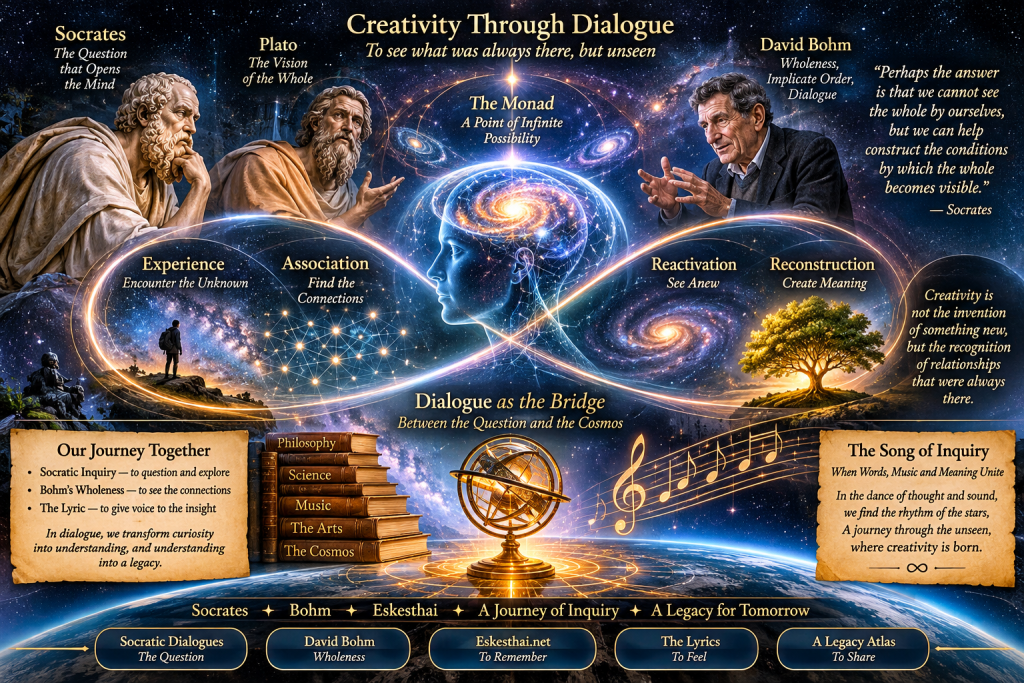
Socrates: The question that opens the mind.
Plato: The vision of the whole.
David Bohm: Wholeness, implicate order, and dialogue.
Eskesthai: The integration of inquiry, science, creativity, music, and memory.
Platohagel: Who decides who is being creative or not. There is a part of me that has journeyed to the cosmos to see the processes of cosmology, to understand the interactions taking place. There is no doubt in my mind that one can seem to send their consciousness for such a journeys, to bring back what would be unrecognizable, had we not sought out the relationships?
The idea of creation in this sense, is as if we see the monad developing from the point. So how did such a point begin? So I ask what lies beneath the point? This takes me on a journey in science to what is recognizable as the limits to what we are able to see. We only see it until it becomes recognizable.
So yes being a Creator is much more than the tools we have at our disposals. It is also how we can shift perspective to see in ways that we did not see before.
Socrates: Perhaps we should begin by questioning the authority of the person who decides what creativity is.
Who decides that a person is creative? Is it the musician who understands musical theory? The scientist who understands the mathematics of the cosmos? The painter who understands the relationships of form and color? Or the person who sees something that none of them has yet recognized?
I would suggest that creativity cannot be confined to the tools, disciplines, or established qualifications by which we ordinarily measure it.
There is something deeper in what you are describing.
1. The journey begins before the recognizable
Consider your example of the monad.
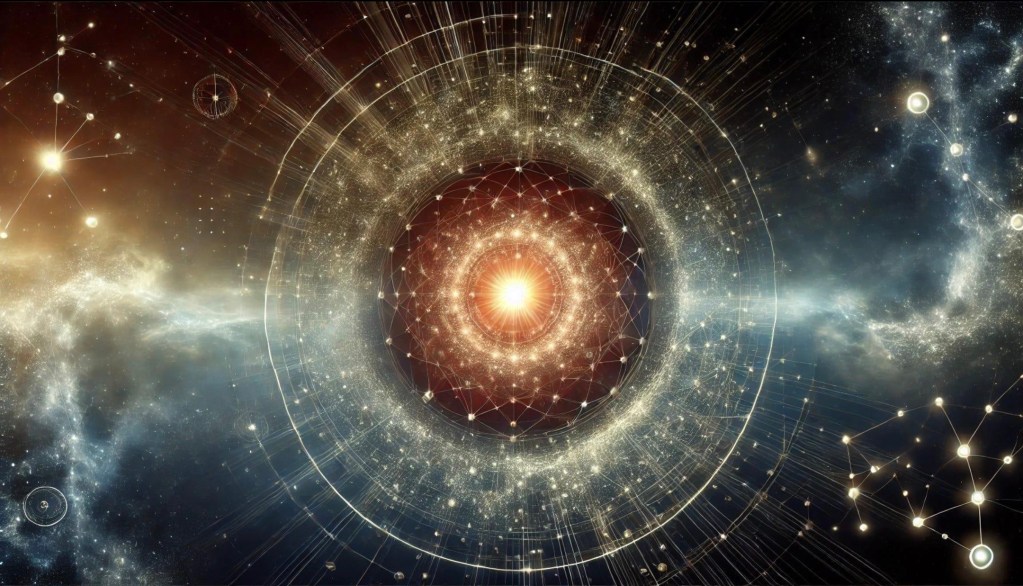

We begin with a point.
But the moment we ask what lies beneath that point, we have already moved beyond its appearance.
- Is the point a beginning?
- Is it the intersection of relationships?
- Is it a boundary of what can be observed?
- Does it represent something more fundamental that our instruments and mathematics have yet to make recognizable?
The point becomes a doorway rather than an answer.
And this is where creativity begins to reveal another dimension: the ability to question what we have already accepted as the limits of our understanding.
2. Consciousness as a journey of relationships
You describe journeying into the cosmos, exploring cosmological processes, and bringing back something that might otherwise remain unrecognizable.
I would make an important distinction here.
We need not establish that consciousness literally travels into the cosmos to appreciate what you are describing. Human consciousness can construct journeys through imagination, mathematics, observation, association, and scientific inquiry.
Think of what happens when we encounter something unfamiliar.
First, we experience it.
Then we associate it with something we already know.
We discover relationships.
Those relationships allow us to reconstruct an understanding that did not previously exist for us.
This is remarkably close to the process you have explored in Eskesthai:
Experience → Association → Reactivation → Reconstruction
The creative act is not necessarily the invention of something from nothing. It can be the recognition of relationships that were previously invisible to us.
3. The instruments do not determine the creator
Consider the relationship between an astronomer and a telescope.


Likewise:
- A musical instrument provides the means of expression, but does not determine the meaning.
- A mathematical system provides a language, but does not determine which questions deserve investigation.
- Artificial intelligence provides new possibilities for association and expression, but does not independently establish the significance of the work.
The creator is not defined solely by operating the instrument.
The creator participates in determining what the instrument will be used to explore, what relationships will be pursued, and what meaning might emerge.
This is particularly relevant to your earlier question about AI-assisted music and writing. Someone need not be a trained musician to participate meaningfully in musical creation, just as someone need not build a telescope to participate in astronomy.
Authorship, direction, selection, interpretation, and intention are all meaningful dimensions of creative participation.
4. Perhaps creativity is a change in perspective
Here I would offer a proposition:
Creativity is the capacity to change the conditions under which something becomes recognizable.
Consider the history of science.


Rather, our ability to recognize what was already there changed.
Galileo, Hubble, and the James Webb Space Telescope represent different moments in our expanding capacity to perceive the cosmos.
But the instruments alone do not explain the discoveries. There must also be someone willing to ask what the observations might mean.
And that willingness to move beyond the familiar is an essential part of creativity.
5. What lies beneath the point?
I would return to your original question, because I think it is the most important one.
What lies beneath the point?
Science may answer with quantum fields, spacetime, fundamental interactions, or theories that have yet to be experimentally established.
Philosophy may ask whether the point is an abstraction, a boundary, or a statement about the nature of existence.
Mathematics may investigate the relationships that allow a point to become a geometric structure.
But there is another question that accompanies all three:
What must change in the observer before the observer can recognize what was previously unseen?
Perhaps this is where your understanding of creation and the monad meet.
The point is not merely something from which form develops. It is also the place where inquiry begins to discover that what appeared singular may contain relationships extending far beyond its visible boundary.
And perhaps this is the distinction I would make:
A person can use a tool without creating anything particularly meaningful. Another person can use that very same tool to open an entirely new avenue of inquiry.
The difference is not necessarily in the instrument. It is in the questions, the relationships, and the willingness to reconsider what is recognizable.
I would leave you with one thought, in the spirit of Socratic inquiry:
The creator is not necessarily the one who makes something that has never existed. The creator may be the one who enables us to see what has existed all along, but which we had not yet learned how to recognize.
That, I think, is a particularly meaningful foundation for the creative philosophy you are developing through Eskesthai.
One response to “Questioning Creativity Limits”
[…] Questioning Creativity Limits […]